

The market is beginning to feel less like a carefully engineered rally and more like a casino built on top of a volcano. For most of the year, investors treated the Treasury market like a controlled demolition site where policymakers could keep the cracks contained behind yellow caution tape, but that illusion is now starting to fracture in real time. The entire game revolved around defending the sacred 5% line on the long bond because everyone in macro understands the same brutal truth: every great bubble eventually dies from the same disease. Rising yields become the pin that finds the overinflated balloon. That was true in Japan in 1989, in America during the dotcom mania, and in China before the financial excesses of the late 2000s rolled over. Once the long end starts trading like a runaway freight train instead of a sleepy pension asset, the entire market structure changes personality. What was once a liquidity party suddenly becomes a collateral stress event.
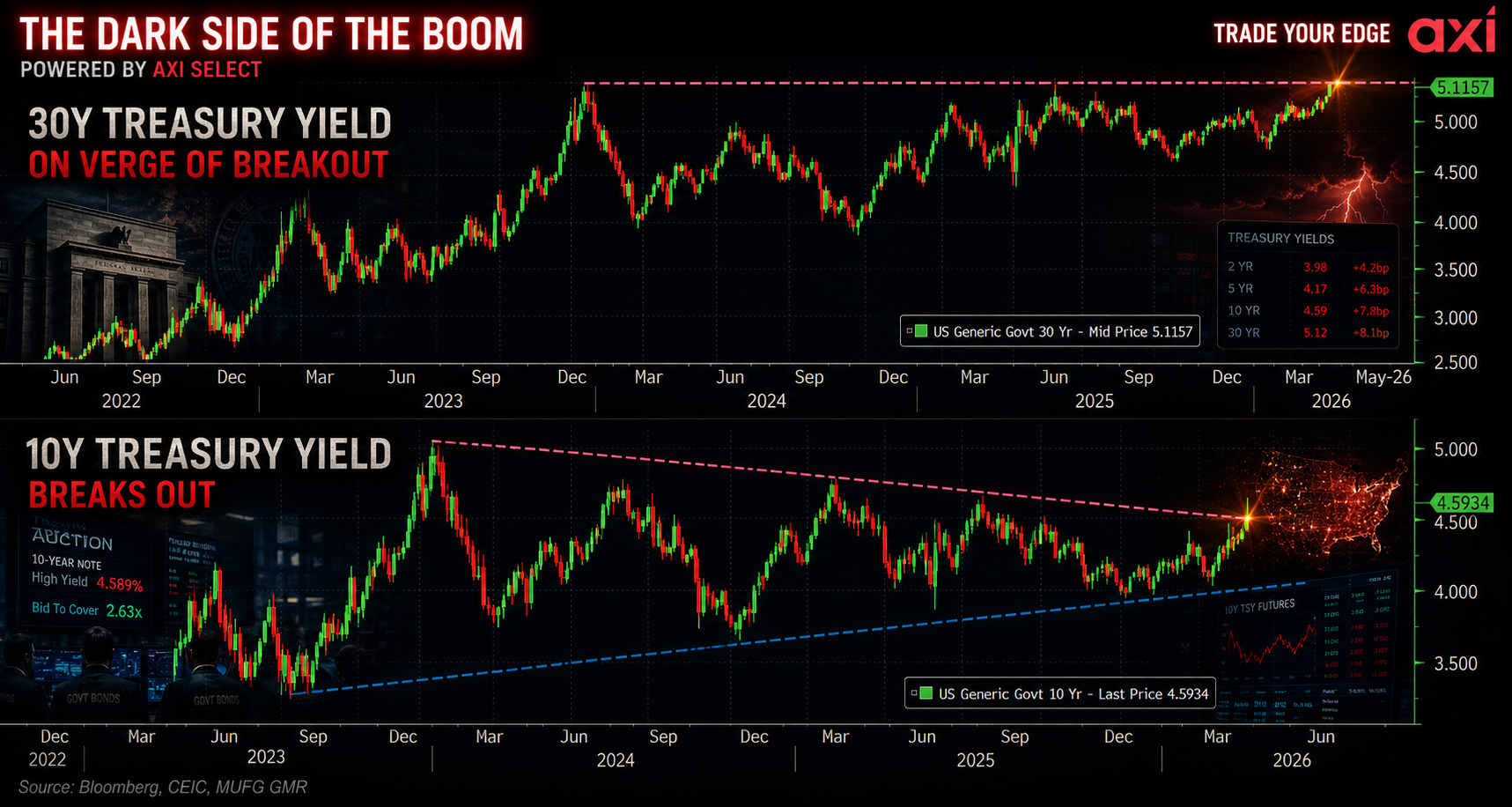
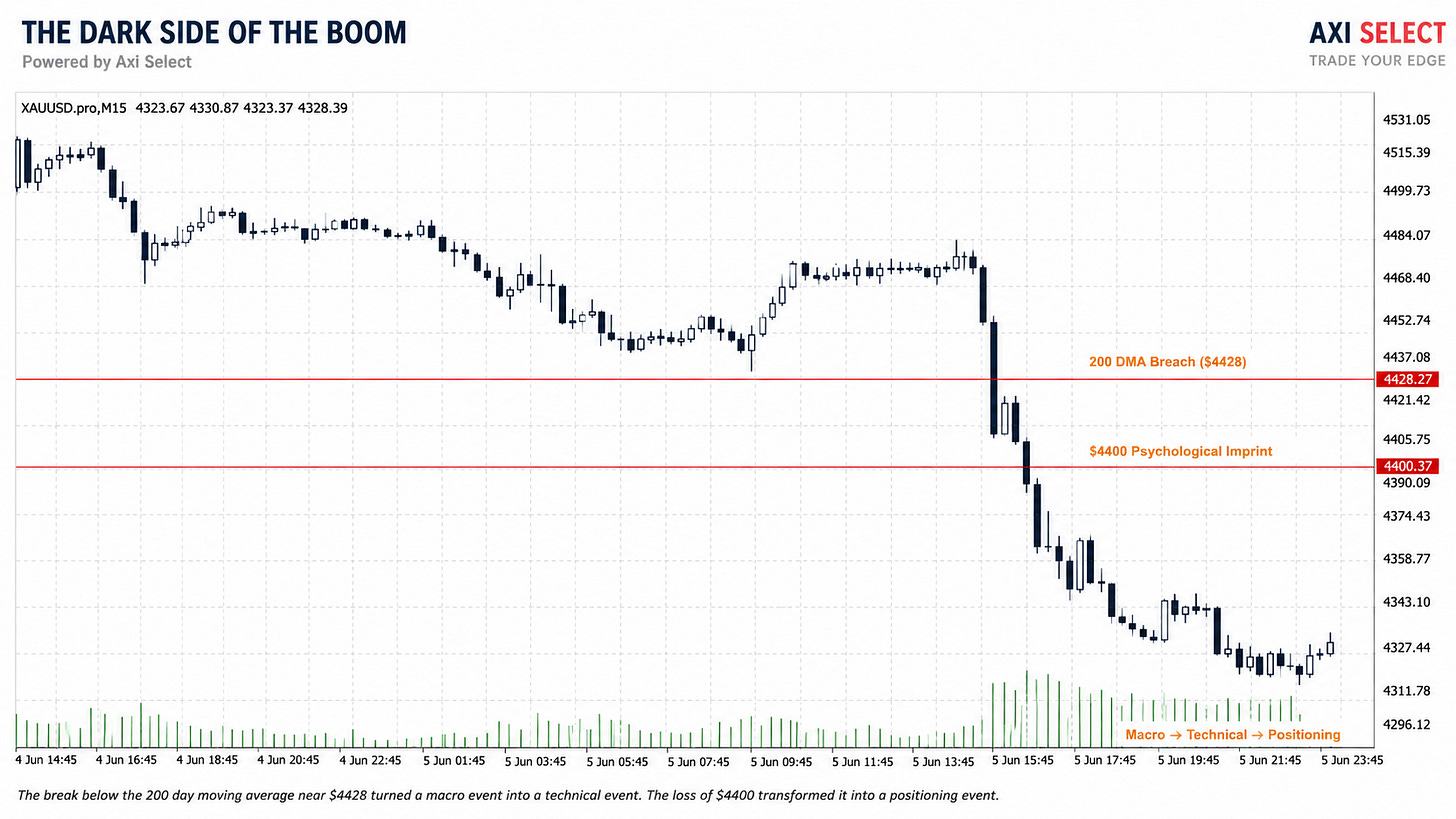
That is why the recent move in the 30 year Treasury matters so much. The so called Maginot Line at 5% was never just another technical level on a Bloomberg screen. It was psychological air support for every crowded risk trade on the planet. It was the invisible ceiling keeping the boom loop alive. Once that ceiling cracked, the market opened the first real door into a darker corridor where Value at Risk shocks, forced deleveraging, and violent duration repricing begin feeding on each other like a chain reaction inside a nuclear reactor. The 10-year Treasury breaking its multi-year trendline only adds gasoline to the fire because now the bond market is no longer whispering concern. It is starting to shout inflation panic through a megaphone.
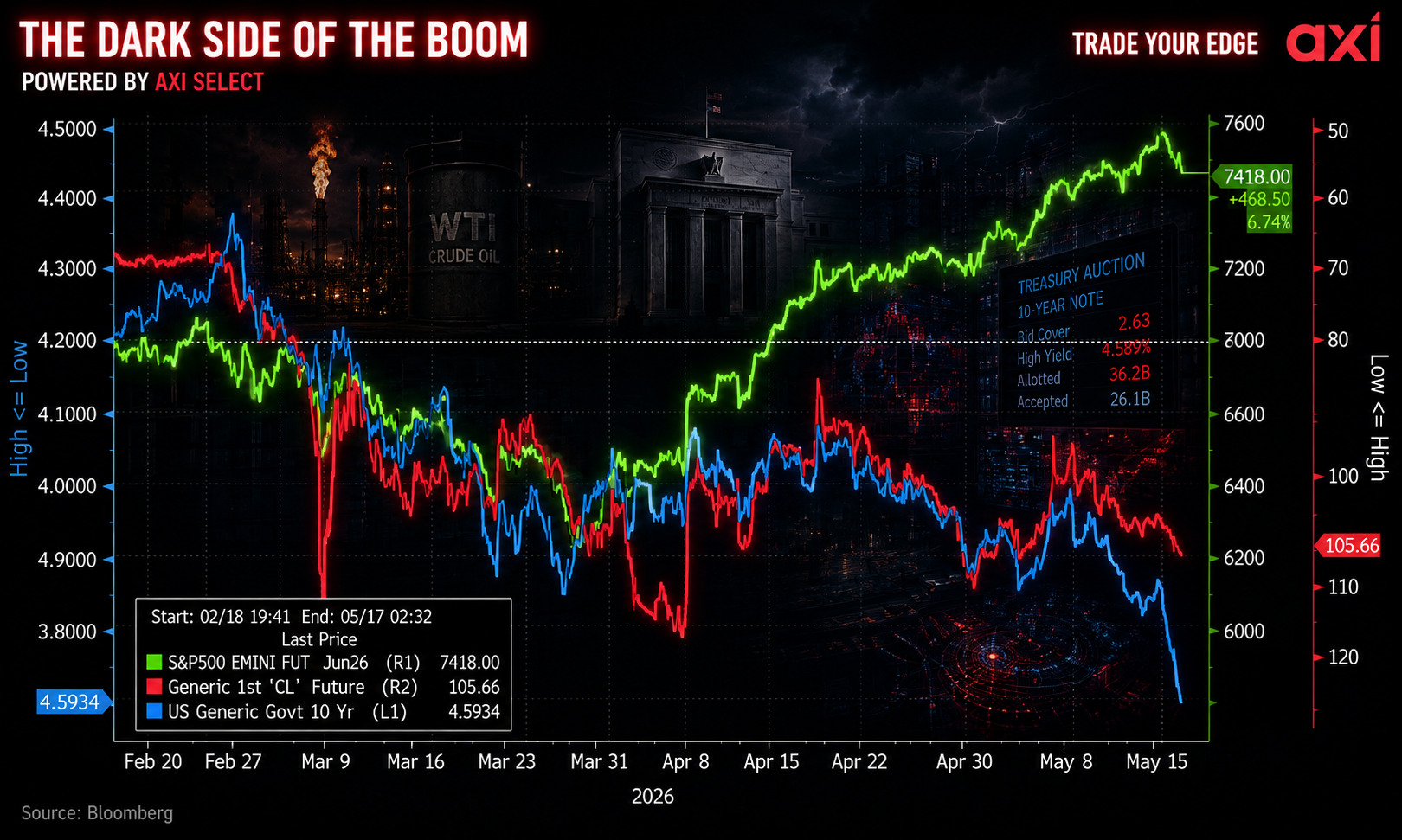
And yet stocks continue to dance like a drunken wedding guest who has not yet noticed smoke pouring from the kitchen. The decoupling between equities and bonds has become so extreme it barely resembles a functioning macro system anymore. Equities are trading in a fantasy universe powered almost entirely by artificial-intelligence euphoria, daily gamma squeezes, and the intoxicating wealth effect created by nonstop gains in household equity portfolios.
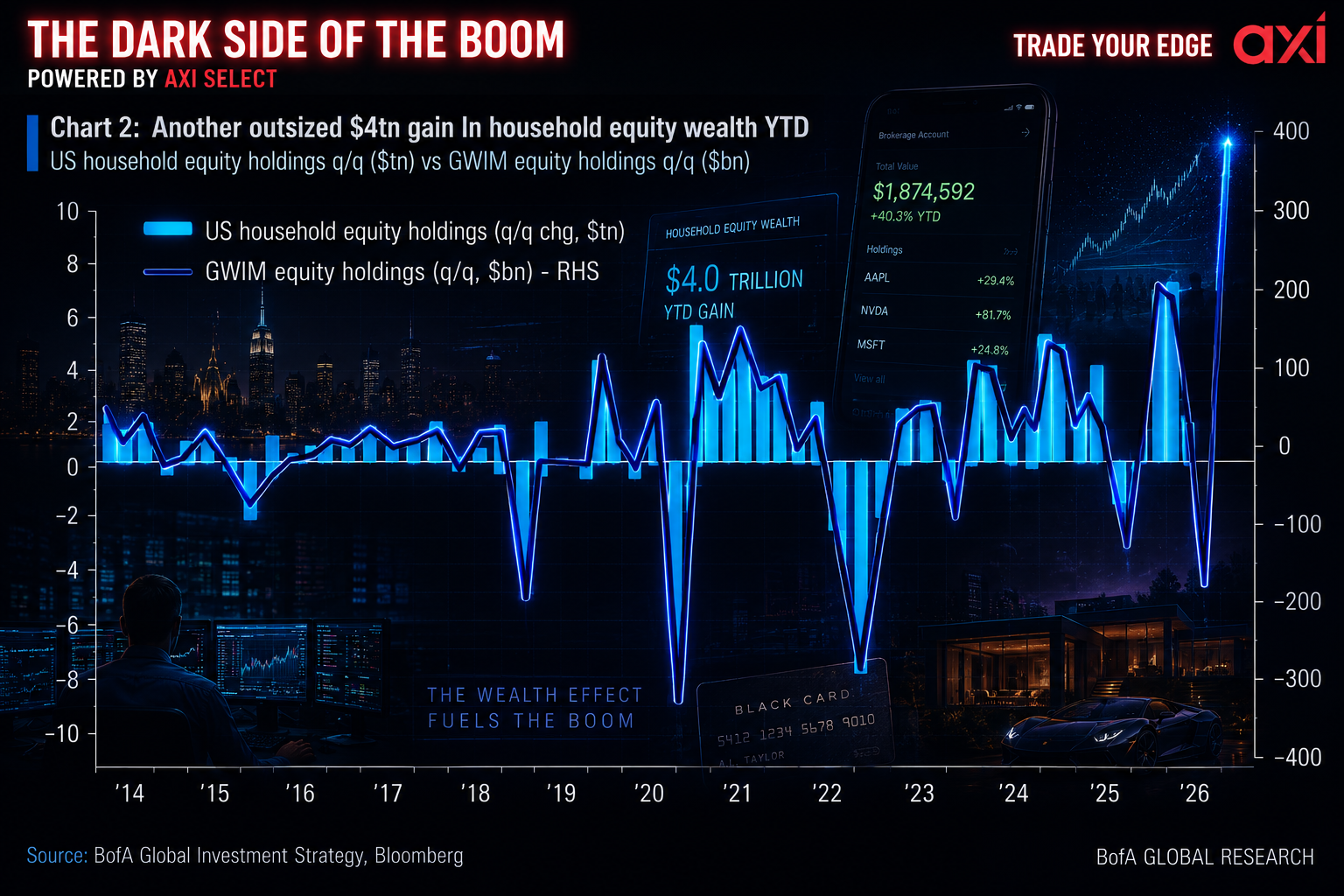
Every dip is treated like a buying opportunity because the market has conditioned investors to believe that momentum itself is now a permanent economic policy tool. The wealth effect has become the fuel injector for the American boom loop. Rising stocks create stronger consumer confidence, stronger spending, stronger political optics, and ultimately more tolerance for higher asset prices. It is a financial perpetual motion theatre.
Something Has To Give?
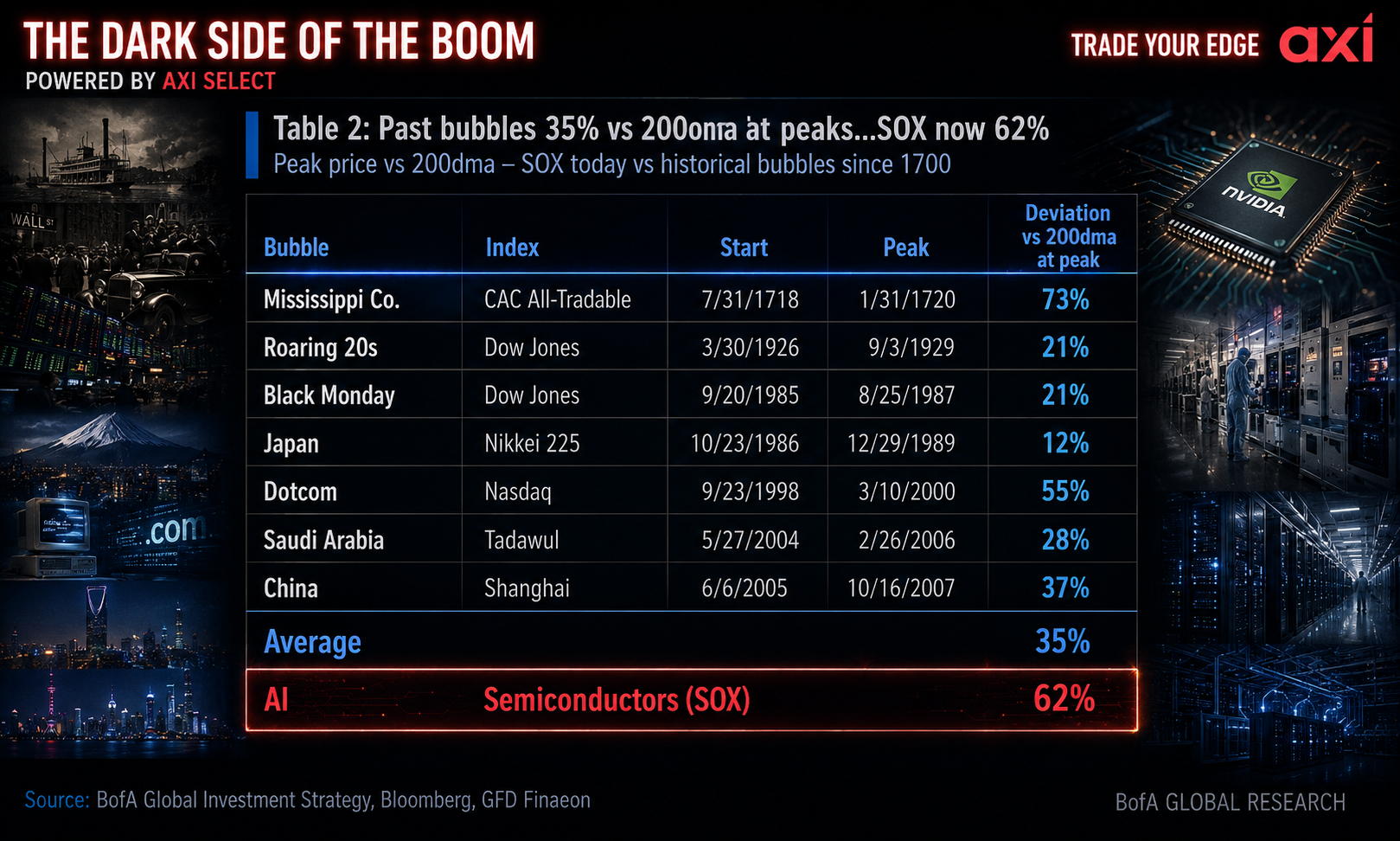
But underneath the surface, the market internals are beginning to resemble late-stage empire behaviour. Breadth is deteriorating so badly that the current concentration makes the old Nifty Fifty era look almost diversified by comparison. The semiconductor complex has become the epicentre of speculative gravity, with the SOX index trading so absurdly far above its long-term moving averages that the setup now echoes the Mississippi bubble in France and the Nasdaq during the peak dotcom years. The melt-up psychology has become self-reinforcing because volatility keeps collapsing at the exact same time, positioning becomes more crowded. That combination creates the illusion of safety right before instability suddenly arrives at full speed. When everyone starts believing the elevator only travels upward, the cables usually snap without warning.
What makes this cycle even more dangerous is that inflation is no longer behaving like a temporary weather disturbance. Energy, electricity, transportation, goods, and rents are all starting to push higher together, which means inflation is slowly mutating from a headline annoyance into a structural political problem. I sometimes think markets are far too cavalier about oil-driven inflation, assuming the Fed has no toolkit to stop it, but in reality, higher rates eventually hit consumers fast and hard through the destruction of affordability. The problem is that by the time demand destruction arrives, the market damage is usually already done. History shows that once CPI moves decisively above 4%, risk assets start twitching like traders trapped in a burning theatre searching for the exits. The issue is not simply inflation itself. It is the toxic cocktail of rising inflation alongside rising yields. That combination suffocates valuation multiples because investors suddenly lose the luxury of paying tomorrow’s prices with cheap money from yesterday.
5% 10s by Mid-Term Election?
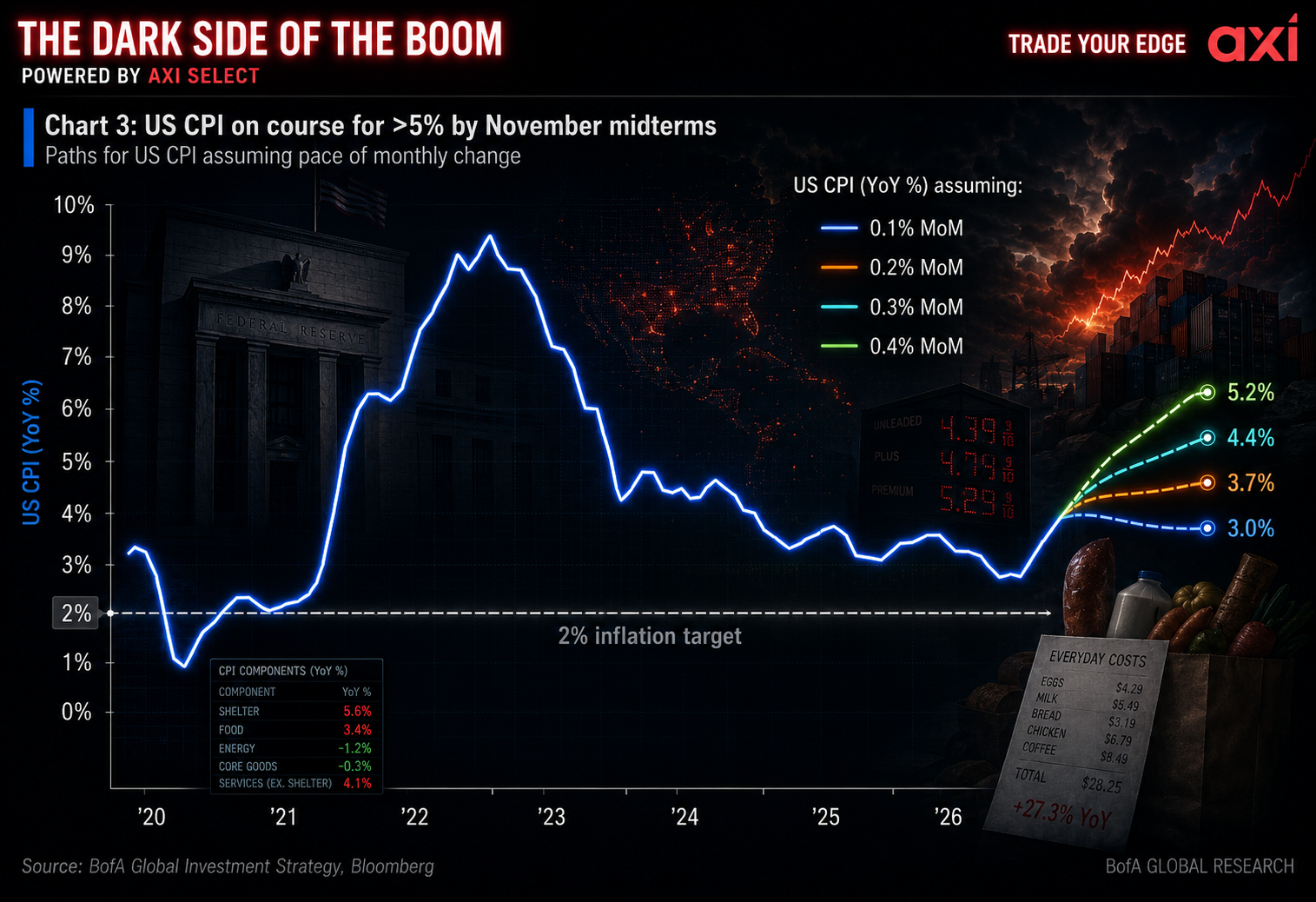
Meanwhile, the Nasdaq and Treasury yields are beginning to move together in a way that feels eerily familiar to both 1999 and 2009. That is not a comforting historical comparison. It is the kind of market rhythm that usually appears near major turning points, either at the beginning of an entirely new monetary regime or near the end of a speculative cycle that has consumed itself. Financial stocks are already flashing warning signs beneath the surface, underperforming to such an extreme degree that relative valuations now sit below the depths seen during the dotcom collapse, the Global Financial Crisis, and even the pandemic era distortions. The message from credit markets is equally unsettling. Technology earnings may still look spectacular for now, but hyperscalers are increasingly scouring the globe for cheaper debt financing as balance-sheet pressure quietly builds behind the AI infrastructure arms race. Investment-grade and high-yield tech bonds are already deteriorating even while equity traders continue throwing confetti at every AI-related headline. That divergence matters because credit usually smells the smoke before equities see the fire.
Japan only adds another layer to the global instability equation. The Nikkei is once again behaving like a market powered by speculative jet fuel while Japanese yields rise at a pace reminiscent of the final stages of the late 1980s bubble economy. The parallel is impossible to ignore. As traders, many of us thought we were nearing the point where parts of the global system would finally buckle under the weight of these shut in geopolitical and monetary dynamics, but markets have continued kicking the can further down the road every single time positioning becomes too one sided. That is the frustrating reality of modern liquidity driven markets. They can stay euphoric far longer than logic allows because the machine now trades flows, momentum, and narrative velocity more than traditional valuation anchors.
At the political level, the ground is shifting too. The center is collapsing across much of the developed world because affordability pressure has become the defining emotional issue of this decade. Voters no longer care about elegant fiscal theories when food, rent, transport, and energy costs feel like daily ambushes on household survival. Extreme politics increasingly creates extreme market outcomes because Wall Street thrives during periods of concentrated wealth creation, while Main Street feels trapped in a pressure cooker of declining affordability. That divergence is becoming politically combustible. I think there is a growing risk that policymakers eventually pivot aggressively toward consumer relief and inflation suppression, which could trigger a massive rotation away from the chips and commodities trade and back toward the consumer economy later in the cycle. That is still a slow-burn scenario for now, but markets are beginning to understand that politics may ultimately become the force that ends the boom loop long before earnings do.
For the moment, though, the melt-up psychology still dominates the tape. Every trader can feel it. The market keeps levitating despite rising yields, geopolitical stress, collapsing breadth, and growing inflation pressure because too much money is still trapped in performance-chasing mode. Nobody wants to step away from the roulette table while the wheel is still spinning green. But the longer this divergence continues, the more violent the eventual reconciliation becomes. At some point, the alligator jaws between stocks and bonds will snap shut. The only uncertainty left is whether the closing sound arrives as a controlled correction or as a full scale market accident that forces investors to finally confront the reality that the door to doom was never fully closed in the first place.

Comments
Log in or sign up to join the conversation.