

A relatively little-known event in the US banking circles last week triggered widespread concern that liquidity was drying up and imperiling the economy. Suddenly, banks were charging each other for overnight cash borrowings at rates considerably above the Fed funds rate, setting off alarm bells in many quarters that “something had gone wrong”. Quickly, the Federal Reserve averted a serious banking crisis by injecting funds into the commercial banking system, resulting in overnight rates returning to expected levels. However, these developments brought to light a much bigger issue that is now moving to center stage: the worldwide dollar liquidity (WDL) shortage.
The accompanying chart maps out the volatility in WDL which, if smoothed out, would suggest that historically liquidity has expanded to support economic growth. Over the last 40 years, WDL grew by about 8% annually. The periods when liquidity contracted greatly, such as 1990-91, 2000-01,2008-09 and 2012-14 were years of economic decline, and in some cases, the decline was swift and severe. Since 2015, WDL has shrunk by an unprecedented 1 % annual rate.
(Click on image to enlarge)
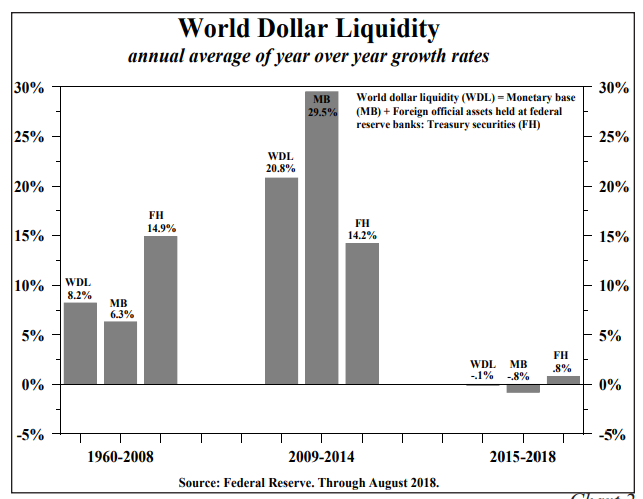
Source: Hoisington Investment Management
A number of factors have been cited as reasons for this most recent liquidity event. The U.S. Treasury sold bonds to raise cash to fund the government rising deficit. Banks, in turn, use their excess dollar reserves to buy those Treasuries. This is how the process drains liquidity from the banking system. Corporate taxes came due and this put additional pressure on banks to supply cash to customers. Also, the Fed was backing away from buying additional bonds under a very modified form of QE. In all, the banks ran down their reserves and monetary conditions tightened.
So, why is the shrinking of WDL important? Is this not just an esoteric topic that need not concern the ordinary investor? The ramifications of declining WDL are being felt in many different areas such as:
- World trade volumes are declining because foreign countries do not have sufficient dollars to purchase imports; the growth in foreign reserves has slowed considerably in many of the emerging markets, placing considerable stress on the flow of international trade;
- Protectionist trade policies restrict emerging markets from earning dollars to fund domestic investment; the USD debt levels in these countries are hard to service, given the decline in foreign reserves;
- US Treasury needs cash-rich customers at home and abroad to buy its ever-increasing supply of bills and bonds to fund the government on a daily basis; the US government is headed for a $1.5 trillion deficit that is heavily financed with dollars held by countries with hefty current account surpluses, namely China and Japan;
- The Federal Reserve will be under pressure to lower rates; the entire yield curve will continue to be pressured downwardly; the Fed will likely re-invigorate its quantitative easing (QE) program, as a means of injecting cash into the system; and,
- As Milton Friedman correctly theorized three decades ago, the drop-in liquidity will result in lower, not higher, interest rates as economic activity slows.


Comments
Log in or sign up to join the conversation.