

"If you're not a liberal when you're 20, you have no heart. If you're not a conservative by the time you're 35, you have no brain."
The quote above, often attributed to Churchill, is debated. What isn't debated is a much older phrase, one that predates him by centuries: Don't shoot the messenger.
For six weeks we've walked through the major causes of our K-shaped economy, housing, healthcare, and education, and found that every one of them has outrun wages and inflation for decades. For many of us, that pressure is manageable. But a generation did what it was told and got a worse deal than the ones before it.
People can tolerate a bad deal for a long time. What history shows, again and again, is that they won't tolerate a bad deal they no longer believe they can escape. As Peter Turchin's research warns, that's when economics turns into politics, or worse.
The Siren Song of Socialism
David Remnick, editor of The New Yorker, recently interviewed Megan Romer, a national co-chair of the Democratic Socialists of America. He picked her apart. I'd recommend listening to the whole thing. As a capitalist, a lot of her comments struck me as borderline crazy. And yet, the movement is gaining support at an alarming rate, for reasons we’ll explore today. The reasons and the followers, it turns out, aren’t crazy at all.
Thankfully, Megan Romer isn't the most convincing messenger. Some of her ideas are radical, and her answers aren't particularly well developed. But buried in the interview are insights that cannot be ignored.
Look at the numbers. The DSA had roughly 51,000 members when Zohran Mamdani launched his New York City mayoral campaign in late October 2024. Today it's around 129,000.
And the reason it's grown isn't socialism. As Romer put it, her constituents don't care whether she's quoting Karl Marx or Thomas Jefferson. They care whether there are "rats in their kid's bedroom." They want affordable housing and cheaper healthcare. Access to education they can pay for. A utility bill that doesn't climb every year. They want to know why working harder stopped getting them further ahead.
For many, capitalism has stopped working. They want a better deal. A fair deal.
Politicians have a sixth sense that picks up on this kind of shift. They're organizing around it. With a better messenger, this movement will spread.
For example, Huey Long was initially dismissed nationally as a Louisiana demagogue with radical wealth-redistribution schemes. By 1935, his Share Our Wealth movement claimed millions of members. Roosevelt was worried enough about the pressure from his left that his administration moved left too.
Dismissing a movement because its early messengers fumble the delivery tells us little about its potential, or where the frustration driving it might eventually lead.
Put the politics aside for a second. Who doesn't want healthcare to cost less? Who doesn't want housing to be more affordable, wages to stretch further, or groceries to cost less? We can argue all day about how to accomplish those things. But the desire itself isn't radical.
I don’t believe young people actually want socialism. Most have likely not studied Marx or seen the utter failures of a socialist economy. I went to Cuba in 2021 with a group from the Global Interdependence Center, organized by my friend David Kotok. I saw and heard firsthand how damaging a system that “controls the means of production” can be. I spoke with a Cuban farmer who told me he called his cooperative representative to tell him his crop would be ready for harvest in a week. The delegate told him he had to wait three weeks to harvest. “But in three weeks, the crops will rot on the vine – they need to be picked now.” The reply was no, we will be ready for your crop in three weeks. Welcome to central planning.
I think what we are witnessing is an awakening. Many Americans feel the system is unfair at best, and rigged against them at worst. And the truth is, it is.
For example, in 2024, special interests spent a record $4.4 billion lobbying Congress. In 2025 it topped $5 billion, the largest jump on record. Pharma alone spent $387 million. Health care in total, $744 million. That works out to roughly $10 million per member of Congress, per year. And that's before you count the 176 former lawmakers who've walked out of Congress and straight into lobbying jobs since 2011.
This is a perfect set up for extreme ideologies of all kinds to take root. The fringe right figured that out first. The fringe left is catching on. Mamdani has shown how powerful a message delivered with charisma and charm can be. Others are borrowing the playbook.
Why Politicians Reach for the Enemy
This is a time-tested political strategy. Tell people there's a problem. Tell them who's to blame. Tell them you'll fix it.
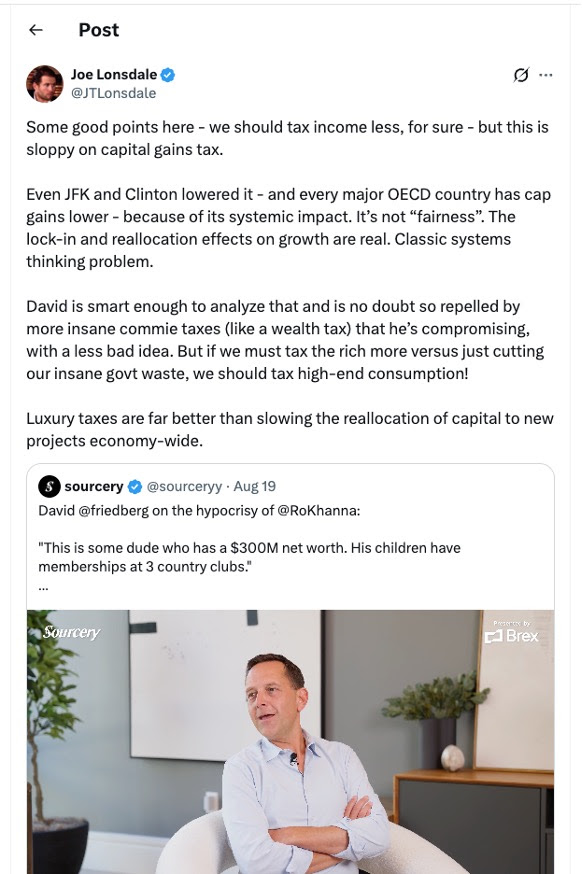
David Friedberg, entrepreneur, investor, and co-host of the All In Podcast, made exactly this point when he said the people moving toward socialism aren't wrong about how they feel — in fact, they're "absolutely right." His problem is with the politicians like Ro Khanna who take that legitimate frustration, point at an enemy, and use it to win votes instead of fixing what caused it.
Source: X
Friedberg points to the capital gains tax. Someone who makes money from long term capital gains pays a federal long-term rate of 15% or 20%, while someone earning income (i.e. from a job or owning a business) can face a top marginal rate of 39.6%. The person who works for a living pays a higher marginal tax rate than the person whose money works for them, and the wealthiest can often defer or completely avoid the tax by borrowing against appreciated assets instead of selling them.
The obvious rebuttal is that lower capital-gains rates encourage investment. I agree. But why is the gap so wide? And why are there legal ways for some to not pay, ways that someone who has a job cannot use? Is that fair, or is that a rigged system?
Here’s where political speechwriters earn their keep. Talking about closing loopholes, the nuances of tax policy, the tax revenue that comes as a result of capital creating jobs… none of that makes for a good political stump speech. What works a lot better is “tax the rich!” or “we need a wealth tax.”
Show me the incentive
Which brings me back to the Charlie Munger quote from last week: “show me the incentive, and I'll show you the outcome.” The hospital follows the incentive. The college follows it. The homeowner with a 2.8% mortgage follows it. Private equity follows it. Investors follow it.
Voters follow incentives too, though often with a lag. So maybe the conversation we should be having isn't how to defend what we've got, or which side is right, but how to give up a little now to bring the system back into balance, because the alternative is giving up a lot more later, on terms we don't get to choose.
The renter writing a $4,000 a month rent check isn't irrational for wanting rent control. The graduate buried in debt and underemployed isn't stupid for wanting it forgiven. The family paying $27,000 a year for health insurance is right to want the healthcare industry overhauled.
People will accept a losing hand for a long time, but not forever. When a big swath of voters feel invisible or oppressed, sooner or later they stop cooperating with the system. What that looks like can range from a political upheaval to something much more chaotic and violent. That’s what I’m writing about today. I want to avoid this.
Where This Leaves Us
But if Turchin is right, if elite overproduction and falling relative wages really are pushing the country toward the kind of rupture it last saw in 1860, then this isn't a story about one mayoral race or one 129,000-member organization. It could be the early tremor of something much larger.
What I like about Friedberg’s clip, is he says the uncomfortable part out loud. He is acknowledging that many people know the system isn’t fair, and they are looking for alternatives. Those of us with gray hair know that politicians are all too eager to make false promises and capture the angst of a moment.
We need to continue this kind of conversation between people like Joe Lonsdale and David Friedberg. You and I need to join them. I tend to agree with Friedberg’s criticisms of the capital gains tax and loopholes, but the fact that Lonsdale disagreed, and then offered up an alternative – that could be the start of a break in the logjam.
I think our system took a serious wrong turn in 2010, when it was decided that corporations are people and can spend unlimited funds on “independent political advertising.”
Just like I don’t want a corporation to preach values to me, I also don’t want them putting their balance sheet to work in the political arena. That’s not a market function – that’s stacking the deck in their favor. Special interests have bought their way into DC and what we ended up with is a government no longer for the people, by the people, but a government for big business. There’s a word for this: corporatocracy.
My fear is if something is not done by those of us in the vanishing political middle, something to make the system fairer for all, then the political pendulum is going to swing in a new direction – one that might seem unimaginable today. And the outcome will be far worse for everyone. Socialists are like the dog chasing the car. They have no idea what to do when they catch it.
So what do we do?
Elected officials might be mostly bought, but they still listen to what’s coming from their districts. I implore you, call them. Email them. Give them your ideas on how to avoid what could be the start of a crisis.


Comments
Log in or sign up to join the conversation.