

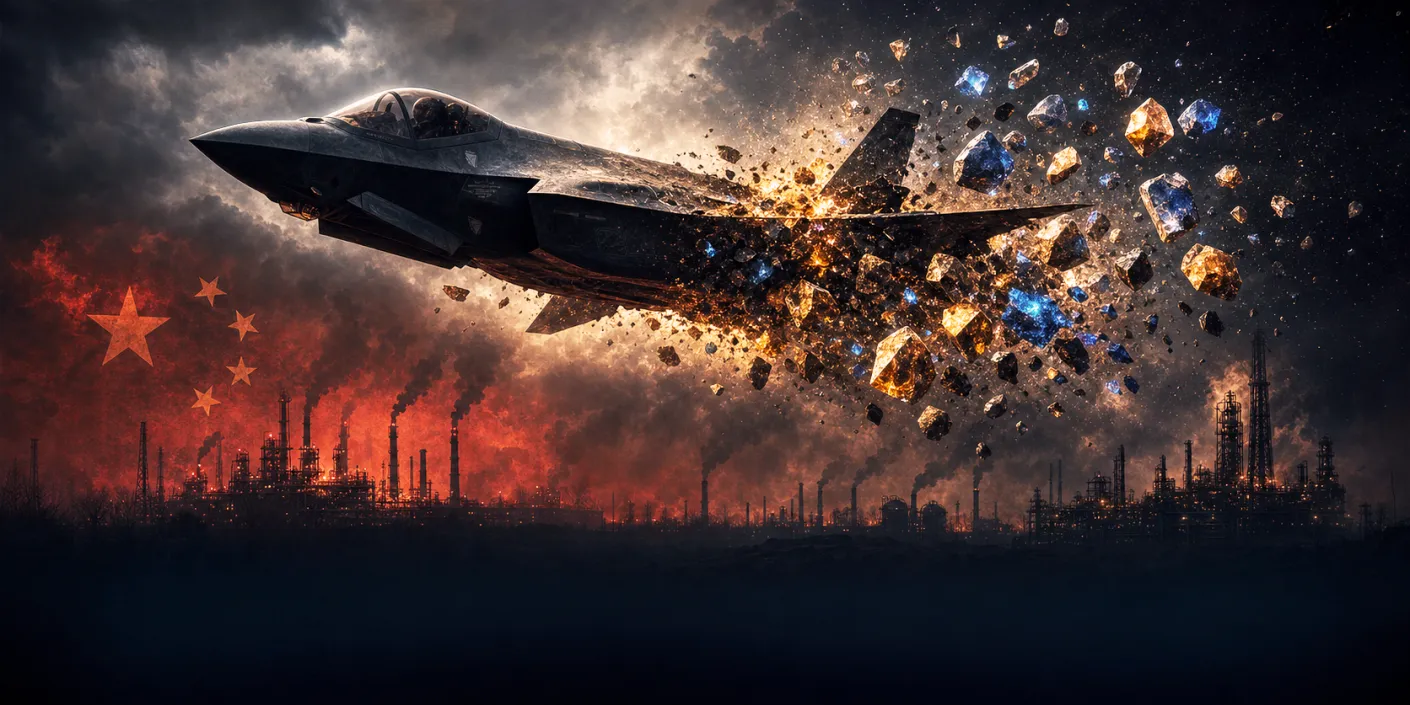
An F-35 fighter contains 920 pounds of rare earth minerals. A Virginia-class submarine needs 9,200. An Arleigh Burke destroyer requires 5,200. Strip those magnets, actuators, and critical inputs out of the supply chain, and the most advanced military on earth grinds to a halt. The country that processes nearly all of them is China.
That uncomfortable fact sits behind almost every headline coming out of the Iran war and the conflict over critical resources. According to Jim Puplava, who has been arguing since 2020 that we are living through another commodity supercycle, the conflict in the Middle East is not an isolated flare-up, but part of a broader contest over the chokepoints that determine who can build, fuel, and arm the modern economy.
The War Beneath the War
Puplava points to a striking asymmetry exposed by the fighting: Tehran can produce roughly 100 ballistic missiles a month, while the United States manufactures only six interceptors in the same period. Each Tomahawk, THAAD, and Patriot fired costs millions of dollars and depends on materials refined almost exclusively in China.
That math has not been lost on Beijing. Some analysts now suspect China is content to watch the Iran conflict drag on, since every interceptor launched over Tel Aviv is one fewer available for a future contest over Taiwan. “In a kinetic conflict, the side that controls the magnets controls the missiles,” Puplava says. Replenishing the stockpile, by most estimates, will take years.
The Periodic Table as Statecraft
China’s grip did not happen by accident. While the West chased software and asset-light business models, Beijing built the gritty back end of the modern economy: mines, smelters, refineries, magnet factories.
Puplava argues that Western elites suffer from what he calls “physical illiteracy,” the conceit that we have built a weightless digital civilization. In reality, a green grid requires 400 percent more copper and 2,000 percent more lithium than the fossil fuel system it would replace. Semiconductors, electric vehicles, AI servers, data centers, and precision weapons all run on the same short list of elements.
Beijing has begun pulling the lever. In 2024 and 2025, China placed export restrictions on gallium, germanium, antimony, tungsten, and high-grade magnets, citing military end-use concerns. Gallium and germanium feed high-speed semiconductors and night vision optics. The magnets show up in F-35s, Columbia-class submarines, drones, and sonar arrays.
“We’ve traded energy dependence on the Middle East for a more rigid mineral dependence on the People’s Republic of China,” Puplava says. Even mines reopened on American soil, such as Mountain Pass in California, still ship their concentrates to China for processing.
Catching Up, Slowly
Washington is finally moving, though the awakening has come late. After winning the Cold War, politicians reduced the strategic mineral stockpiles that once anchored national defense. Reviving them is now a bipartisan project.
In February 2026, the Trump administration launched Project Vault, a stockpile backed by $10 billion from the Export‑Import Bank and roughly $1.7 billion in private capital, with companies including General Motors, Boeing, Google, and GE Vernova reported as participants. Federal commitments to critical minerals and supply chain resilience total at least tens of billions of dollars across Project Vault, Pentagon investments, and related initiatives, and lawmakers have proposed additional funding to expand the national stockpile.
The key bottleneck is not money but permitting. Citing the Center for Strategic and International Studies, Puplava notes that opening a new American mine requires thirteen separate permitting steps before construction even begins. The Idaho cobalt project spent eight years simply moving from a draft environmental impact statement to a notice of intent. Add NIMBY (Not In My Back Yard) opposition, the whiplash of four-year political cycles, and recent moves in twelve states to pause AI data center construction, and the picture grows uglier.
The New Great Game
Rudyard Kipling called the nineteenth-century rivalry between Britain and Russia the Great Game. Its twenty-first-century version is being played out in the Lithium Triangle of Argentina, Chile, and Bolivia, the cobalt corridors of the Democratic Republic of Congo, and the long highways of China’s Belt and Road. Beijing offers infrastructure in exchange for exclusive commodity agreements. American counteroffers, freighted with labor and environmental conditions, often lose the bidding.
Iran fits the same map. The Strait of Hormuz remains the world’s most important energy chokepoint, yet the conflict is accelerating the very transition that favors China. Disruption in oil markets pushes buyers toward EVs and batteries, sectors where Chinese firms make some of the cheapest and best products on the planet. Beijing has even managed to pose as a responsible mediator while Washington escalates militarily. As Puplava puts it: “In the twentieth century, it was about blue-water navies protecting oil lanes. The twenty-first century looks to be about deep-earth diplomacy.”
The Investment Map
For investors, the strategic implications are becoming clearer. Puplava personally favors companies exposed to broader US-China decoupling, favoring miners and refiners in Australia and the United States, along with defense contractors developing next‑generation missile and AI‑enabled systems. He also highlights commodities like lithium, copper, nickel, precious metals, rare earths, and natural gas infrastructure plays as potential longer-term beneficiaries of supply realignment and re‑armament trends.
Bank of America’s Michael Hartnett has called the next five years a commodities decade. Puplava agrees, and adds that the future map of power will be drawn with geological surveys rather than strict national borders. The world is moving, in his phrase, “from a world of high finance to a world of high physics.” The countries that figure that out first will write the rules of the next era. The ones still treating mines as eyesores may find they have built a military, an economy, and a technology stack they no longer control.
Sources:



Comments
Log in or sign up to join the conversation.