


The Federal Reserve held interest rates at 3.50%–3.75% on July 29 in a 9-3 vote, the most lopsided dissent since September 2016, as three regional presidents pushed for an immediate 25 basis point hike, sending 30-year Treasury yields to an intraday high of 5.2273%, their steepest level since June 2007, before settling at 5.2039% per Reuters data. This data drop puts Bitcoin ETF flows under increasing pressure.
Fed Chair Kevin Warsh acknowledged the yield surge at his post-meeting press conference, welcomed it as evidence that markets were doing the tightening work, but explicitly declined to validate those moves with a policy commitment.
Fed funds futures responded by pricing in roughly a 60% chance of a rate hike at the September meeting, with 33 basis points of cumulative tightening implied by year-end, according to CNA.
That repricing immediately elevated the opportunity cost calculation for non-yielding assets, a transmission that runs directly into Bitcoin’s institutional demand curve and into the ETF flow mechanics that have become the primary price-discovery mechanism for spot crypto in 2026.
The Yield-to-Bitcoin Transmission Channel: How a Hawkish Hold Reaches Crypto’s Order Book
The Federal Reserve’s decision on July 29 impacts Bitcoin’s spot market through four main steps. First, the hawkish hold on interest rates raises the probability of a September hike, increasing expected short-end yields.
Second, dissent among FOMC members about hiking rates pushes long-end yields higher, raising the 30-year Treasury yield to a 19-year high. With long-end yields above 5.20%, Treasuries present a higher return hurdle for non-yielding assets like Bitcoin, influencing institutional allocation decisions.
This leads to de-risking through Bitcoin ETF redemptions, which creates selling pressure in the Bitcoin spot market. Previous yield spikes have correlated with significant BTC drawdowns and ETF outflows.
Blerina Uruci from T Rowe Price remarked that Warsh’s ambiguous stance could create market confusion, as the September rate hike is priced in without a guarantee of action.
Kerry Craig from JP Morgan noted that the discrepancy between the Fed’s rhetoric and actions challenges market expectations, contributing to yield volatility that poses additional risks for Bitcoin and high-beta assets.
IBIT Flow Mechanics: What the Hawkish Posture Does to Spot Bitcoin ETF Demand
The BlackRock iShares Bitcoin Trust (IBIT) emerged as the leading institutional option for spot Bitcoin exposure, capturing most net inflows during the 2026 bull run.
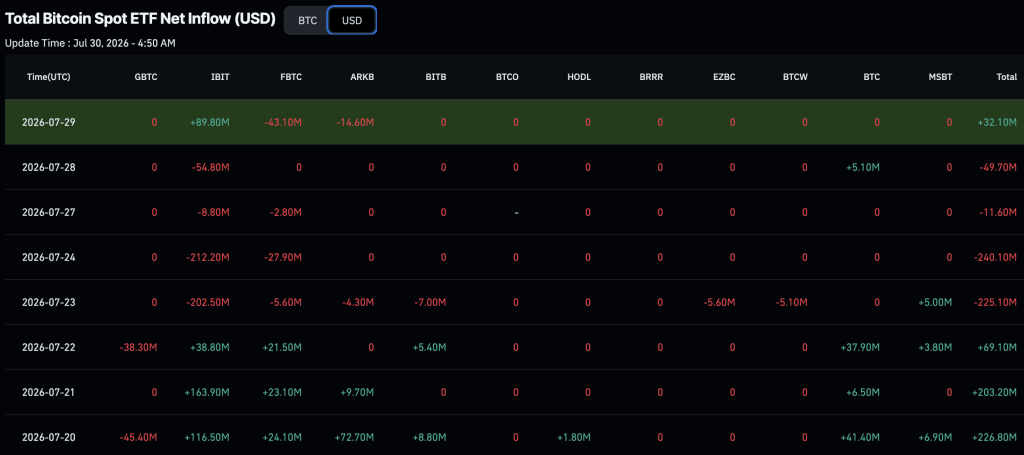
A hawkish hold is altering the flow outlook for IBIT, as institutional clients reassess their risk models against a 5.22% 30-year Treasury benchmark, leading to redemption orders that prompt the transfer of Bitcoin from Coinbase custody to spot markets and increase available supply.
This mechanism was evident in June, where large outflows from IBIT demonstrated how rising Treasury yields could quickly reverse inflow trends, with single-day redemptions reaching hundreds of millions.
The post-July 29 environment, characterized by a 19-year yield high and a 60% chance of a September rate hike, mirrors conditions that drove June outflows, tightening timelines for institutional reallocations.
Coordination across spot crypto ETFs like IBIT and Fidelity’s FBTC enhances the impact. Simultaneous net outflows in response to macroeconomic factors indicate that institutional investors are reacting to the overall yield environment rather than specific products, with the July 28 session already highlighting the connection between rate-hike expectations and ETF outflow pressure.
Bitcoin ETF Crypto-Linked Equities: How the 5.22% 30-Year Yield Compresses Valuations Across the Listed Sector
The impact of the hawkish hold on crypto-linked equities, such as miners, exchanges, and leveraged Bitcoin holders, operates through a valuation-compression channel rather than via the Bitcoin ETF redemption mechanism.
With the 30-year Treasury yield at 5.2273%, discount rates for long-duration, non-yielding assets rise, reducing the present value of future cash flows for Bitcoin-related companies. Coinbase Global (NASDAQ: COIN) exemplifies this, as its revenue is volume-sensitive and contracts when institutions lower risk exposure amid tighter financial conditions.
Bitcoin miners face additional sensitivity due to their reliance on debt markets that have adjusted alongside rising Treasury yields, increasing refinancing costs and compressing margins as BTC prices face downward pressure from ETF flows.
Strategy (NASDAQ: MSTR), which holds leveraged Bitcoin, encounters dual compression: rising discount rates lower its BTC holdings’ value, while higher yields increase its debt costs.
The crypto-linked equities that rallied before the July 29 meeting are now the most exposed to a downturn, having anticipated a more dovish Fed. The 9-3 vote alters this outlook.
OCBC’s Vasu Menon highlighted that the steepening Treasury yield curve, coupled with Middle Eastern tensions and semiconductor volatility, suggests continued market instability, which has historically correlated with higher downside risk for crypto equities.



Comments
Log in or sign up to join the conversation.