

Amazon (AMZN) is delivering spectacular returns, shares of the online retail leader have gained over 66% in the past 12 months, fueled by vigorous top-line performance from the company. However, Amazon generates remarkably low profitability levels, and valuation is a major risk factor to consider when evaluating a position in the stock. In terms of finding the right risk and reward combination in Amazon, the options markets can offer some interesting possibilities.
Amazon Stock: Risk And Reward
Amazon is a remarkable growth story. In 1995 the company made only $511,000 in revenue per year. Fast forward to 2018, and Amazon is expected to generate $237.47 billion in revenue and growing at full speed. In the process, Amazon has consolidated its leadership position in online retail and cloud computing infrastructure, and the company is now also a big player in industries such as hardware and digital content.
The most recent financial report from Amazon confirms that the business keeps firing on all cylinders as of the first quarter of 2018. Revenue during the quarter grew 43% year-over-year, reaching $51 billion. It takes a truly exceptional business to generate that kind of growth from such a big revenue base.
Moving forward, Amazon still has a lot of room for expansion over the years ahead. Online retail is rapidly gaining share versus traditional retail, but online still represents a relatively small 9.5% of the overall retail industry in the U.S. Amazon is well positioned to be one of the main beneficiaries from growing online retail sales in the long term. In addition, the company is also enjoying powerful momentum in cloud computing infrastructure, and Amazon has barely scratched the surface when it comes to international markets opportunities.
On the other hand, Amazon reinvests most of its cash flows for growth, so both earnings and free cash flows are low and unstable. Due to aggressive reinvestments, current earnings and cash flows don't really tell the whole story about the company's earnings power over the long term. However, it's still important to note that the price to earnings ratio is currently above 212, and the price to free cash flow ratio for Amazon is around 45.6.
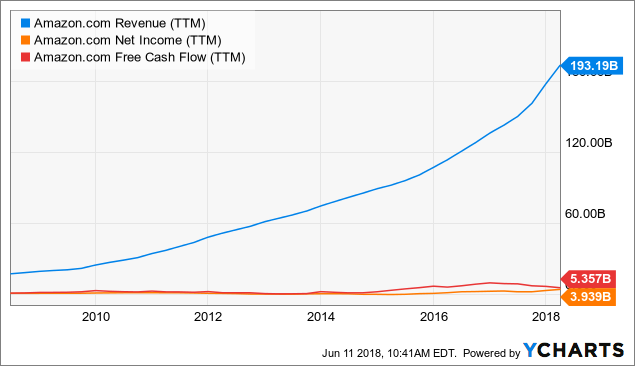
AMZN Revenue (NYSE:TTM) data by YCharts
Bullish investors can arguably say that the company will generate better margins in the future because of factors such as increasing engagement among Amazon Prime members, a growing share of revenue coming from third-party sales, higher contribution from Amazon Web Services, and better cost leverage in areas like fulfillment and logistics expenses. That is a plausible scenario, but whether Amazon can make higher profitability in the future still remains to be seen.
A position in Amazon provides exposure to an impressively dynamic growth juggernaut, but it also carries substantial risk, since it means buying a company priced at stratospheric valuation levels based on current earnings and cash flows. Interestingly, approaching Amazon stock through the options markets can be a smart way to find the right risk and reward equation in such a particular name.
Options Trade Idea 1: Buy A Short Term Call
Investors looking to make a short term bet on Amazon with plenty of upside potential and limited downside risk may want to consider buying short term calls on the stock. For example, you can buy a call contract on Amazon stock with an expiration date on July 27, 2018 and a strike price of $1,690 for approximately $70.5 per contract.
The maximum potential loss in this trade is the contract price, meaning $7,050 per contract. But you can completely lose your investment if the stock price is below $1,690 per share at the time of expiration, so this is an important risk factor to watch. Investors buying this call contract need Amazon stock to move in the right direction and rapidly.
The main advantage is that the trade offers plenty of upside potential in the short term. If Amazon stock rises by 10% before the time of expiration, the call price would rise to $17,000. This would mean a total return of over 140% for investors in the call contract.
Options Trade Idea 2: Buy A Long Term Bullish Call Spread
Another alternative to play the stock on the long side is buying a long term bullish call spread. For example, you can buy a long term bullish spread by purchasing the call contract with an expiration date on February 15, 2019 and a strike price of $1,690 for $168.4. In order to reduce the entry price in the position, you can also sell the call with the same expiration date and a strike price of $1,960 for $66.75 per contract.
In comparison to just buying a long term call, this strategy leaves money on the table in case Amazon stock rises above $1690 by the time of expiration. However, the spread reduces the entry cost, and a longer term position provides more flexibility and more time for the trade to work.
Options Trade Idea 3: Sell A Put Contract
What if you like the business but you don't like the stock price? Or perhaps you think that Amazon stock is due for an adjustment in the middle term, and you don't want to chase the stock when it's trading at historical highs. In this case, selling puts could be a smart idea.
For example, you can sell a put contract on Amazon with an expiry date on July 20, 2018 and a strike price of $1,500 for nearly $4.08. If the stock never pulls back to below $1,500 before the time of expiry, then the put contract will expire worthless, and investors in this trade get to keep the contract price as full profit.
Conversely, if Amazon falls below $1,500 by the expiry date, the put will be executed, and the investor will need to buy $100 shares of Amazon at $1,500 per share. Since the main idea was buying the stock on a price correction to begin with, this doesn't sound like such a bad scenario at all.



Comments
Log in or sign up to join the conversation.