
Tuesday Talk: Off To A Running Start
The major stock indices got off to a running start on the first trading day of the year and Apple (AAPL) and Tesla (TSLA) helped the pack to get going. Apple was one of the most active issues and Tesla was the top gainer by far.

Apple made history yesterday when its stock briefly rose to $182.86 per share, bringing its valuation to $3 trillion, the first company to do so; before it fell to close at $182.01. Tesla gained 13.5% Monday after it far exceeded estimated deliveries of new vehicles for Q4'21.
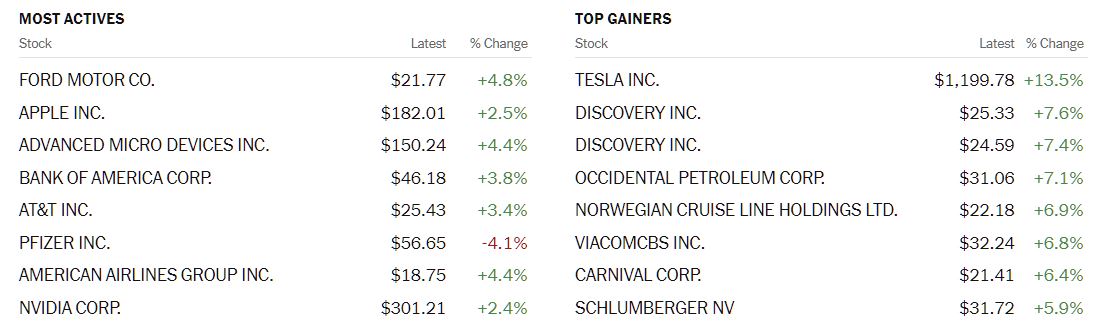
Charts: The New York Times
The S&P 500 closed at 4,797 Monday, up 30 points, the Dow Jones Industrial Average closed at 36,585, up 247 points while the Nasdaq Composite closed at 15,833, up 188 points. Currently, market futures are trading green; S&P futures are up 18 points, Dow futures are up 135 points and Nasdaq 100 futures are up 57 points.
Staying with the top headlines, contributor Phate Zhang reports that Tesla Beats Expectations With Record 308,600 Global Deliveries In Q4.
"Tesla delivered a record 308,600 vehicles worldwide in the fourth quarter of 2021, up 70.9 percent year-on-year and up 27.9 percent from the third quarter, according to data announced by the company Sunday. The delivery figure was well above the 263,000 vehicles expected by analysts in a Bloomberg survey. Tesla delivered 296,850 Model 3 and Model Y vehicles in the fourth quarter, accounting for 96.2 percent of total deliveries. A total of 11,750 Model S and Model X vehicles were delivered in the fourth quarter."

"For the full year 2021, Tesla delivered 936,172 vehicles globally, up 87 percent from 2020. Tesla delivered 911,208 Model 3 and Model Y vehicles, and 24,964 Model S and Model X vehicles in 2021."
TalkMarkets contributor Mish Shedlock says Apple Is The First $3 Trillion Company, But Where Will It End The Year?
"On the first trading day of 2022 Apple became the First $3 Trillion Company.
Apple Inc. AAPL became the first U.S. company to reach $3 trillion in market value, the latest milestone in a pandemic-era surge that carried shares of the iPhone maker and other large technology companies to unprecedented highs.
Apple shares crossed the milestone when they topped $182.856 Monday. The share price has more than tripled since the pandemic lows of March 2020, adding around $2 trillion in market capitalization."

Mish continues his article with snaps of a Twitter (TWTR) conversation with his colleague Stacy Herbert who wagers that the company's market cap will be $5 trillion by the end of 2022.

TM contributor Michael Kramer explains that Stocks Jump On January 3 Ahead Of Massive Data Dump.
"Tomorrow (Tuesday) will mark the start of a lot of economic data, and we should start to get a better sense of how the market feels about this data."
Kramer does not have any definitive take on Monday's action. He does give the following technical take on recent S&P 500 action:
"We have been in a vacuum of no real news, and the S&P 500 has been hovering around this 4,800 region with minimal movement. The index was stuck most of the day between 4,780 and 4,785 and made a late-day break back to 4,796. Interestingly, the pattern on the daily candles, starting on December 27, with a green bar, followed by a red bar the next, followed by a green bar, then two red bars, and then a green bar. The same pattern occurred on December 8 through December 16, with a green bar, followed by a red bar, then a green, followed by two red bars, followed by a green. I mention this because the next bar on December 17 was a big red bar lower. Maybe it’s something, maybe it’s nothing, but I noticed it and found it odd and seemed obvious."

He follows this up with a look at the charts for Tesla, Qualcomm (QCOM) and Amazon (AMZN).
In a recent TalkMarkets Editor's Choice piece, contributors Keith Schneider, Donn Goodman and Holden Milstein look back into history as they tackle the question on many minds as the year begins, What Will Be The Tune Of Markets In 2022?
"When we discuss investment returns, it looks like it was a good 2021...investment returns were positive, considerable, and once again, they spoiled the average investor. Heed our words: three straight double-digit returns are not the norm. Folks, the long-term average of the stock market is about 8%, so any year we get close to that, we are on a normal trajectory of average stock market returns. When you have three good-to-great years, one must take note that at some point there will be a reversion to the mean. Market returns will inevitably fall back to long-term averages.
What Song Might We Hear Next?

That is the million, or let us say, billion-dollar question that everyone from the top analysts, hedge fund managers, pension fund administrators, RIAs, and individual investors are all asking.
For summary purposes here, we have listed a few of the points that make up her “song” for the New Year:
- Continuation of the inflation trade. This should benefit materials, agricultural and commodity stocks, and ETFs.
- Transportation looks to have a potential “breakout year” once things settle down with COVID-19 and airplanes, specifically, have less disrupted schedules.
- Retail sales stay strong, and consumer optimism remains high, provided inflation does not create out-of-sight pricing.
- Gold, silver, and other metals/mining may have a breakout year and catch up as the dollar declines. Strong demand for inputs for technology products continues to fuel scarce mineral demand throughout the world.
- Rates trend up, but not too drastically, and the Fed is challenged on whether to raise rates faster than expected based on inflation.
- Cash may be king at times as we get hit with corrections as multiples contract as a result of rising rates or higher trending inflation.
- Energy prices continue trending higher spurred by rising demand, especially from the transportation sector. This will create desirable energy trading opportunities."
TalkMarkets contributor Siddharth Gundapaneni reminds investors that much of what happens in the economy and the markets in 2022 is contingent upon the actions of the Fed, in a piece entitled, Inflation Or Recession? The Fed Faces A Choice.
"On December 15, the Federal Reserve announced numerous quantitative tightening measures that have the intended goal of combating the rising inflation that has been bogging down the American economy. As of November 2021, the rate of inflation has reached 6.8 percent, the highest since 1982, and is unlikely to have peaked yet...
With the quantitative easing policy maintained throughout the COVID-19-induced recession finally ending, the federal funds rate is expected to rise to 0.9 percent in 2022, 1.6 percent in 2023, 2.1 percent in 2024, and 2.5 percent in the undetermined long run. Mortgage-backed security and bond purchases will be reduced by $10 billion and $20 billion a month, respectively, in order to expedite the conclusion of the program by March 2022, rather than June.
While this course of action is likely to mitigate the soaring inflation, it may lead to a myriad of detrimental effects to other facets of the economy...interest rate hikes will most certainly have strong effects on many Americans’ fiscal behavior. The upcoming interest rate increases will pull the prime rate up, thus furthering the burden of credit card holders paying interest. It would be in the best interest of consumers to pay off their debts in a timely manner in order to avoid further economic strain later on. We should also anticipate a rise in fixed mortgage rates...
Car loan rates are also likely to increase, which may worsen already tense conditions for those looking to purchase a vehicle...Used car prices have reached all-time highs in 2021, and following the disbursement of stimulus checks, consumption expenditures on durable goods starkly dropped...higher loan rates on cars may discourage such purchases even more.
In the final analysis, while contractionary monetary policy may be necessary to combat the recent rise of inflation, the sheer number of adverse effects of these actions (recession) remind us why we should try to avoid these situations altogether."
Be that as it may, more than a few Jane and John investors received something other than coal in their stockings and are looking for places to invest in 2022. Contributor Mircea Vasiu looks at Financial sector equities and finds the Best Financial Companies To Buy In Early January: JP Morgan, Citigroup, And BlackRock.

Image: VantagePointTrading
"Financial services companies benefit in an environment of rising interest rates. As the Federal Reserve of the United States announced a faster tapering and tightening conditions, financial stocks outperformed...
JPMorgan
JPMorgan (JPM) reports its quarterly earnings on January 14. The financial services company's stock delivered a double-digit performance in the last twelve months, on the back of the Fed speeding up tapering on the path to liftoff...This is a dividend-paying company with a dividend growth history of 8 years. Moreover, the forward dividend yield is 2.47%, and the dividend payout ratio is 26.89%.
Valuation looks attractive at the start of the trading year, at least if we judge by the P/E Non-GAAP (TTM) ratio of 10.56, much lower than the 11.24 sector median. For the Q4 FY2021, JPMorgan is expected to deliver EPS of $2.96 and the annual revenue estimate for the fiscal period ending December 2021 is $122.60 billion.
Citigroup
Citigroup's (C) stock price underperformed in the last twelve months, affected by investors' willingness to invest in riskier assets as the financial conditions remained loose for most of the year. As such, Citi's stock price is down more than 2% in the last twelve months. But the decline made the stock even more interesting because it improved its valuation...the forward dividend yield is 3.23%, and the company increased the dividend in the last 5 years by 37.18%.
BlackRock
BlackRock's (BLK) shares outperformed during the second year of the COVID-19 pandemic. They delivered 26.89% in the last twelve months and the valuation exceeds the sector's median by more than 100%. This is a company operating with a gross profit margin for the past twelve months of 50.82% and it is reporting its quarterly earnings on January 14. Investors expect EPS of $10.04 on the quarter and BlackRock has delivered better than expected results for the past 9 consecutive quarters."
See the full article for more details.
Caveat Emptor.
Have a good one.
I'll see you on Thursday.



Comments



