


Image Source: Pexels
A compilation:
(Click on image to enlarge)
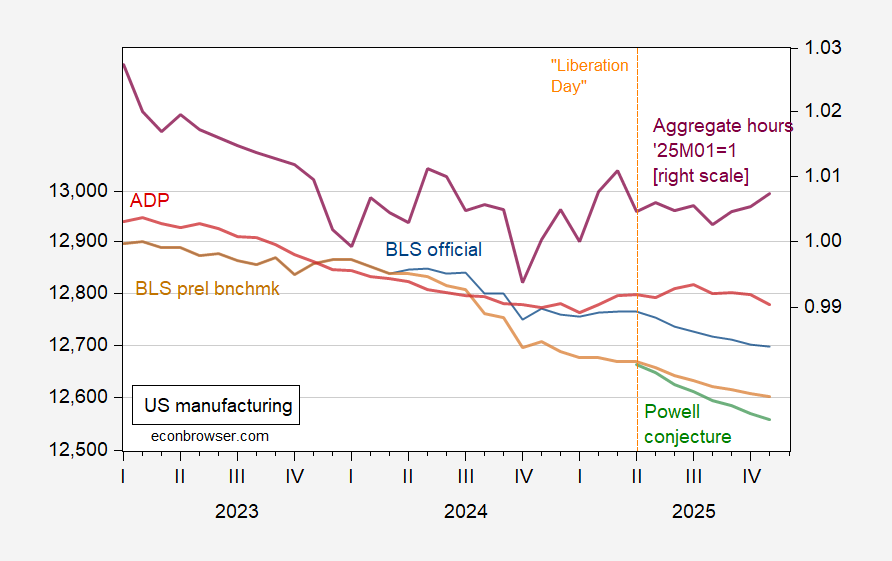
Figure 1: Official BLS manufacturing employment (blue, left log scale), implied BLS preliminary benchmark (tan, left scale), Powell conjecture on implied preliminary benchmark (green, left scale), ADP (red, left scale), all in 000’s, s.a., and official aggregate hours, 2025M01=1.00 (purple, log right scale). Aggregate hours calculated by multiplying average weekly hours by production and nonsupervisory workers. Powell conjecture is prorated 60K overcount applied to manufacturing employment, April-November. Source: BLS via FRED, BLS, and author’s calculations.
While aggregate hours are up since January, manufacturing employment by any BLS related measure is down, and even the ADP measure is just even with the beginning of the year number (and is, as of November, trending down). Note that the ADP measure, while relying on BLS weights, is not directly subject to the vagaries of the birth-death model.
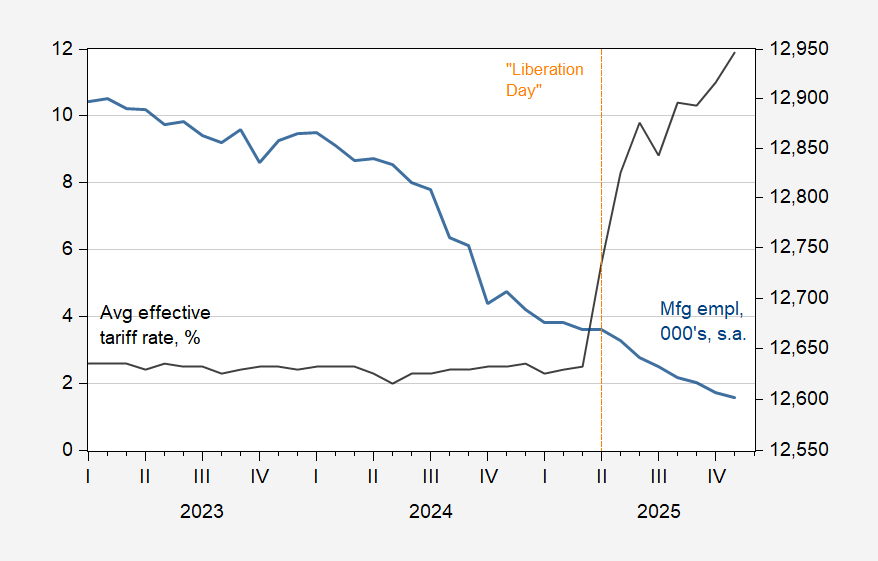
If we focus on manufacturing employment (implied benchmark), we can see a acceleration in employment decline with “Liberation Day” and the average effective tariff rate.
(Click on image to enlarge)
Figure 2: Average effective tariff rate, % (black, left scale), and implied preliminary benchmark revision manufacturing employment, 000’s (blue, left log scale). Source: BLS, Paweł Skrzypczyński, and author’s calculations.
It should be noted that, like aggregate employment, manufacturing gross output and value added measures have diverged from employment series, both having risen slightly relative to January 2025 and 2024 Q4 (2.1% through September, 1.3% through Q2).
Addendum:
Just saw this Dean Baker article highlighted on Bluesky.
More By This Author:
Republican Sentiment: “The Sun’ll Come Out, Tomorrow”
Mysteries of the CPI Release
A Conjectured Sahm Index For November



Comments
Log in or sign up to join the conversation.