

The skirmishes in the macro wars are getting dirtier. More recently, the debate on inflation has pitted 'Team Transitory' and its detractors—I’ve seen the other side described as 'Team Permanent' and 'Team Sustained'—in a mud-slinging and, often emotionally charged, spat. I suspect that 'Team Transitory' will win, eventually—whatever that means—though I also think this side of the debate has most to answer for in terms of the deteriorating debate.
The rules seem to change as the consensus-beating inflation prints roll in. As I as explained here, it is unreasonable to term all versions of the world in which inflation is not making a new high on a monthly basis, as a transitory one.
More importantly, however, the checkmate-like rebuttal to anyone arguing that rates could and should go higher that they must be in favor of higher unemployment is particularly odd to me. The question we need to ask is whether there are conditions under which policy tightening—both fiscal and monetary—to rein in demand are optimal or desirable in an economic sense, even if it means, presumably, unemployment going up. The answer is: yes.
Before the virus—and even during a big part of the pandemic—the stimulus debate took place, intellectually speaking, in a classic IS/LM framework. In this model—see first chart below—without prices, you can expand output indefinitely, especially if you assume political control over monetary policy. In the traditional model, the IS curve will travel along an upward sloping LM curve, raising interest rates as fiscal policy is eased.
But this effect can be negated if the LM curve moves to keep rates constant even as fiscal policy is eased. In the extreme, you end up with a flat LM curve. But then the supply side reared its ugly head. In the classic tale you go from the IS/LM to the AD/SAS model. In this model—see second chart below— you can move along a "short-term" upward sloping supply curve for a while, but eventually you hit the vertical supply curve.
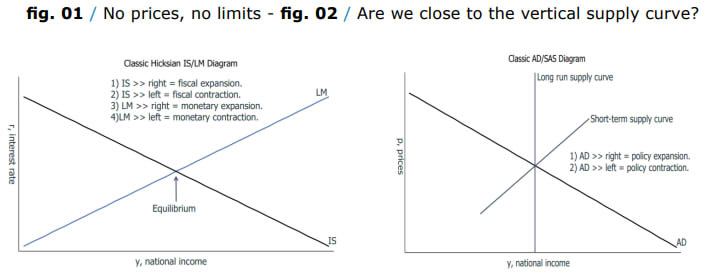
At that point, you're pushing on a string. Push on the demand side, and real output stays constant for a higher level of prices, or inflation if continued over time. This seems like a sub-optimal position from which to use policy stimulus to lift economic output.
Staying with the labor market, though, isn’t higher nominal activity good in itself, if unemployment continues to fall? No. If employment is rising, but real output stays the same, or even falling, productivity will be declining, which in turn means that real income will be sliding.
This outcome is one in which inflation eats away at the economy, and it is not a good economy, but I suppose it can be a politically desirable one, for a while. So, are we at the vertical supply curve now? It's impossible to tell, but we certainly see signs that we might be, which raises the vexing question; do we have to bring demand in line with supply, or can we expand supply?
The answer in the traditional model is clear. You have to curb demand, in the short-term. The supply curve is vertical for a reason. It can be moved, but not quickly. If it could, you're just straight back in the IS/LM model. So, when you hear: "higher rates won't solve a shortage in containers," it is true. But it could bring demand in line with supply, and in a cyclical sense, this could be the only choice for policymakers.
The standard analysis raises two questions in the present context. How malleable is the supply side? I am all for supply-side optimism; in fact, I genuinely believe it, but realism is needed. A world in which the economy enjoys a series of endogenous positive supply shocks, guided by a clever social planner with no near-term budget constraint, is possible, but also probably unlikely.
The catch-22 is then that, barring true "manna from heaven," it will always be difficult to engineer a supply curve shift relative to the ability of policymakers to stimulate demand. The second question is whether policymakers can afford to ignore evidence of supply constraints?
Remember that the current discourse to a large extent is a product of the reality that official estimates for where the mythical vertical supply curve is, Nairu, output gaps, etc., have been proven wrong over and over again. Slack has been consistently mis-estimated, and inflation/wage pressures have remained absent well beyond thresholds in unemployment assured by economists to be "dangerously" low. Little wonder many are calling the current inflation scare's bluff.
For investors, for example, it is worth considering that our inability, or reluctance, to see a vertical supply curve staring us is the face, for entirely legitimate reasons related to initial conditions, is exactly the recipe needed to generate a shift in the inflation regime. In an economic sense, such a shift comes with a "be careful what you wish for" clause, but at this point it is entirely possible that running the economy hot even in the face of a bruised supply side is a good idea.
I can certainly see the political impetus to do so at the present juncture. What is also clear, however, is you don't have to be an unemployment-loving philistine to sound the alarm over high inflation. There is a trade-off, after all, and traveling along a vertical supply curve for an extended period won't help workers, or the economy; I guarantee it.


Comments
Log in or sign up to join the conversation.