


Analysts and economist are, broadly speaking, offering up four reasons for the continued rise in developed market, and in particular, US bond yields. A resurgence in inflation due to the negative supply shock in global energy markets as a result of the US-Iran war, loose fiscal policy with little or no credible plan for any near-term consolidation, a reflection of improving underlying growth and rising productivity—linked to the AI investment boom—lifting the real neutral rate for “the right” reasons, and more specifically in the context of AI, rapidly accelerating AI debt issuance “crowding out” government debt issuance, lifting the cost of capital for the sovereign.
The idea that AI debt issuance is now a key driver of rising bond yields via a “crowding out” effect has captured a lot of attention in recent weeks with key Wall Street analysts and publications offering evidence to support the claim. The FT’s Toby Nangle, however, is not so sure, and in a recent FT Alphaville piece he sets out to rebut the claim.
Toby acknowledges the intuition behind idea that the AI investment boom is crowding out the US Treasury. Hyperscalers are issuing unprecedented quantities of long-dated debt at the same time as the US government is financing very large fiscal deficits. If both are competing for the same pool of duration-sensitive capital, the additional corporate supply should require higher yields to induce investors to absorb it. Fed chair Kevin Warsh, for example, has cited this competition for capital as one possible explanation for the recent rise in Treasury yields.
His first point is that focusing on gross hyperscaler issuance gives a misleading picture of the supply shock. Bonds are wasting assets from the perspective of duration: a five-year bond issued last year is a four-year bond today, while a one-year bond eventually disappears altogether when it matures. The relevant question for the market is therefore not simply how many billions of dollars of new AI bonds are being issued, but whether issuance is adding enough duration to the overall stock of fixed-income assets to overcome this natural attrition.
On this measure, Nangle finds little evidence that AI debt issuance is moving the needle, yet. Despite spectacular hyperscaler issuance, the US investment-grade corporate bond market has not grown as rapidly as the Treasury market, either in nominal terms or when adjusted for duration, while the average duration of the corporate market has actually fallen. Hyperscalers are supplying substantial quantities of new long-dated paper, but so far they appear mainly to be replenishing duration that is disappearing elsewhere in the corporate bond market rather than creating a large net increase in aggregate corporate duration. Kamil Kovar chimes in adding the point that while hyperscalers have added duration, the US government has actually been reducing the maturity of its overall debt by shifting the issuance profile to the front end of the yield curve.
The market evidence points in the same direction. PIMCO finds that the effects of hyperscaler issuance are clearly visible inside the corporate credit market: long-dated hyperscaler spreads have widened relative to other non-financial issuers, and USD hyperscaler bonds have underperformed comparable euro-denominated bonds, consistent with some investor fatigue from heavy dollar issuance. But PIMCO finds much less evidence that this pressure has spilled materially into Treasuries. The recent rise in long-term Treasury yields has been driven predominantly by changes in expected monetary policy and the expected path of short rates, rather than by a large AI-induced increase in the Treasury term premium.
Indeed, excluding hyperscalers, the share of long-dated issuance in the rest of the IG corporate market has been unusually low. The market therefore appears to be doing exactly what one would expect if the supply shock remains principally a relative-price shock within credit: hyperscaler paper cheapens relative to other bonds until investors are willing to hold it.
This does not mean that AI financing can never affect Treasury yields. Hyperscaler issuance is already very large when expressed in ten-year Treasury-duration equivalents, and continued growth could eventually create a genuine secular pressure on the supply of duration that investors must absorb. But that is a prospective argument at best, rather than a convincing explanation of the rise in Treasury yields observed so far.
The burden of proof therefore still lies with the crowding-out hypothesis: it must explain why Treasury yields should have been driven higher by an explosion in one conspicuous category of corporate issuance when the aggregate stock and duration of the corporate bond market have not experienced a comparable explosion. For now, Nangle's conclusion is that hyperscaler borrowing is changing the composition of the corporate bond market far more obviously than it is changing the equilibrium price of US government debt.
Game, set and match then for the scores of Wall Street analysts peddling the link between AI debt issuance and rising bond yields? Far be it from me to question Mr. Nangle’s bond market story, but let’s see whether we can’t lift the burden of evidence a little bit using a simple macro model.
What is a crowd anyway?
It makes sense to start with the idea of “crowding out”, because it denotes a fairly specific mechanism in macroeconomics: the fall in private investment that arises when a fiscal expansion pushes up interest rates. In other words, in standard macro theory it is government borrowing that crowds out private-sector investment and borrowing. Most economics students will encounter the concept first in the classic IS/LM model, in which a rightward shift of the IS curve—denoting fiscal stimulus—raises both output and interest rates, assuming an upward-sloping LM curve. The increase in interest rates in turn depresses interest-sensitive private investment, meaning that the ultimate increase in output is smaller than it would have been in the absence of this interest-rate response. In the classic first-year undergraduate expression, the shift in the IS curve is tugged back a bit, reflecting crowding out.
Assuming, in principle, that crowding out can also operate in reverse—with a private investment boom raising the government's borrowing costs—creates a simple macroeconomic mechanism through which the AI capex boom could be lifting Treasury yields: the standard saving-investment balance. A huge increase in desired private investment—whether financed with bonds, equity or retained earnings—raises demand for real resources and capital and, unless matched by additional saving, pushes up the equilibrium real interest rate. In that sense, AI capex can contribute to higher Treasury yields. But that is quite different from saying that Alphabet, Meta or Microsoft issuing another $20bn of bonds mechanically removes $20bn of demand from the Treasury market, or indeed that a stable quantitative relationship exists between the two. The financing instrument determines who bears the financial risk; the underlying investment determines the pressure on economy-wide saving and real resources.
So far so good, but this still doesn't offer a convincing argument for why the AI investment boom should currently be more than a marginal driver of rising government bond yields, for exactly the reasons highlighted by Toby Nangle. We need to identify the initial conditions under which a private investment shock is particularly likely to raise government borrowing costs.
How about a world with a large existing stock of public debt, persistently large fiscal deficits with little credible prospect of adjustment, and relatively high interest rates gradually feeding through into the government's effective cost of servicing that debt? Add sticky, above-target inflation, and the central bank's ability to accommodate the resulting pressure on interest rates is constrained too.
To explore this, we need to do two things. First, we need a model that reverses the standard crowding-out mechanism, allowing a private investment shock to raise the government's borrowing costs. Second—and more interestingly—we need to show how the strength of that effect can itself be a positive function of the government's existing debt burden. It has been a while since I did much formal economic modelling, so I invited my trusty AI macro research assistant to help formulate a simple framework. The model was constructed from scratch for this exercise, but I make no claim to originality; similar, and almost certainly more sophisticated, frameworks will exist in the literature.
I am going to run through the steps blow by blow to make sure I leave no one behind, but there will be some algebra and a little simple calculus in what follows.
First, let's state the basic saving-investment accounting identity.
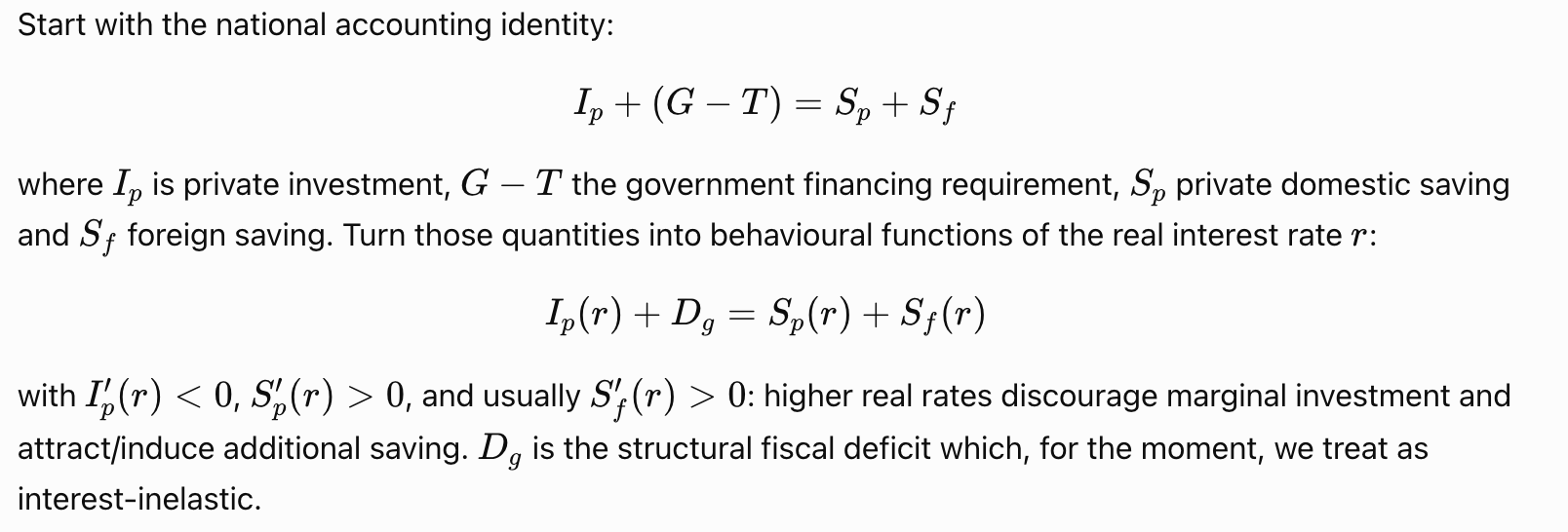
Then allow for an exogenous investment shock, A, and let investment and saving be positive and negative functions of the interest rate, respectively. For simplicity, “A” denotes an autonomous increase in AI-related private investment. The financing mix—debt, equity or retained earnings—is left unspecified, since our model is concerned with the aggregate saving-investment balance rather than the portfolio effects associated with a particular financing instrument. Collect the “r” and take the first derivative to end up with a reversal, or more aptly, an equalisation of the traditional crowding out result. Now r increases as a function of a rising government deficit and a private investment shock.
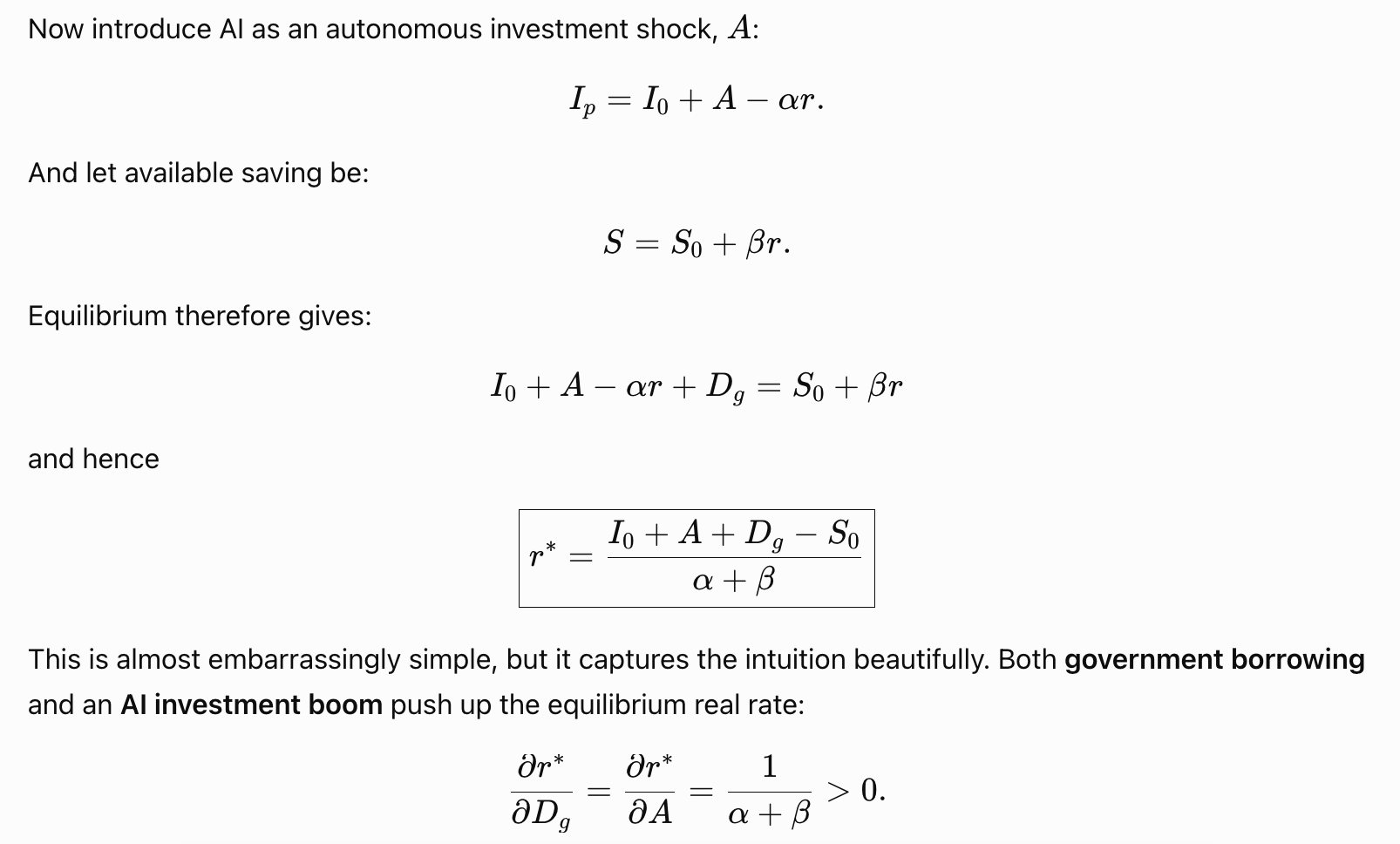
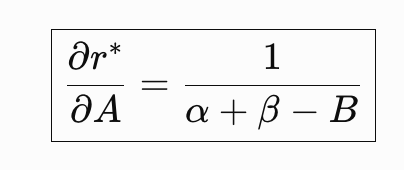
The next step is to create a link between the sensitivity of the interest rate to the private investment shock and the government debt ratio of deficit. As it turns out, it’s relatively simple to get an expression like the one below where the sensitivity of “r” with respect to the private investment boom is a positive function of the government debt level B. As B gets larger the denominator gets smaller. But this, as admitted by my AI assistant, is “dimensionally sloppy” because it is only a tractable model in practice if the two state parameters—alpha and beta—are quantitatively similar to B. They might be, but in many instances they won’t be unless we do a bit more legwork.
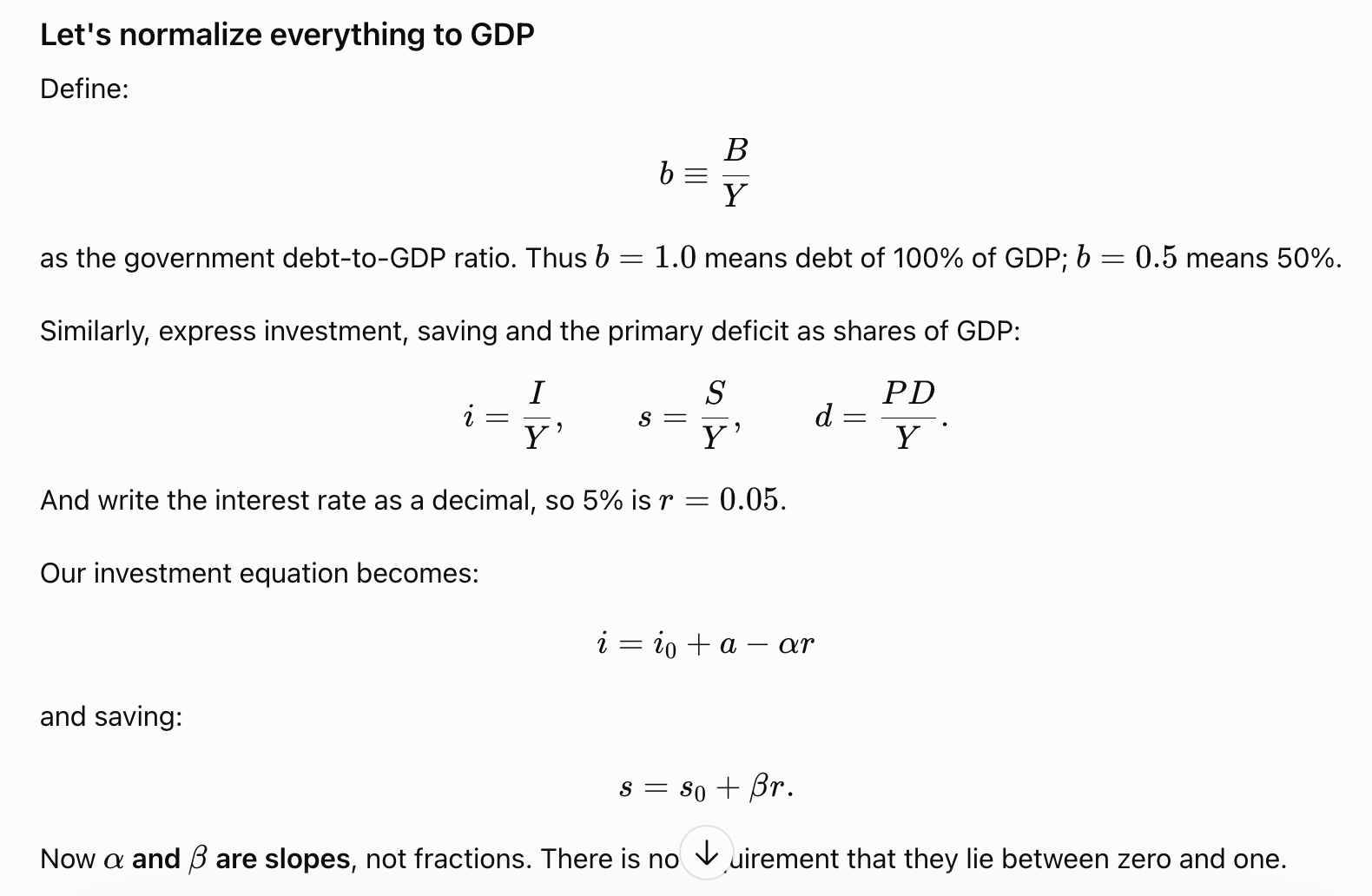
Normalising everything by the level of GDP is always a good trick, which is exactly what my AI macro assistant suggested next.
Now, and admittedly I am moving a bit quick here, add a variable—lambda—governing the fraction of government debt that is sensitive to interest rates in any given period—if all debt refinances every period lambda is 1—and you end up with the following equilibrium condition.
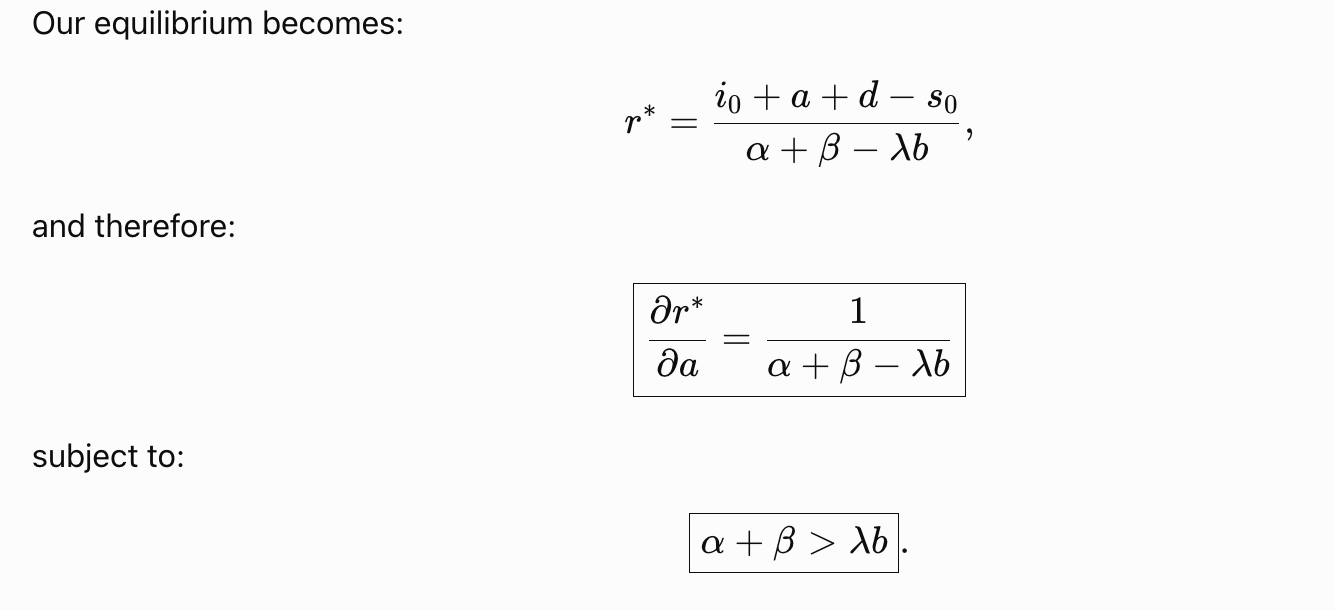
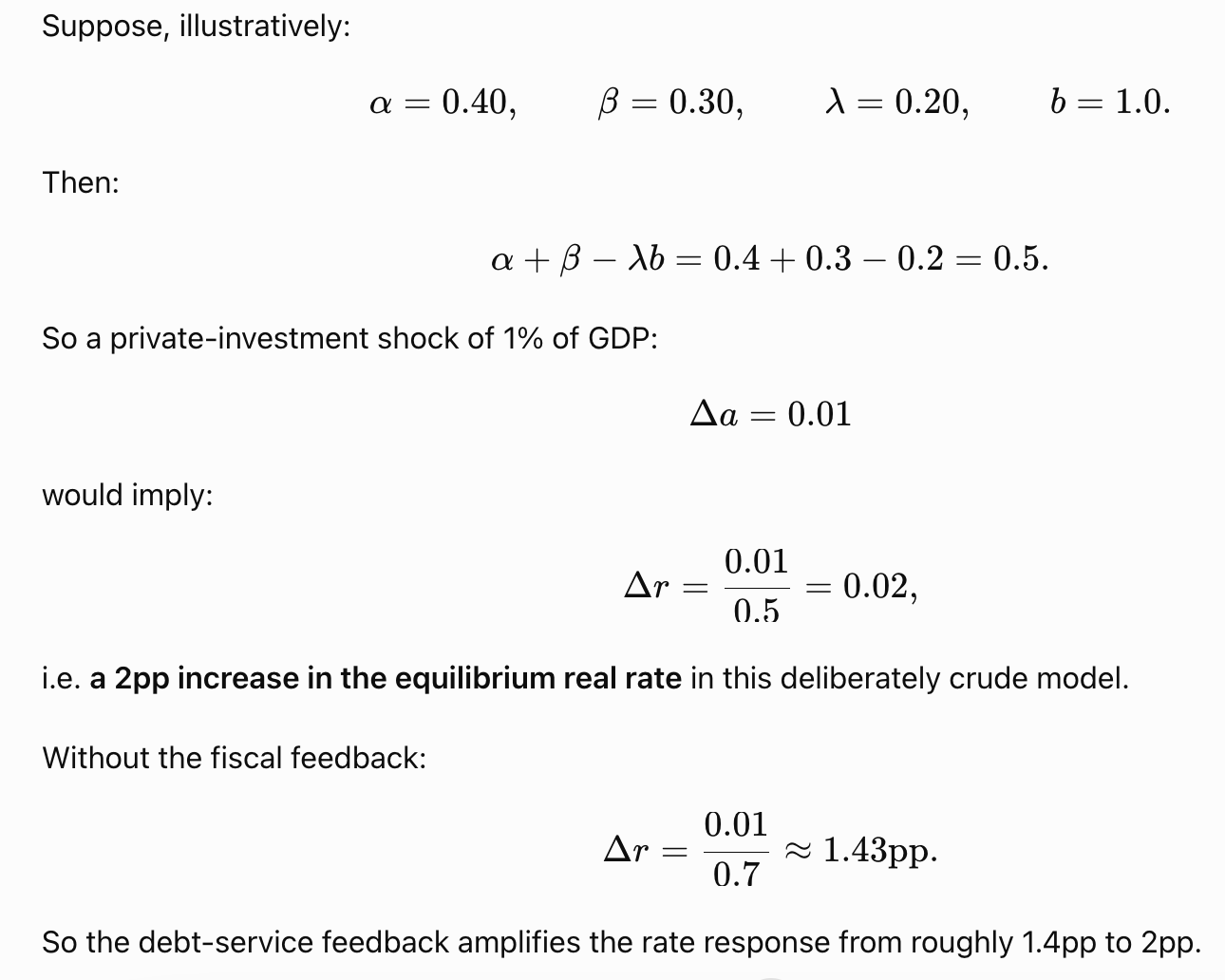
This allows us to calibrate an theoretical model which looks somewhat plausible, though this ultimately is an empirical question. In the model below with a debt-to-GDP level of 100%, and a fraction of the debt stock rolling over in every period at 20%, an investment shock A of 1% of GDP raises the equilibrium interest rate by 2pp with the fiscal feedback mechanism and 1.4pp without it.
For the geeks, we even have this result, which is a bonus in terms of linking this story to the discussion about monetary v fiscal dominance.
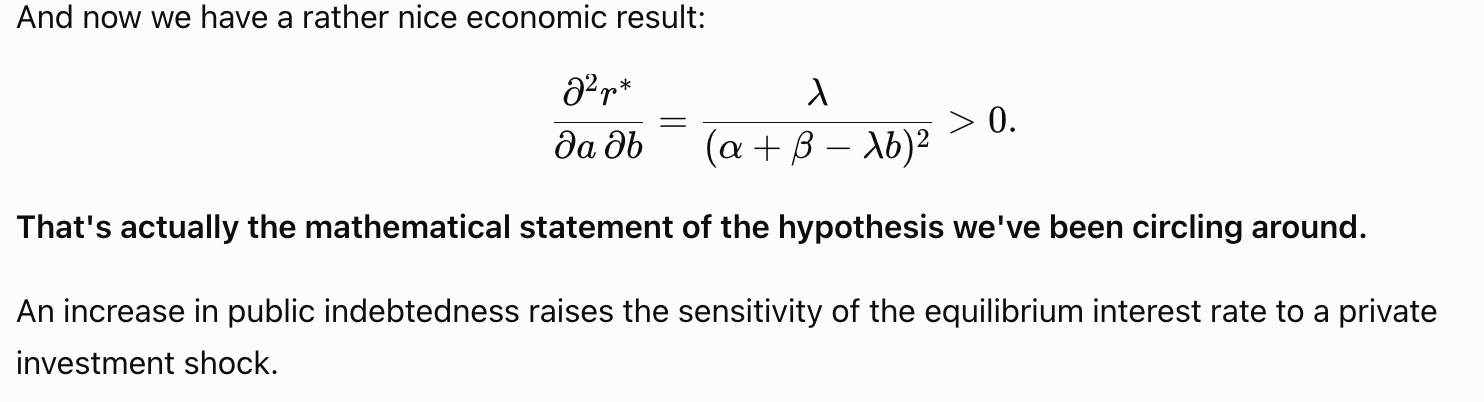
The higher the initial public debt burden, the larger the increase in equilibrium interest rates required to accommodate a given AI investment boom, provided higher market rates feed through into government debt-service costs and fiscal policy does not offset that increase through higher primary surpluses.
More generally, this implies that the sensitivity of sovereign yields to a private investment boom is itself be conditional on the fiscal regime. When public debt is low and fiscal policy adjusts to higher debt-service costs, an outward shift in private investment demand can largely be accommodated through higher saving, foreign capital and modestly higher real rates. But when the initial public debt stock is large, deficits are persistent and fiscal policy does not credibly adjust, the same increase in private capital demand raises sovereign borrowing costs against a much larger refinancing base. Higher rates then increase the government's own financing requirement, potentially amplifying the initial shock.
This leaves us I think with an interesting conclusion. Toby Nangle is right that AI isn’t currently “crowding out” sovereign debt in the way some of the more sensational Wall Street analysis has suggested, But if we’re now witnessing a glacial shift towards fiscal dominance, the it restores the more fundamental macroeconomic intuition behind the idea; namely that an exogenous private investment shock with an initial condition of high public debt and high deficit can indeed shift interest rates higher, raising the cost for the government to keep financing its presently high deficits.


Comments
Log in or sign up to join the conversation.