

Image Source: Unsplash
I've traded for 38 years. I've never seen a market this bulletproof.
Consumer confidence just hit four-month lows. Housing data shows sellers pulling listings at the fastest pace in months. Manufacturing contracted for the ninth consecutive month. None of it matters. The market rallies anyway.
This isn't bullish strength. This is systematic manipulation designed to close the year with the third consecutive double-digit return. Wall Street needs these numbers. Fund managers need year-end bonuses. Every broker needs to call clients in January and say "place your bets, give us another million."
The probability of breaking below 6,500 before December 31st is zero. Not low. Zero.
I'm calling this time in a bottle. The market is sealed inside a range. The ship trapped inside moves sideways. Nothing breaks the glass through year-end because breaking it destroys the illusion Wall Street spent all year building.
The Genesis COG Scanner tracks when these mechanical patterns shift from defense to distribution. When year-end positioning ends and real price discovery returns.
Here's why that floor holds and what breaks the bottle in January.
The 6,500 Line They Won't Cross
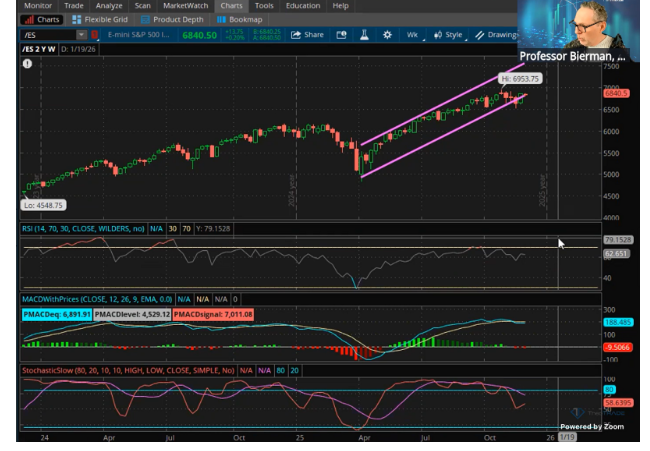
Look at the two-year weekly chart. We're sitting right on the edge of that lower channel boundary. That level held three weeks ago when Gianni and I were live together.
The machines stepped up exactly where they were programmed to defend. We bounced off 6,500 and recovered immediately. Not because fundamentals improved. Because automated systems detected the technical threshold and executed their buy programs.
That pattern repeats through December. Fund managers need decent fourth quarter numbers for their year-end reports. Every dip below 6,550 gets bought within minutes. Not by fundamental investors analyzing balance sheets. By predetermined programs executing at mathematical inflection points.
The potential downside between now and year-end is maybe 100 points maximum. The potential upside is another 100-200 points to new all-time highs. Risk-reward is neutral.
But that range reveals how this year-end game actually works.
How They're Maintaining The Illusion
Today shows the mechanism. Tech is up across the board. Semiconductors leading. Everything else bleeding.
They're selling healthcare. Selling financials. Selling consumer staples. Taking that capital and rotating into the seven stocks that actually move the index.
This is pure gaming. They're calculating what can we liquidate and buy to continually elevate this. The rotations are mechanical. The execution is programmed. The goal is maintaining index levels through December.
Consumer confidence hit four-month lows this morning. The market response? Rally another 100 points.
That's not humans analyzing economic data. That's machines ignoring inputs that don't match their parameters. The market is data agnostic right now. It just wants to own at a given time.
This daily rotation pattern reveals a deeper structural problem that makes the January break inevitable.
The Concentration That Creates The Trap
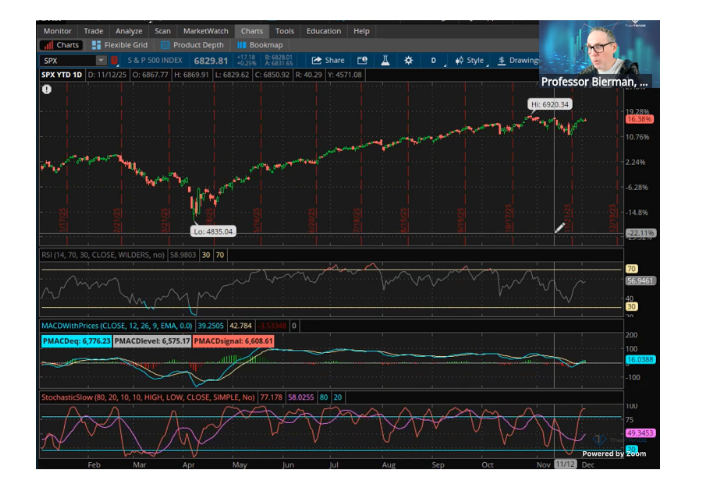
The S&P is up 16% year-to-date. One-third of that entire gain comes from just two stocks. Google and Nvidia account for 5.13% of the total 16% return.
Two stocks. 33% of the index gain.
When Wall Street needs to keep the market elevated, they don't need to buy 500 companies. They buy seven. When they really need to juice the index, they focus on two.
This concentration creates the illusion of broad market strength while masking weakness underneath. The average stock isn't participating in this rally. The index moves because capital pumps into the handful of names that actually matter for index calculations.
That concentration becomes the trap when the bottle breaks. When rotations reverse, when year-end positioning ends, when the mechanical buying shifts to mechanical distribution, you won't have time to exit cleanly.
The sealed bottle protects bulls through December. But the same mechanism that defends 6,500 now becomes the accelerant for declines in January.
Position For The Range, Prepare For The Break
Don't short this through December. I looked at my short positions this morning and closed my screens. The mechanical setup is too one-sided.
Every technical indicator screams overbought but the machines don't care about technical indicators when they're programmed to defend specific levels. Fighting that programming destroys accounts.
The longs in my portfolio are getting crushed today because they're defensive positions in sectors being rotated out of. The shorts work because I'm positioned against broken technical structures, not fighting mechanical momentum in defended ranges.
Stop buying dips in sectors outside tech. The market shifted from balanced trading to one-sided machine dominance. When automated systems lock into these patterns, they create self-reinforcing loops.
One algorithm buys because another bought. That triggers stop losses on short positions. Those forced covers trigger more buying programs. The cycle feeds itself through year-end.
Then the parameters change. The programs reset. The defense mechanisms that protected every dip suddenly flip to offense that attacks every rip.
When The Bottle Breaks
This is time in a bottle. The ship sealed inside glass laying on its side. The market trapped in a sideways pattern through December while Wall Street maintains the illusion needed to close the year with acceptable numbers.
But bottles don't stay sealed forever. The glass shatters in January when fund managers stop needing year-end performance numbers. When mechanical buying programs shift their parameters. When three consecutive years of double-digit returns can't overcome the mathematical gravity pulling valuations back toward reality.
The transition happens fast. One day the machines defend 6,500. The next week they attack 6,800. The concentration in two stocks that created stability through December becomes the accelerant for declines in January.
You won't get advance warning beyond recognizing when year-end positioning ends and the bottle finally breaks. The mechanical patterns that defended this market for months exhaust themselves. The sealed range shatters. Real two-sided price discovery returns.
Position for the range now. Prepare for the break in January. The ship stays trapped inside through December. But the glass won't hold forever.
More By This Author:
TLT Just Flashed A Print Everyone Missed
Yen Carry Trade Unwinding
The Dippers Just Made A Fatal Mistake



Comments
Log in or sign up to join the conversation.