
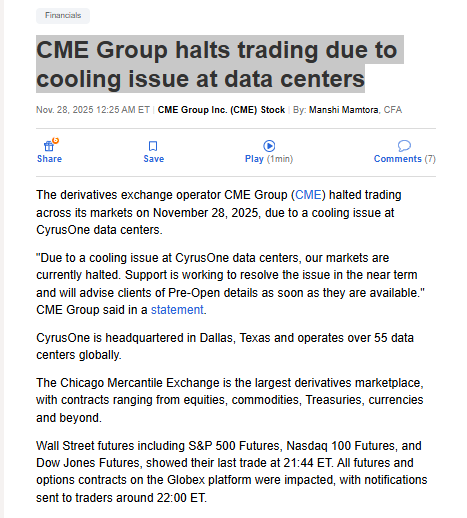
The Chicago Mercantile Exchange (CME) trading platforms were shut down for approximately 4 hours due to overheating after its cooling system at its Illinois data center failed. The outage began around 10:00 p.m. ET on November 27, halting about 90% of global derivatives volume on the Globex platform across futures and options for equities, bonds, commodities, and currency markets. The incident stemmed from a chiller plant failure that knocked multiple cooling units offline, leading to data center overheating. While no major market chaos ensued due to thin post-holiday trading volumes, the lack of price discovery froze markets and frustrated traders worldwide.
While this may appear to be a one-off technical problem, it should serve as a reminder of how vital data centers have become to the daily functioning of financial markets. With AI workloads growing by over 30% annually, the importance of data center cooling and the prevention of overheating is becoming increasingly critical. We may have gotten lucky with the timing of last week’s outage, but the next time we may not be so fortunate. Without the ability to trade derivatives and hedge price movements, sudden volatility due to another overheating incident could temporarily cripple the financial markets.
What To Watch Today
Earnings
(Click on image to enlarge)

Economy
(Click on image to enlarge)

Market Trading Update
Yesterday, we reviewed the technical backdrop following last week’s rally. One thing we didn’t mention was that the market triggered a Zweig Breadth Thrust as well, which is an encouraging sign given the recent concerns about market breadth in general.
A Zweig Breadth Thrust is a rare technical indicator used to identify the beginning of a potential new bull market. Initially developed by the renowned investor Martin Zweig, it measures the momentum of market breadth by observing the number of advancing stocks relative to the number of declining stocks. Specifically, the indicator tracks a 10-day moving average of the ratio of advancing issues to the total number of advancing and declining issues on the New York Stock Exchange (NYSE). When this ratio moves from below 0.40 to above 0.615 within a 10-day window, it triggers a Zweig Breadth Thrust signal.
Why does this matter?
Because it reflects a sudden, broad-based surge in buying across the market. Not just a handful of large-cap names. An actual breadth thrust suggests that institutional money is flowing into equities aggressively and across sectors. Historically, when this signal has triggered, it has often marked the early stage of significant market advances. The last breadth thrust came in early April of this year, and preceded the sharp rally that followed. The historical statistics are worth paying attention to.

Martin Zweig found that when this condition was met, the market was almost always higher 6 to 12 months later. While no indicator is perfect, the Zweig Breadth Thrust is rare and typically signals a significant shift in market sentiment. For investors, it’s a helpful tool for recognizing a change in trend. Rather than trying to guess bottoms, the Zweig Breadth Thrust offers an objective signal that risk appetite is returning. In a market dominated by macro noise and headline risk, tools like this help cut through the clutter.
If you’re managing long-term capital or timing exposure shifts, keeping an eye on this indicator can help you avoid being too cautious when conditions turn decisively bullish. It’s not about predicting tops or bottoms — it’s about catching the shift early.
High Beta And High Dividends
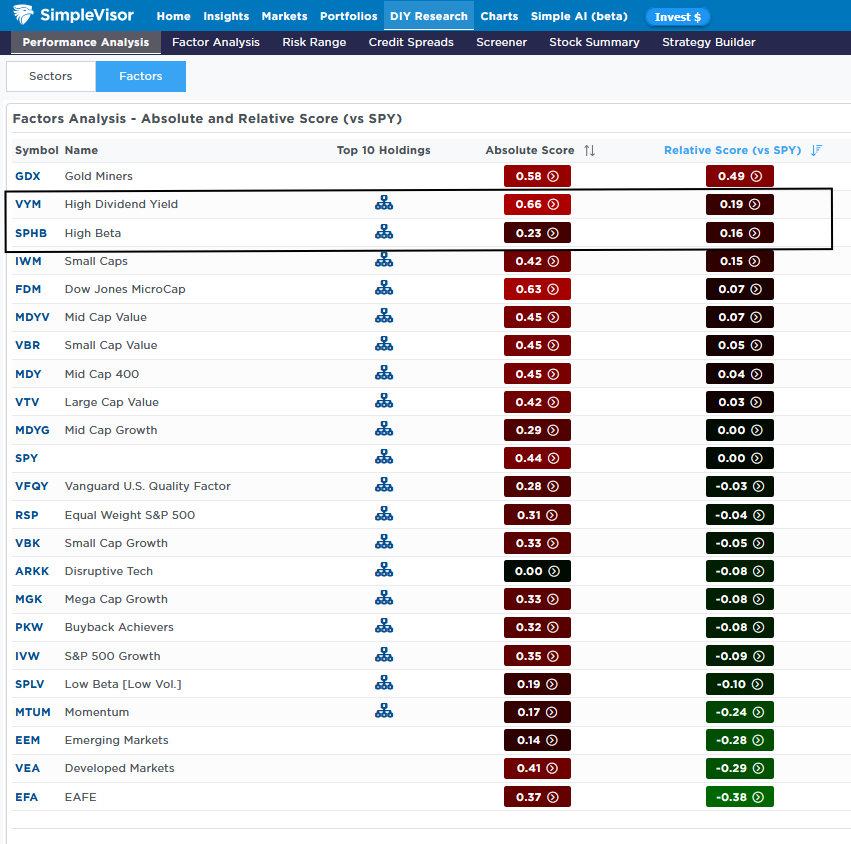
There has been a strong negative correlation between the excess returns (vs. the S&P 500) of high-beta stocks and high-dividend stocks. During risk-on upward trends, high beta has been among the factors with the highest relative and absolute scores. Conversely, during these bullish episodes, the more conservative high dividend stocks have been among the bigger laggards. Today, after a decent rally over the past few days and market weakness over the three preceding weeks, we find that both high beta and high dividend stocks are among the most overbought on a relative basis, as we highlight below.
However, the absolute analysis points to a key differentiator between the two. High dividend yield stocks are the most overbought on an absolute basis among all factors, while high beta is only slightly overbought. If the market can continue to rally, we suspect high beta stocks will outperform high dividend stocks. The second graphic shows the top ten stocks in the high beta ETF. Alternatively, if a subset of investors wants to chase the market more conservatively, high dividend stocks could keep up with high beta stocks if the market trends higher through December.

A Bear Market Is A Good Thing
One of my favorite writers for the WSJ is Spencer Jakab, who recently penned an article explaining why a bear market is not necessarily a bad thing. He starts with a quote from “The Godfather.”
““These things gotta happen every five years or so, ten years. Helps to get rid of the bad blood…been ten years since the last one.”
In today’s markets, mentioning the “B-word” will get you thrown into the “permabear” camp, and everyone immediately assumes you mean the end of the world: death, disaster, and destruction. Unfortunately, even the Federal Reserve and the Government also believe bear markets “are bad.” As such, they have gone to great lengths to avoid bear markets and recessions through massive interventions and zero-interest-rate policies.
Yes, bear markets are indeed destructive, as they reverse the “wealth effect.” People lose their jobs as economic demand declines, weak companies go out of business, and consumer sentiment declines. However, sometimes destruction is a “healthy” thing, and there are many examples we can look to, such as “wildfires.” Like a bear market, wildfires are a natural part of the environmental cycle. They are nature’s way of clearing out the dead litter on forest floors, allowing essential nutrients to return to the soil. As the soil enriches, it enables a new, healthy beginning for plants and animals. Fires also play a vital role in the reproduction of some plants.
However, just as the Federal Reserve has tried to stop bear markets, California has had similar negative results from trying to prevent wildfires, as noted by MIT:
“Decades of rushing to stamp out flames that naturally clear out small trees and undergrowth have had disastrous unintended consequences. This approach means that when fires do occur, there’s often far more fuel to burn, and it acts as a ladder, allowing the flames to climb into the crowns and takedown otherwise resistant mature trees.
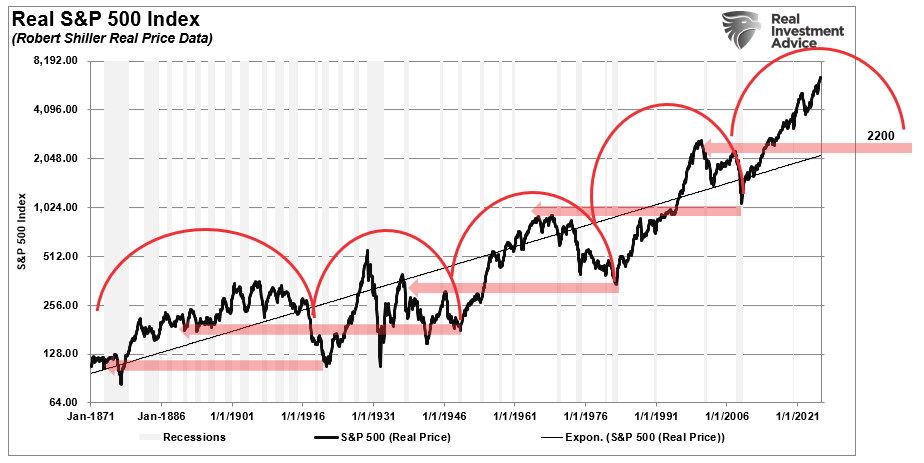
Yes, bear markets have terrible short-term impacts, but they also allow the system to reset for healthier growth in the future.
Tweet of the Day

More By This Author:
A Bear Market Is A Good ThingHSBC Casts Doubt On OpenAI’s Future
Year-End Rally Begins

Comments
Log in or sign up to join the conversation.