
Market Briefing For Monday, October 17, 2016
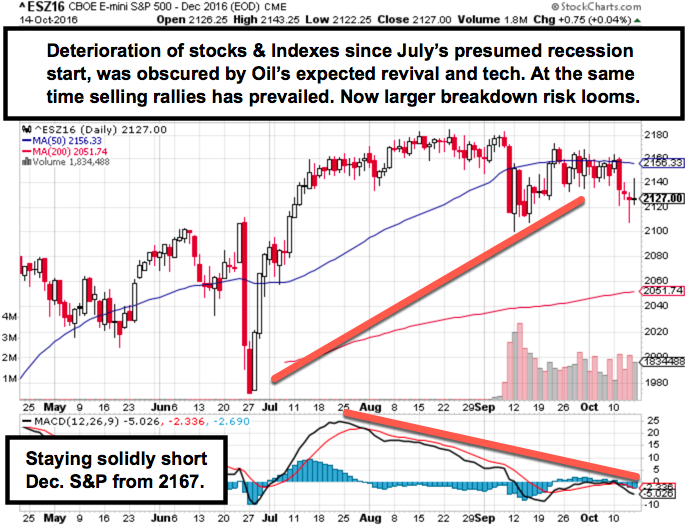
A 'Bank-led' rebound was assessed as unsustainable and actually a decent spot to layer in additional bearish exposure for speculators on a short-term basis. This early Friday move importantly was repulsed right at the lower 2140's (basis Dec. S&P); which is the lower portion of S&P resistance discussed in the prior session as being about as high as we thought a rebound might get from an ideal technical perspective.
Daily action views a 'nakedly bearish' technical picture, interspersed by rebounds that are entirely unsupported by facts or follow-through. It was the case with the Bank rally early Friday (which we suggested was a good spot for speculators to increase bearish positions if desired); as well as the post-Yellen 'express recovery' (?) convoluted speech too. A 'Bank-led' rebound was assessed as unsustainable and actually a decent spot to layer-in additional bearish exposure for speculators on a short-term basis. This early Friday move importantly was repulsed right at the lower 2140's (basis Dec. S&P); which is the lower portion of S&P resistance discussed in the prior session as being about as high as we thought a rebound might get from an ideal technical perspective.
The market subsequently descended with essentially the mid-afternoon rebound followed by a late session fade, in-line with my idea of volume shrinkage, amidst no real investment-grade buying interest. Nor should there be buying interest, as not only equity and bond valuations are still so high, but many stocks are breaking formation structures I basically called descending wedges (FANG stocks included excepting Apple so far), or at best lateral ranges which at a high level often precede drops.
Our idea was to stay show and layer-on more bearish exposure right at the height (perhaps five minutes before the morning peak) on 'earnings' being celebrated by banks stocks (an opportunity for trading sales not buys as pundits typically solicited). Then I ideally foresaw an absence of bids late in the day, which would set-up a possible purge early in the new week; before a rebound try from lower level to lower rebound high points, within context of this evolving (and 'flash crash' risky) pattern.
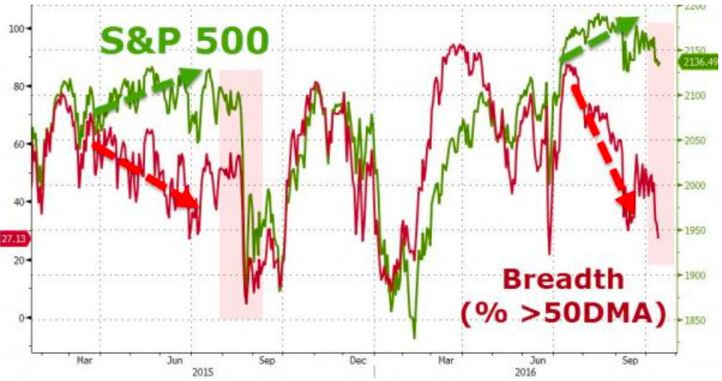
This coming week features a number of earnings reports which should not be generally encouraging. Remember that most companies (and of course the government) told us how things were going to be so improved in the 3rd and 4th Quarters. I have shown consistent evidence sadly to the contrary; and unfortunately my view, along with that of the Atlanta Fed incidentally, has prevailed. Since robust growth can't be delivered at this time, the markets should further punish those expecting just that.
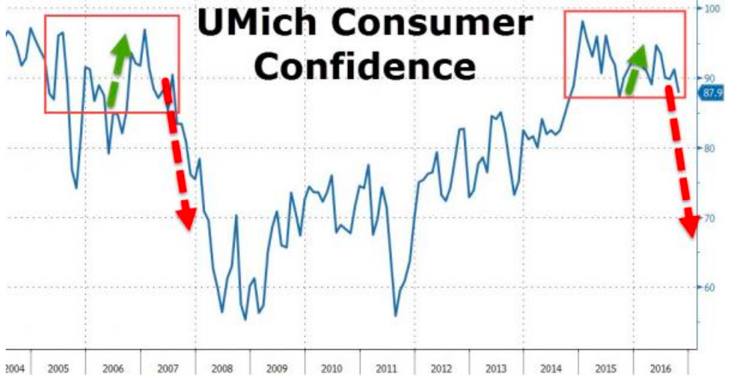
Because this is occurring at a technically vulnerable spot, not to mention the geopolitical challenges, we not only remain short and bearish for now; but also must suggest 'crash alert' conditions either continue or increase in terms of probability. Of course that doesn't mean a 'crash' (a rare event by definition) must occur. However it does mean that conditions are present. We project a drop well under 2100 Dec. S&P if this cracks in the manner we've outlined along with our evolving pattern analysis.
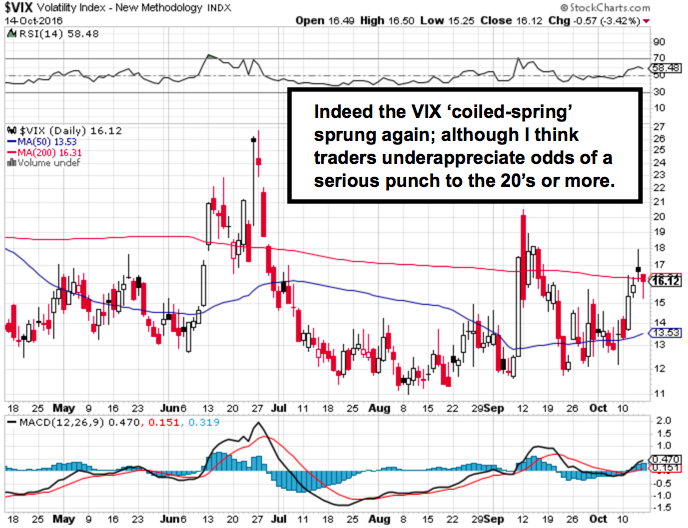
Of course, anything that rallies Oil (we are in the middle of a crisis of sorts) could sure deflect risk; but only briefly; as this is a heavy market dominated by overly-laden fund guys that have no choice but to sell into forthcoming weakness to build cash for what's likely to become at least a short-term exodus of funds (to wit more redemptions). As we were (though they'll never say so) probably right about the Russian/Saudi/Iranian 'quid-pro-quo', we do have the ongoing Switzerland 'Syrian ceasefire renewal' talks; so we'll have to see what if anything comes out of it.
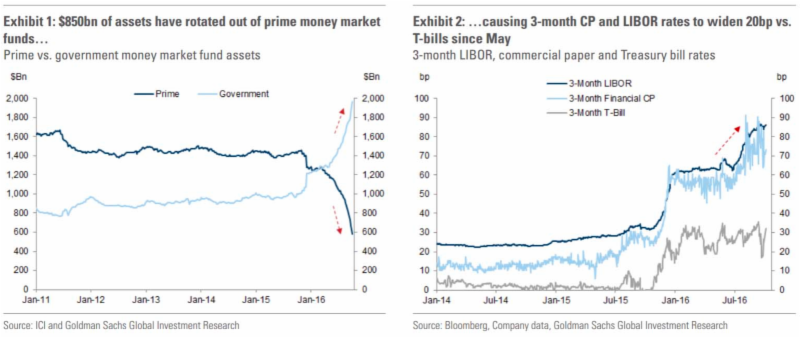
The market is less of a conundrum. It's clearly risky. Historically most crashes (only a handful exist) have occurred from 'oversold', not 'overbought', conditions. The S&P's rebound from almost identical lows this past week (as we'd seen in September), was a desperate 'Hail Mary' which afforded the increasing short spot Friday morning for traders, if they wanted to layer back on preceding profits from the sidelines, in terms of bearish exposure.
Now with the later decline, stochastics are not so overbought, and can easily move to hourly (not daily or weekly) oversold. Do not assume that just having an oversold hourly or daily reading means the market can't do an 'el foldo'. The trading desks will probably try to rebound from there; and fail; and that's where it gets interesting in the week ahead. Because if accompanied by more variable chatter from the Fed-heads (to the extent they have any market-moving credibility left), and a few mediocre earnings reports, you could handily reverse any such rebound.
Bottom line
Investors should remain defensive as traders can be nimble but overall continuing to hold short December S&P from 2167 (or some surrogate equivalent or any bearish approach that would capitalize from recent rallies on a breakdown). In the coming week we'll get another opinion from Vice Chair Stanley Fischer, and we already know he's in favor of tempering the monetary tantrum that our Fed has been in for some time. We hold short Dec. S&P from 2167.
Disclosure: None.




Recession is coming