

Ahead of this week’s FOMC meeting, the major equity indices last week all rallied toward their October highs, even as short-term indicators got further pushed into overbought territory. The meeting likely becomes a sell-the-news phenomenon.

The Russell 2000 finished up 0.8 percent last week to 2521, with Thursday’s high of 2540 just about matching the high from 27 October and barely underneath the all-time high of 2542 from 15 October (Chart 1).
This followed aggressive defense three weeks ago of 2300, which represents major horizontal support as well as breakout retest.
As things stand, a breakout is the path of least resistance. It remains to be seen if it sustains. This week’s FOMC meeting will probably hold the key.

All businesses are rate-sensitive, but small-cap businesses are probably a little bit more. They have a higher exposure to the domestic economy than, let us say, large-caps, which also have international exposure. A growing domestic economy hence helps small-caps, which also tend to be leveraged, so lower rates will help.
The Federal Reserve began an easing cycle in September last year. The fed funds rate, between 525 basis points and 550 basis points back then, currently sits between 375 basis points and 400 basis points. A two-day meeting – the last of the year – is scheduled to end this Wednesday, and a rate cut is widely expected.
Markets began aggressively pricing in a 25-basis-point reduction in response to John Williams’ November 21st speech saying “further adjustment in the near term” for interest rates was likely. He is the head of the New York Fed, which has a permanent seat in the FOMC (Federal Open Market Committee); Williams, therefore, has clout.
Fed funds futures are currently betting with 88-percent probabilities that there will be a cut this week, followed by two more next year (Chart 2). If the FOMC statement leans more dovish than expected for next year, then small-cap stocks can be expected to respond very positively, but this is an unlikely scenario as things stand.

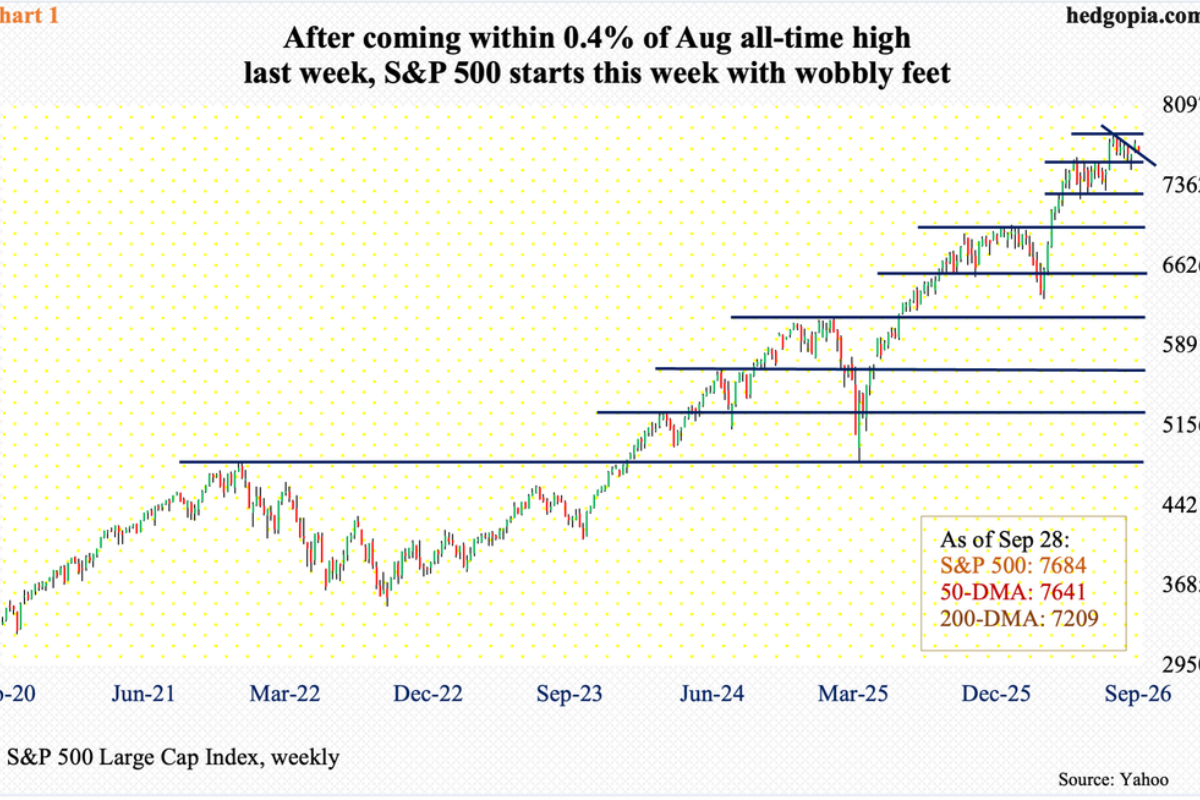
The S&P 500, too, rallied last week, but large-cap bulls’ enthusiasm was a little less subdued versus their small-cap cousins. The S&P 500 closed the week up 0.3 percent to 6870, and the index finished way off Friday’s intraday high of 6896. It is now 0.7 percent from the October 29th all-time high of 6920.
Three weeks ago, as the S&P 500 dropped 5.8 percent from the October 29th high, bulls stepped up in defense of horizontal support at 6550s (Chart 3), with an intraday low of 6522 on 21 November. Last week, the index kind of broke out of a falling trendline from that high. Bulls have a good shot this week at rallying toward that high.

This also applies to the Nasdaq 100, although the tech-heavy index remains 1.9 percent from the October 29th high of 26182.
The Nasdaq 100, too, came under decent pressure after the late-October high, dropping 8.9 percent through the November 21st low of 23854. Horizontal support at 23800s goes back to mid-August, and it held, hence the rally the last three weeks (Chart 4).
This obviously also means that this week’s rate cut is in the price, which raises the risk of a sell-the-news phenomenon unless the Fed surprises the market with a much more dovish message than expected.

Curiously, VIX is approaching crucial support, and a breakdown is highly unlikely right here and now.
In July last year, VIX put in a low of 10.62 and reversed higher. As a matter of fact, the volatility index had straddled 12 since mid-May. A rising trendline from these lows extends to 15 (Chart 5). Last week, it gave back 0.94 points to 15.41. A breakdown here can easily open the door toward 13-14, but it is highly unlikely things will evolve this way at this juncture.

Concurrently, a ratio of VIX to VXV further pushed into oversold territory last week, closing at 0.80, down from 0.83 in the previous week (Chart 6).
VIX measures market’s expectation of 30-day volatility on the S&P 500. VXV does the same, except it goes out to three months. During a risk-on investing environment, as has been the case in recent weeks, demand for VIX-derived securities is lower than VXV. The opposite is true when sentiment turns to risk-off, and this might be the case post-FOMC if the message coming out of it is not more dovish than currently priced in.
More By This Author:
Surging Rate-Cut Hopes Combined With Defense Of Support Led To Last Week’s Rally
Bulls Hope To Rebuild Momentum On Fri’s Intraday Reversal
Bulls Down But Not Out, Wounded Bears At This Stage Probably Have Slight Edge
Comments
Log in or sign up to join the conversation.