


Image Source: Unsplash
Digital-first financial services leader SoFi Technologies (SOFI) has captured investor attention with its rapid growth and innovative approach to banking. Founded 14 years ago as a student loan refinancing platform, SoFi has evolved into a comprehensive fintech platform offering personal loans, mortgages, investing, credit cards, and more – all through a seamless mobile app. Unlike traditional banks burdened by physical branches and legacy systems, SoFi operates with high efficiency, boasting net interest margins around 6%, nearly double the industry average.
In the third quarter, SoFi added a record 905,000 members, bringing its total to 12.6 million. Revenue surged 38% year-over-year, driven by strong lending activity and diversification into fee-based services. The company achieved its first full-year profitability recently and continues to post consistent gains.
Among its key growth drivers are the Galileo technology platform, which powers backend services for partners like Southwest Airlines (LUV) and Wyndham Hotels (WH), generating recurring revenue. SoFi also emphasizes cross-selling, with products per member rising steadily.
A Vision for Long-Term Growth
At a recent investor conference, SoFi CEO Anthony Noto boldly stated the company's goal: "Our ambition is to become a trillion-dollar company." Noto, a former Goldman Sachs executive and Twitter COO, outlined a layered strategy focused on scaling the core lending business through third-party originations, expanding fee-based platforms, and innovating in areas like digital assets and blockchain remittances.
He highlighted tailwinds such as potential privatization of federal student loans and the Galileo platform's potential to become the "AWS of fintech," referencing Amazon's (AMZN) cloud services platform, powering transactions for thousands of partners
.
Noto's vision centers on digital disruption, where SoFi's low-cost model and tech-savvy user base (primarily millennials and Gen Z) enable faster scaling without the overhead of traditional banks. The company targets 50 million members and 150 million products by 2030 – a sevenfold increase in members from current levels. With unaided brand awareness still low, there's significant room for organic growth.
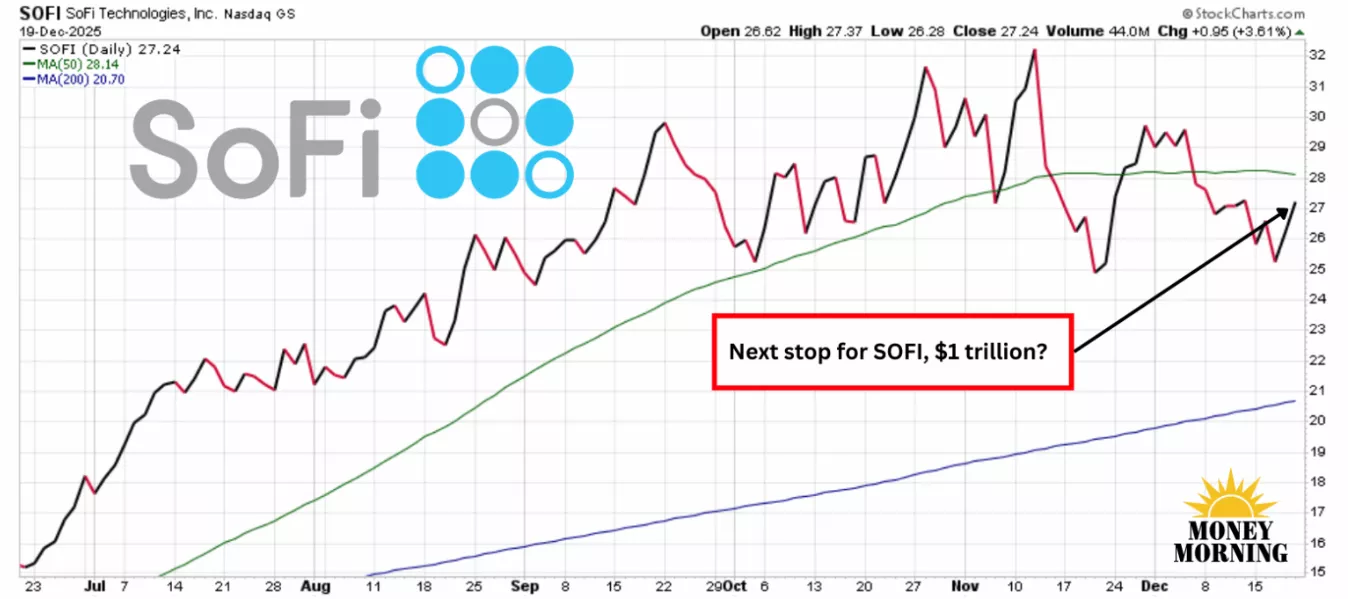
SoFi's current market cap hovers around $34 billion, meaning it will require roughly a 30-fold increase in valuation to reach $1 trillion. While ambitious, this aligns with SoFi's trajectory of 35% annual member growth and strong profitability momentum.
Bottom Line
Sure, one day – perhaps decades from now – SoFi could theoretically become a trillion-dollar company if it executes flawlessly on its digital-first strategy and captures meaningful share in the vast U.S. financial services market.
Still, SOFI stock has been fairly range-bound for the past few months following a meteoric rise earlier this year. It's also given to fits of volatility. Shares trading at around $27 each today are up 77% in 2025 and have more than tripled from their 52-week low.
However, fanciful goals are not why investors should consider SoFi Technologies today. The stock's appeal lies in more concrete factors: sustained profitability, impressive member and revenue growth, high-margin fee-based diversification, and a scalable platform business that reduces reliance on interest rates.
These fundamentals provide a compelling case for long-term value, far more tangible than speculative trillion-dollar aspirations. Investors are better served focusing on SoFi's execution and near-to-medium-term progress rather than distant moonshots.
More By This Author:
President Trump Signs Cannabis Executive Order: Canopy Growth Collapses
So, Trump Media Is An Energy Stock Now? That Doesn't Mean You Should Buy
Disney Has Been A Poor Investment In 2025. Will Next Year Be Better?



Comments
Log in or sign up to join the conversation.