


Image Source: Pexels
Chinese forces are conducting a massive military exercise in the areas surrounding Taiwan — a major economic power and supplier of semiconductor chips essential to the world (and US) economy (true in 2022, true today).
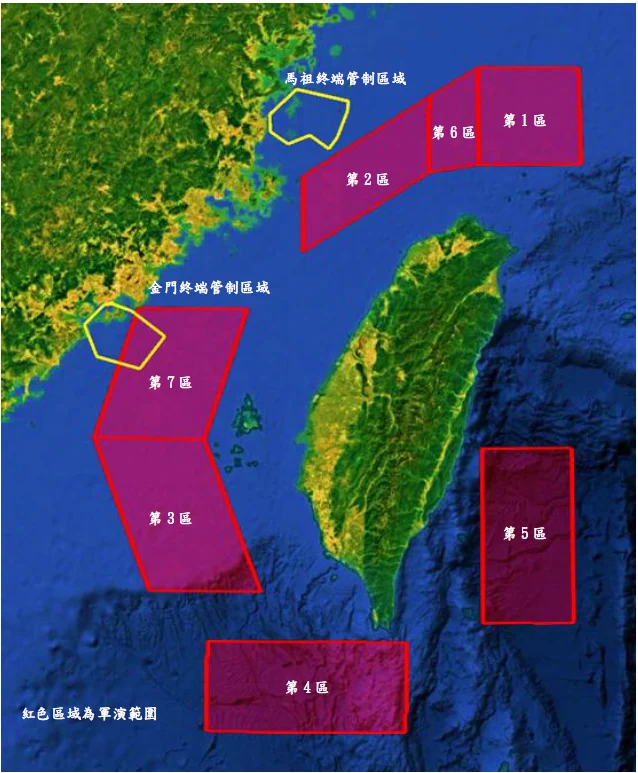
Source: PLA via US Naval Institute, accessed 12/29/2025.
From the US Naval Institute:
The drills will focus on sea-air combat readiness patrol, joint seizure of comprehensive superiority, blockade on key ports and areas, as well as deterrence outside the island chain, In a statement posted on the China Military Bugle account on X, the PLA stated that that the drills are part of a series of Beijing’s responses to the US arms sales to Taiwan as well as a warning to the Lai Ching-te government. Beijing had earlier on Friday sanctioned 20 U.S. defense companies and 10 defense company heads for the arms sale.
…
…the Easter[n] Theater Command announced that on Tuesday, it would conduct activities in five designated areas around Taiwan, which included live firing activities, from 8 a.m. to 6 p.m..
“For the sake of safety, any irrelevant vessel or aircraft is advised not to enter into the afore-mentioned waters and airspace.”, read the announcement.
…
This is not the first time this year that the Chinese military has conducted live firing activities at short notice resulting in disruption to civil aviation, a PLAN task group in February disrupted flights between Australia and New Zealand over the Tasman Sea when it announced at the last minute that live firing drills will be conducted.
See also NYT today.
And where’s the US Navy? We know that there’s a large buildup in the Caribbean, although the full extent is not completely disclosed. From public sources, we have the following picture of (disclosed) naval deployments.
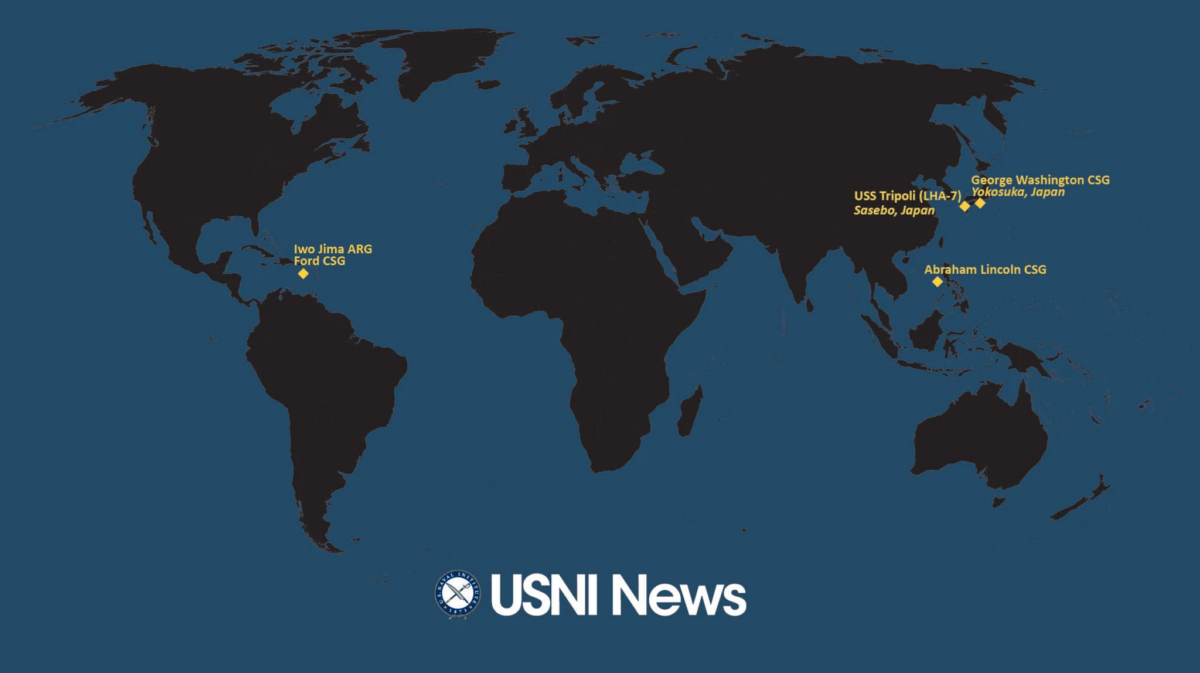
Source: USNI, accessed 12/29/2025.
In other words, we have (at least) one Carrier Strike Group and one Amphibious Ready Group in the Caribbean, blowing up various small craft.
According to the DoD’s annual report to Congress, operations like this can portend several different things (pp 44-45).
China’s Military Options to Force Unification with Taiwan
As of 2024, China’s leaders probably view the PLA’s capabilities for a Taiwan campaign as improving but remain unsure of the PLA’s readiness to successfully seize Taiwan while countering U.S. involvement. Beijing is continuing to refine plans for several military options to unify Taiwan by force. During the past year, the PLA conducted operations that exercised essential components of these options, including exercises that focused on blockading key ports, striking sea and land targets, and countering potential U.S. military involvement in a conflict. Outlined below are four military options that Beijing is likely considering, should China’s senior leaders determine that military action is necessary.
- Coercion Short of War. Beijing probably is considering options to try to induce unification that combine escalating military pressure with other elements of national power to force Taipei’s capitulation. China could employ a range of disruptive, punitive, and lethal military actions in a limited campaign against Taiwan, coordinated with economic, informational, and diplomatic pressure. Such a campaign could involve cyberattacks, electronic attacks, or conventional strikes against Taiwan’s political, military, and communications infrastructure to instill fear and degrade public confidence in Taiwan’s ability to defend itself. The objective of this campaign would be to pressure Taiwan’s government into negotiating unification on Beijing’s terms. Beijing probably views this approach as less costly than a conventional military campaign to seize the island. However, success of such a campaign would be highly dependent on Taiwan’s resilience and will to resist China’s coercion as well as external support from the United States and others. Such a strategy also lacks the decisiveness of a direct military campaign and thus poses serious downsides for Beijing.
- Joint Firepower Strike Campaign. China could use precision missile and air strikes against key government and military targets, including air bases, radar sites, missiles, space assets, and communications facilities to degrade Taiwan’s defenses, decapitate its military and political leadership, or undermine the public’s resolve to resist. In a joint firepower strike campaign, the PLA would likely employ organic ISR capabilities to provide battle damage assessment supporting long-range fires but probably will struggle with performing this action in a time-sensitive manner to enable re-attack recommendations due to the complex intra-service coordination required for such actions. Although the PLA has exercised joint operations, a joint firepower strike campaign requires close coordination between PLA services and operations groups, which the PLA probably will face challenges in effective coordination for multiservice strikes.
- Joint Blockade Campaign. China could employ blockades of maritime and air traffic, cutting-off vital imports to compel Taiwan’s capitulation. The PLA probably would posture air and naval forces to conduct weeks or months of blockade operations while conducting missile strikes and possible seizures of Taiwan’s offshore islands in an attempt to compel Taiwan to negotiate or surrender. China probably would conduct concurrent electronic warfare, network attacks, and information operations to further isolate and degrade the island and to control the international narrative of the conflict.
- Joint Island Landing Campaign (JILC). An amphibious invasion of Taiwan would involve a highly complex three-dimensional assault on Taiwan, involving multiple carefully coordinated operations. The objectives would be to break through Taiwan’s shore defenses and establish a beachhead that allowed the PLA to build up enough combat power to seize key targets or territory to force unification. A large-scale amphibious invasion would be one of the most complicated and difficult military operations for the PLA, requiring it to achieve and maintain air and maritime superiority and rapidly buildup and sustain its forces. Such an approach would carry both enormous risks for China as well as providing the most decisive potential option for forcing unification on Taiwan. While Beijing might prefer less dramatic options, it is preparing for a JILC and could determine that it is its only prudent option for compelling unification. We lack information about whether Beijing has determined the viability of other unification options, and the decisiveness of a JILC will probably make it an increasingly more appealing option as the decision space for other options is constrained.
Across all courses of action, China probably will face some challenges employing cyber capabilities, due to the PLA’s lack of combat experience and integration of cyber into joint combat operations. The PLA’s cyber and other non-kinetic warfare forces probably are still contending with organizational challenges following the dissolution of the SSF in 2024 and the establishment of the Information Support Force, Cyberspace Force, and Aerospace Force as PLA support arms (alongside the Joint Logistics Support Force).
Here’s the DoD’s assessment of the the PRC’s Eastern Theater, with the most forces dedicated to Taiwan.
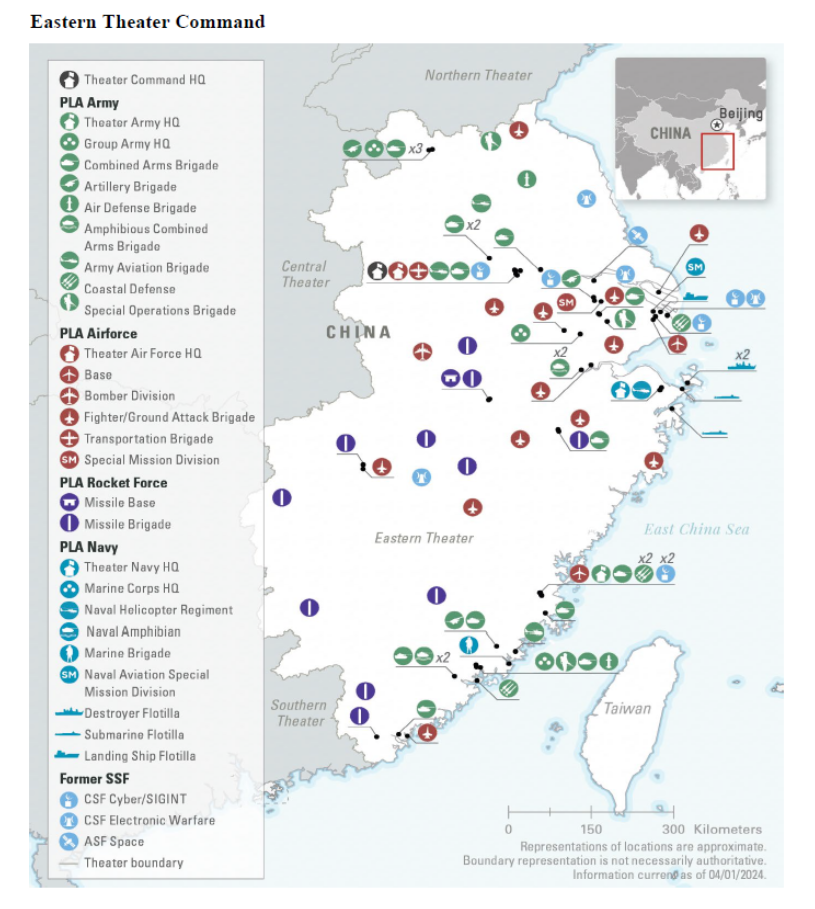
Source:DoD, Annual Report to Congress: Military and Security Developments involving the People’s Republic of China, 2025 (December 23, 2025).
As many have noted, outright invasion at this time is unlikely; however blockade would pose a challenge to the West, difficult to coordinate a response exactly because it’s not an outright military strike. Still, a blockade would inflict a substantial shock to the world economy.
A more in-depth discussion of the centrality of the Taiwan to the global supply chain is here (CSIS).
More By This Author:
Corporate Profit Peaks and Business Cycle Peaks2025Q3 4.3% q/q AR Growth In Context
A Holiday Memo: NBER BCDC And Alternative Indicators



Comments
Log in or sign up to join the conversation.