


Image source: Wikipedia
Starting in the aftermath of the 2008 financial crisis, a profound change to the Fed’s liquidity-providing role in the capital markets was underway. We can sum up the Fed regime change with a popular quip: The Fed has shifted from lender of last resort to the lender of only resort!
In our articles QE Is Coming and its follow-up, How The Fed Deals Liquidity, we discuss why the Fed has become the primary provider of liquidity since 2008 and the tools it uses to maintain ample liquidity in the markets. While that Fed regime change has been incredibly impactful on the financial markets, there is a growing possibility of another meaningful regime change that could prove equally impactful.
This article, like the two linked above, is dry. Still, investors today must understand that monetary policy has become a primary driver of liquidity, which in turn significantly influences asset prices. Without a clear understanding of what the Fed is doing and how it functions, your investment ideas, no matter how solid, can be flawed.
Groupthink Has Been The Fed Norm
The Fed’s monetary policy-setting group, the Federal Open Market Committee (FOMC), meets every six weeks to discuss the economy, financial markets, liquidity, and a host of other factors that help the Fed set monetary policy to meet its inflation and employment objectives.
After two days of data analysis, conversation, and debate, the FOMC’s voting members vote on whether to adjust monetary policy. Most often, the policy changes involve the Fed Funds Rate and or the monthly pace of QE or QT.
The committee is comprised as follows:
- Seven members of the Board of Governors- including the Chairman
- Four rotating regional Fed Presidents
- The President of the New York Fed
While there are debates and many divergent views expressed at the FOMC meetings, the published results always give the impression of agreement. This is evident in the meeting statement, which lists the members who voted for the monetary policy actions and those who dissented. The example below from the October 29, 2025, meeting shows that two of the twelve members dissented or voted against the prescribed policy actions.
Voting for the monetary policy action were Jerome H. Powell, Chair; John C. Williams, Vice Chair; Michael S. Barr; Michelle W. Bowman; Susan M. Collins; Lisa D. Cook; Austan D. Goolsbee; Philip N. Jefferson; Alberto G. Musalem; and Christopher J. Waller. Voting against this action were Stephen I. Miran, who preferred to lower the target range for the federal funds rate by 1/2 percentage point at this meeting, and Jeffrey R. Schmid, who preferred no change to the target range for the federal funds rate at this meeting.
Historical Dissents
As we shared above, there were two dissenting votes at the last meeting. On average, since 1936, 5% of members have cast dissenting votes per meeting. Since 2000, the most dissenting votes at a single meeting were three. On average, over the last 25 years, the odds are 50/50 that one member will dissent at each meeting.
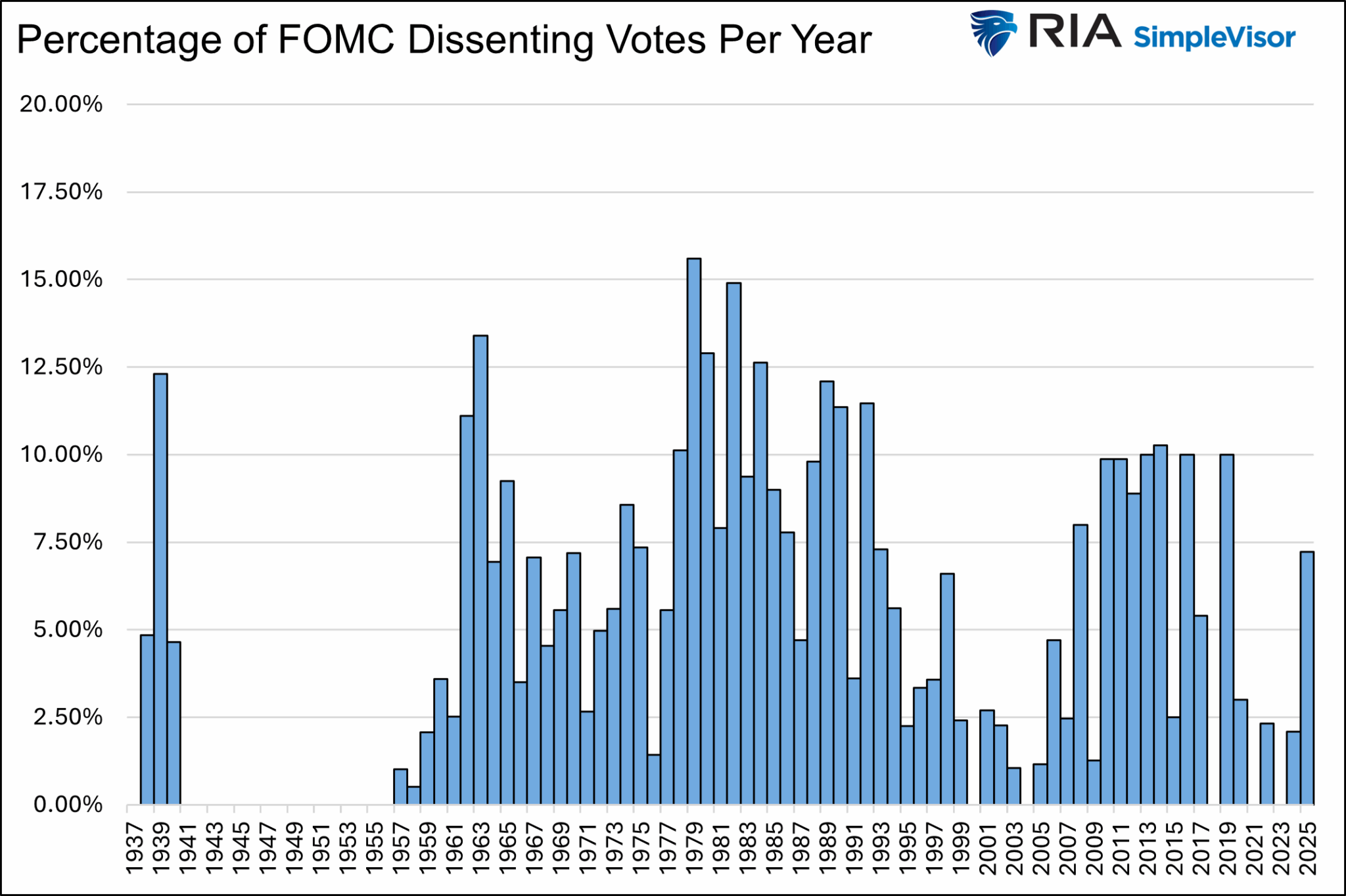
The bottom line is that dissents occur with some regularity, but the votes for or against policy action are always a strong consensus. More simply, the Fed has been in a groupthink regime fro the last 100 years!
Consensus At The Fed
In the FOMC minutes, released three weeks after the meeting, we gain a better understanding of the debates that took place. It’s clear from these minutes that there are many divergent opinions. This should not be surprising, as the members come from different regions across the country and have diverse economic views. This has been the case since 1936, when the Fed began sharing the minutes.
While there may be many views on the economy and the right course for monetary policy, the graph above clearly shows that almost all Fed members coalesce around a single policy action.
Quite often, the Fed Chair steers the FOMC toward presenting a consensus view.
Politics At The Fed
We argue that, despite its supposed independence from the executive branch, the Fed has always been political to some degree. Furthermore, we must assume that every Presidential nomination of a Fed member is primarily based on the nominee’s alignment with the President’s views.
Thus, it’s not shocking that Stephen Miran, Trump’s latest appointee, is arguing for aggressive rate cuts. Furthermore, Trump’s possible appointee to replace Lisa Cook and Chairman Powell when his term ends in May will most likely also hold dovish views.
While there is an infusion of dovish voters to join existing dovish members, there also remains a camp of hawkish voters. It appears that most of the dovish-hawkish standoff is a function of whether members are more concerned about keeping a lid on inflation (hawkish) or about preventing a worsening of the labor market (dovish).
However, we offer that the debate may be becoming political as well. Is the Fed morphing into entities like the Supreme Court or Congress that are politically motivated?
In other words, are some dovish members not as concerned about the labor markets as they appear, and instead pushing for a more accommodative policy to help Trump achieve his economic goals? Conversely, might some hold hawkish opinions, not because they fear inflation, but because they disagree with the President’s policies?
Is Consensus Dead?
If, as we postulate, the Fed is becoming more politically divided, might the Fed Chairman be losing the ability to present a group consensus? Interestingly, the odds of a rate cut at the next Fed meeting have been floating between 25% and 85%. Those odds have been shifting as various Fed members have weighed in on whether they may cut rates at the next meeting. Currently, there is a split between those wanting to cut rates and those dissenting from another cut in December. A few members also appear undecided. If the Chairman is unable to get the members to reach a consensus, it’s quite possible there could be four, five, or even six dissenters at the next meeting.
Our Take On Dissents
Historically, as we noted earlier, the Chairman gets the FOMC to form a strong publicly facing consensus. Doing so gives investors, consumers, and business leaders a false sense of confidence that the Fed is fully aware of what is happening in the economy and that it has the right policy prescription.
We welcome dissent at the Fed. We welcome change. Groupthink, as managed by one person, the Chair, has led to significant policy errors. While the Fed will still make errors in the future, investors, business leaders, and consumers will at least be better versed in other policy opinions. For instance, a vote with multiple dissenting votes signals that the Fed is not confident in its views or policies. While that may make some uneasy, it’s better to recognize their stance than to believe something that isn’t true. Conversely, in an era of multiple dissenting votes, a complete consensus should lead investors to think the Fed has strong confidence in its views and policies.
Summary
As we said earlier, we welcome a regime change at the Fed. We want 12 autonomous FOMC members deliberating and voting on Fed policy. We don’t like the opinion of one person, the Chairman, dictating the views and policies of the Fed.
A new Fed regime consisting of 12 voting Fed members, voicing their own opinions and casting votes on what they think, not what the Chairman wants, would be a welcome change, albeit it might introduce short-term volatility in the financial markets.
More By This Author:
TPUs Or GPUs: Is Nvidia’s Moat Eroding?How The Fed Deals Liquidity: The Monetary Toolbox
Is Strategy Dragging Bitcoin Down?


Comments
Log in or sign up to join the conversation.