


Image Source: Pixabay
We talked about bearish USdollar Index already back on March 04, when we mentioned and highlighted that much more weakness is coming due to a recovery on 10Y US Notes.
USDollar is weak, and it may stay so for a while as USDollar Index is in an impulsive decline, so it could easily stay in the downtrend, especially if we take a look at the ratio charts of USDollar Index against 10Y US Notes (DXY/ZN) and SP500 (DXY/SPX).
DXY/ZN (USDollar Index against 10Y US Notes) ratio chart shows an ongoing five-wave bearish impulse with room for more weakness within subwave “v” of 3 after current subwave “iv” pullback, which can keep USDollar under bearish pressure.
(Click on image to enlarge)
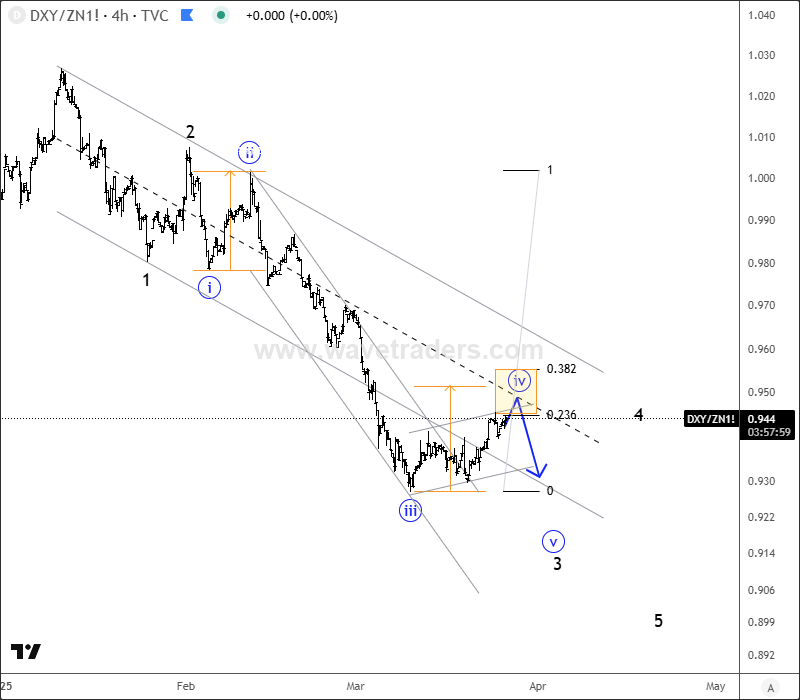
DXY/ZN 4H Ratio Chart
On the other hand, DXY/SPX (USDollar Index against SP500) ratio chart shows a sideways consolidation due to weak stocks in the last couple of weeks, but it can be forming a bearish ABCDE triangle pattern, where we are observing a three-wave abc decline within wave D. And, while subwave “c” of D has space for more weakness, it means that USdollar can stay down even against weak stocks.
(Click on image to enlarge)
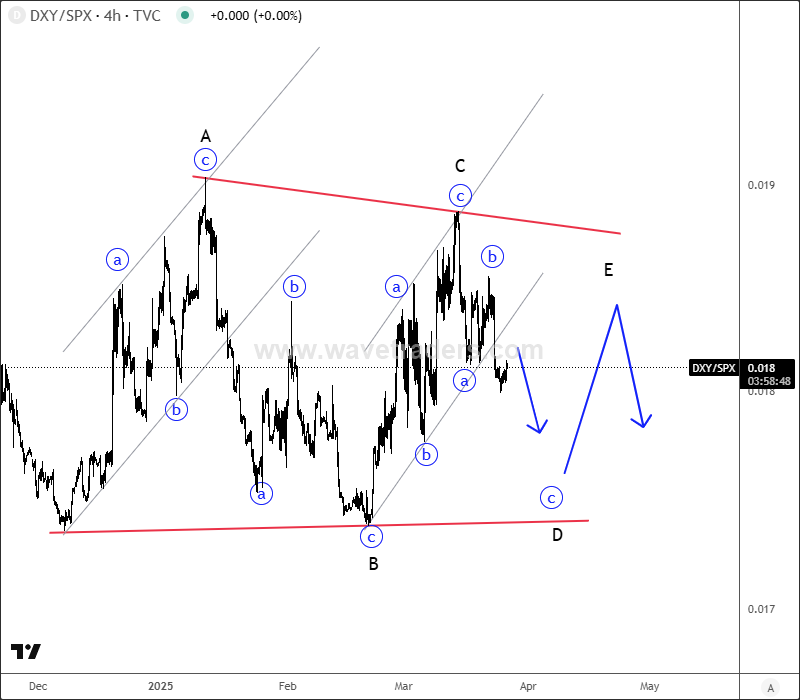
DXY/SPX 4H Ratio Chart
All that being said, seems like USdollar will stay one of the weakest currencies, and USdollar Index should see a bearish continuation after current recovery.
For a detailed view and more analysis like this, you may want to watch below our latest recording of a live webinar streamed on March 25 2025:
More By This Author:
Elliott Wave: Corrective Rise On Dollar At Resistance, Crypto Back To Life?
Bitcoin Still Shows A Bullish Technical Picture
AUD/NZD Finally Turning Bearish?



Comments
Log in or sign up to join the conversation.