


Image Source: Unsplash
The EUR/USD turned lower after starting the session on the front-foot. The US dollar further advanced against the slumping yen and a few other currencies too, ahead of upcoming data releases, while in the eurozone core inflation came in softer ahead of the ECB’s policy decision on Thursday. The EUR/USD remains under modest pressure for now, although further forecast-beating US data is needed to convince traders that the US dollar recovery has some staying power this time around.
Don’t expect any fireworks from the ECB
This morning’s slight drop in the EUR USD exchange rate was in part driven by the fact Eurozone inflation came in weaker than expected at 2.2% y/y on the core front compared to an unchanged 2.3% y/y rate expected. The drop in headline CPI to 1.7% means inflation is now below the ECB’s target and this further increases the chance of the next move to be a cut than a hike, although don’t expect anything at Thursday’s meeting. The main focus on Thursday will be the ECB press conference rather than the rate statement itself. Let’s see if Christine Lagarde will say anything meaningful then. It is likely that the ECB President may show some verbal discomfort about the recent strength of the euro, although with the single currency softening in the past few days, that effectively does some of the work for them.
Dollar remains main driver for EUR/USD
Anyway, much of the pair’s volatility has been – and remains – driven by the US dollar. The US dollar index has firmed in recent times on the back of surprisingly strong data and Trump’s nomination of a Fed chairman who is not exactly dovish. To a lesser degree, the dollar has also been supported by the relatively sharp rise we saw in oil prices in January, which wasn’t particularly good news for energy-importing economic regions like the eurozone. With the US economy proving to be a little more resilient than markets were previously expecting, investors have marginally reduced their expectations on US interest rate cuts.
At this stage, unless we get a clear negative catalyst for the US economy, it’s hard to build a convincing bearish case. The only real complication is the partial US government shutdown, which has now ended, is going to delay the release of Friday’s non-farm payrolls. This removes some near-term event risk from the calendar, but this may, arguably, help the dollar on the margin, as the market would need weak data to justify pushing the USD materially lower. Not having that data at all keeps the current USD-positive narrative intact.
ADP employment and ISM PMI coming up next
For today, we will have ADP employment and ISM services PMI, which should garner a lot of attention in the absence of NFP. ADP is seen at +46K vs. +41K last month. ISM has been climbing steadily in the last three months or so, rising to 54.4 by December from around 50.0 in Q3 of last year. However, it is expected to have moderated to 53.4 in January.
The only major data we have had so far this week was released Monday – and it was quite good. Specifically, it was the ISM manufacturing index, which jumped back into expansion territory at 52.6. This was the first expansionary reading in a year and the strongest since August 2022. That is a signal that US manufacturing momentum is improving, with production, new orders and order backlogs all pointing to solid forward activity.
EUR/USD technical analysis
(Click on image to enlarge)
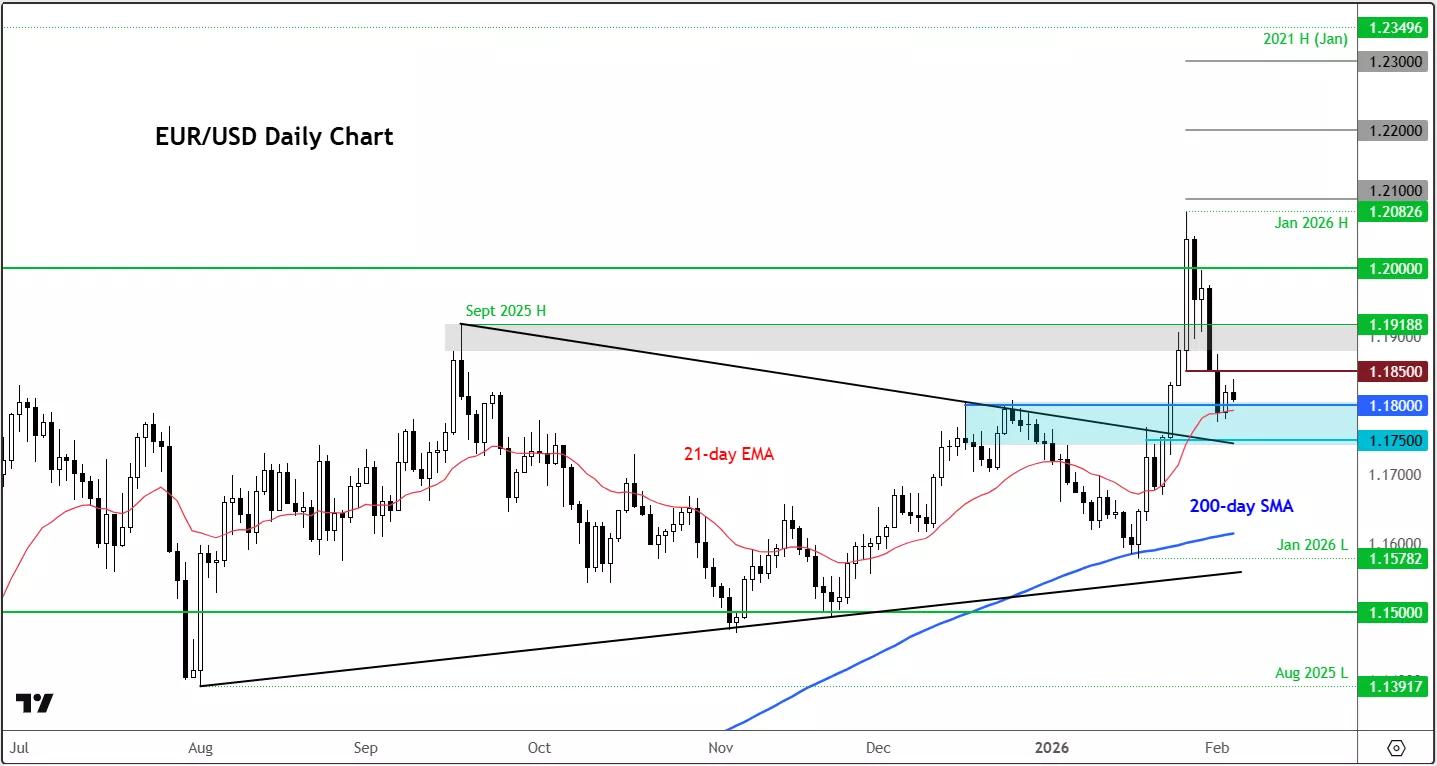
The EUR/USD has been falling in recent days, losing its prior bullish momentum. It has also broken a couple of levels that the bulls would argue should have held as support, including the September 2025 high of 1.1919. This week, the EUR/USD has been testing another major inflection point between 1.1750 to 1.1800 area. Here, the top side of the broken resistance trend meets the 21-day exponential average and the prior resistance region. So far, the bulls have managed to hold their ground here. They will need to continue doing that in the coming days to prevent a complete reversal. While the pair holds its own above here, it is important not to turn aggressively bearish, given that the underlying trend has been bullish since last January.
Indeed, any signs of a bullish reversal could see the pair bounce back quickly. Initial resistance is at 1.1850, then around the 1.1900/20 area. Above that would expose 1.20 handle for another test.
If EUR/USD starts slipping further lower instead, then the technical narrative would start to turn bearish if 1.1750 breaks. Below that, stops resting below the January low of 1.1578 could be in trouble, potentially leading to an eventual drop to 1.1500 area.
More By This Author:
Gold Bounces Off Lows After Extending Plunge
Nasdaq: US Markets Hold Near Record Highs In Mixed Tech Results
USD/JPY Remains Under Pressure From Intervention



Comments
Log in or sign up to join the conversation.