


Image Source: Pixabay
As Western economies begin to mirror the volatility and inflation risks once associated with so-called “banana republics,” Laurent Lequeu—a respected macro strategist and author of the popular Macro Butler column on Substack—has a message that’s both clear and urgent. With confidence in traditional assets and public institutions fading, Lequeu argues it’s time for investors to rethink what safety really means. Here’s what he shared in our recent interview on FS Insider:
The Great Exodus: From Dollars to Hard Assets
“Since 2022 and the Russia-Ukraine war, owning US dollar assets could be dangerous for those who end up on the US government's blacklist,” says Lequeu. In his view, the shift out of US Treasuries and dollars into hard assets is not just a passing fad—it’s accelerating. The fear of sanctions and exclusion from the dollar system has prompted countries, especially those outside the West, to rethink how they store wealth and settle trade.
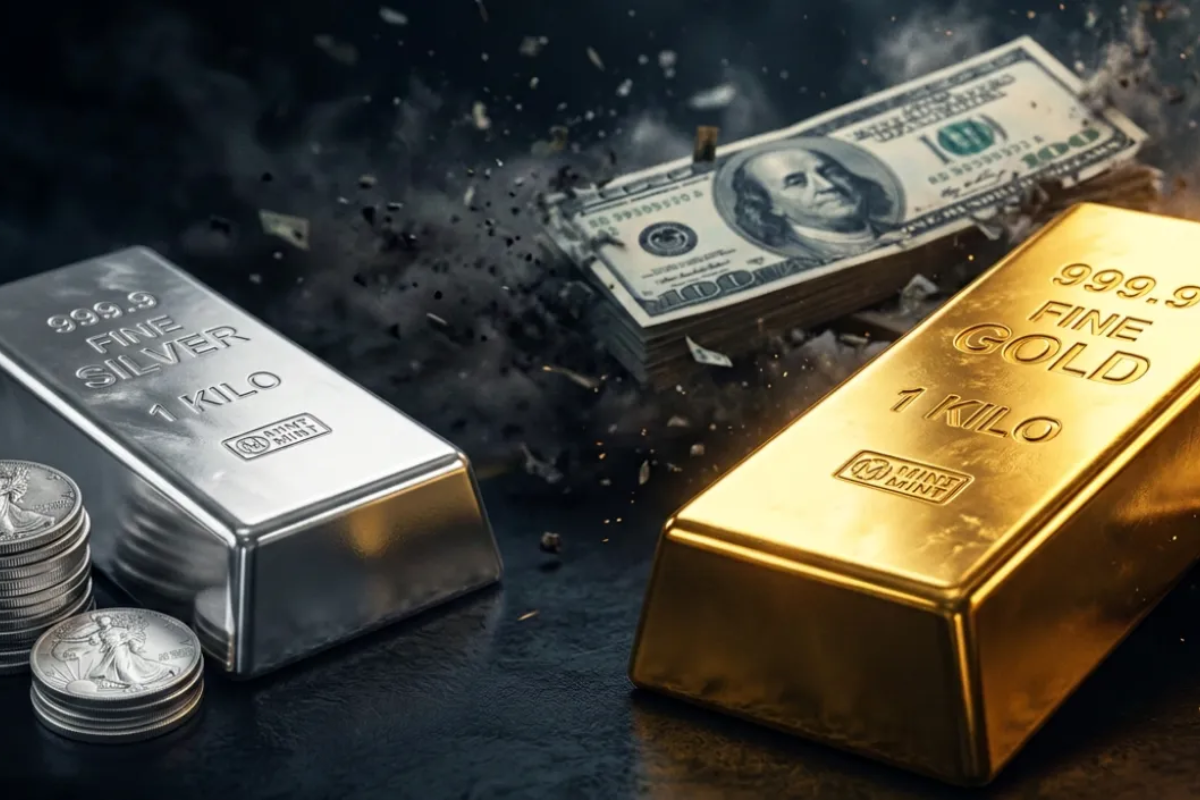
This movement is visible in the strong performance of gold, silver, and platinum throughout 2025. Lequeu argues that, with no end to global tensions in sight, demand for these assets will remain robust. “Gold is the real anti-fragile asset—it has no counterparty risk,” he explains. For investors, that makes it a uniquely attractive hedge against both inflation and systemic uncertainty.
Surging Metals Prices

Gold at $6,000? Silver at $100? The Case for Sky-High Metals
How high could this go? Lequeu isn’t shy about his forecasts: “I believe that $6,000 per ounce gold is possible for 2026, and I wouldn’t be surprised to see a three-digit number for silver.”
Remarkably, as of the day this article was written, silver is trading close to $97 an ounce—just a few dollars shy from crossing into triple digits. Gold, too, has surged to around $4,920 an ounce, with both metals already posting impressive gains at the outset of 2026.
Lequeu points to a combination of persistent inflation, eroding trust in public institutions, and the hard pivot away from US dollar assets as powerful tailwinds. Even after huge gains in 2025, Lequeu sees “no sign that this trend will change” over the next 12-24 months.
The Commodity Supercycle: Why Supply Constraints Matter
Lequeu’s bullishness isn’t confined to precious metals. He sees the entire commodity complex—energy, base metals, and agricultural goods—primed for a sustained bull market, perhaps lasting “until the end of this decade, and probably into the next.” What’s driving this? It’s a classic case of Economics 101: “If demand increases and supply is constrained, prices inevitably move in a parabolic way.”
A key shift is underway in how countries and companies manage inventories. Gone is the era of “just-in-time” supply chains; welcome to the “just-in-case” world, where strategic stockpiling is the norm. Lequeu explains, “In times of war and instability, investors and entrepreneurs can’t rely on ‘just in time’ supply chains but must rely on ‘just in case.’” As a result, global demand for commodities is rising just as supply remains tight.
A Secular Shift: The S&P 500 to Gold Ratio Flashes Warning
Lequeu is a keen student of market cycles and ratios. One signal he’s watching closely: the S&P 500 to gold ratio, which broke below its seven-year moving average in early 2025. Historically, such a move has marked “a good indicator of a change in the macroeconomic and geopolitical environment.”
“In a world where monetary policy is used by politicians to finance reckless government spending, measuring your wealth in nominal or dollar terms doesn’t mean much anymore,” Lequeu warns. Instead, he advocates tracking wealth in “real terms”—with gold and commodities as the new yardsticks. As the regime shift unfolds, he expects outperformance by hard assets and a waning era for traditional financial assets.
The Resource War: Geopolitics Drives Demand for Critical Minerals
The US government’s recent move to designate silver, copper, uranium, and platinum as “critical minerals” highlights the strategic value of these resources. For Lequeu, it’s further evidence of the deepening resource war between the US and China, now intensified by Russia’s alignment with China. “The biggest mistake the Western world and the US made was pushing Russia into China’s arms in 2022,” he observes. With Russia’s vast resources and China’s manufacturing might now joined, the global race to secure commodities is only heating up.
Countries are scrambling to lock in supply chains and build inventories, potentially supporting higher prices for years to come. “If a government or country wants to be a superpower and drive economic prosperity… they’ll need these commodities to power AI and quantum development,” Lequeu notes. This dynamic, he argues, leads to “tariff wars, trade wars, and, eventually, possibly even kinetic wars” over access to critical minerals.
The “Banana Republic Portfolio”: A Blueprint for Resilience
Lequeu’s prescription? Take a page from emerging markets. “I now recommend to my clients what I call the ‘Banana Republic portfolio,’ which is basically 50% stocks and 50% hard assets—meaning gold, silver, and other commodities.”
In his view, such a mix is the best defense against structural inflation and reckless government policies. But he’s quick to note: not just any stocks will do. In his opinion, the winners will be companies with “low leverage, strong balance sheets, and the ability to generate steady free cash flow across the business cycle.”
As Western economies increasingly resemble the volatile, inflation-prone “banana republics” of old, Lequeu’s playbook is simple: hard assets, quality equities, and a vigilant eye on the shifting tides of global power.
More By This Author:
This Week In Markets: Fed Pressure, Tariff Talk, And Geopolitical RisksWall Street’s Wild Cards: Ten Surprises That Could Shake 2026
This Week: Investors Rotate Into Cyclical Sectors

Comments
Log in or sign up to join the conversation.