

.webp)
Photo by Zlaťáky.cz on Unsplash
Welcome to this week’s market wrap podcast, I’m Mike Gleason
Coming up don’t miss our exclusive interview with Edward Sterck of the World Platinum Investment Council. Edward shares the drivers behind the recent price gains over the last couple of years in the Platinum Group Metals, but discusses how the prospects for the two main metals in that group – platinum and palladium – have different looking outlooks over the longer term.
Edward dives into what his firm’s analysis shows regarding the forecast for these metals and also discusses the impact electric vehicles have had on the ever-reducing need for catalytic converters, the primary industrial use for the PGMs, and what a decrease in demand on that front will mean going forward, and if there are any other industrial applications on the horizon that may replace that demand.
So, be sure to stick around for another fascinating Money Metals interview between Mike Maharrey and this week’s guest Edward Sterck of the World Platinum Investment Council, coming up after this week’s market update. And as a reminder please download, like, rate and subscribe to this podcast wherever you consume this content.
Well, the Federal Reserve announced another rate cut and another round of Quantitative Easing on Wednesday.
The mainstream called this quarter-point reduction in interest rates “a hawkish cut.” We have to wonder if that’s akin to jumbo shrimp? Or government intelligence?
And if this is hawkish, we wonder what will happen when the Fed people turn dovish!
The CNBC report on the December Fed meeting was typical.
It reported that the FOMC voted 9-3 to trim rates to a range between 3.5 and 3.75 percent. It highlighted the so-called dot plot projecting just one cut in 2026 and another in 2027.
And then buried 19 paragraphs in, the report mentions that the Fed will resume buying Treasury securities starting now. This means the central bank plans to resume expanding its balance sheet – something known as Quantitative Easing!
According to Fed officials, the central bank will purchase $40 million in Treasury Bills today... and going forward, purchases will “remain elevated for a few months” before they are “significantly reduced.”
Of course, you will not hear any central banker or mainstream pundit utter the words "quantitative easing."
In fact, if pushed, they’ll almost certainly deny that they’re doing it. They’ll call it reserve management or tell you they’re engaged in technical operations to keep the financial system’s plumbing moving.
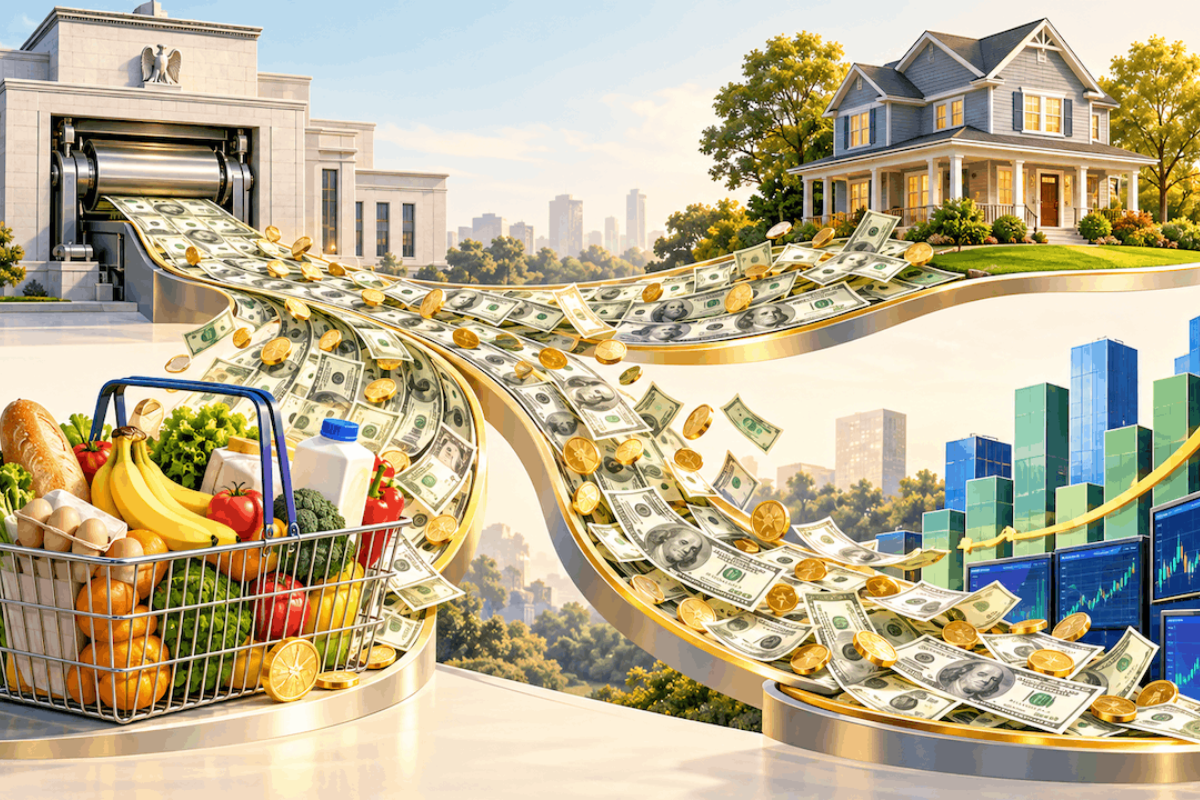
In practice, the Fed plans to start buying Treasury bills with money created out of thin air. This will increase the money supply and put downward pressure on Treasury rates. The balance sheet will grow; liquidity will increase; risk asset bubbles will get more air. This is exactly what QE does – and by definition, this is inflation.
In effect, the Fed supersized its rate cut while still maintaining a somewhat cautious stance on further rate cuts.
TradeStation head of market strategy, David Russell, told CNBC the central bankers “threaded the needle" by delivering a modest cut while quietly easing monetary policy even more through the back door.
Not surprisingly, the stock market rallied on the move, thrilled that the easy money punch bowl is going to fill up even faster than they thought. Gold and silver moved up sharply also, although silver has pulled back here today, more on that in just a moment.
I mentioned that pundits are calling this a “hawkish cut.”
What exactly is hawkish about it?
Certainly, nothing that Jerome Powell & Company just did was hawkish.
They cut rates – again. They announced balance sheet expansion.
But Powell did say some things that one might perceive as hawkish... but actions speak louder than words.
To sum it all up, the central bankers at the Fed are revving up the inflation machine while trying to convince YOU they are diligently fighting the inflation dragon.
They made two concrete moves to loosen monetary policy, but they said some things to make you think they might not loosen much more.
The reality is the Fed is in a Catch-22. It simultaneously needs to hold rates higher to deal with inflation and cut rates to try to keep the economy from being completely sucked into the Debt Black Hole. Make no mistake, no matter what you hear coming out of the mouths of Fed officials, they’ve picked inflation.
The bottom line is you need to watch what the Fed people do, and you can almost completely ignore what they say. The open-mouth operations are a deflection as they keep relentlessly devaluing your money.
Lastly here, and before we get to this week’s interview, let’s take a look at the weekly market action, and it has been a wild week.
Gold hit over $4,300 earlier today and threatened the October all-time high, but it has since pulled back a bit. The yellow metal currently checks in at $4,298 an ounce, good for a gain of nearly $90 on the week or a 2.1% gain.
Turning to silver, it actually eclipsed $64 earlier today but has since reversed in what has been a long-anticipated pullback. Despite that pullback silver is still up over $3 an ounce or 5.7% as of this Friday late morning recording.
Turning to the PGMs, which will be the subject of our upcoming interview, platinum is a cool $100 or an even 6.0% to check in at $1,753 an ounce. Palladium is up as well, gaining 3.0% since last Friday’s close to trade at $1,522.
Well now, without further delay let’s get right to this week’s exclusive interview.
Video Length: 00:34:01
Mike Maharrey: Greetings. I'm Mike Maharrey and I'm joined today by Edward Streck. Edward is the director of research at the World Platinum Investment Council. How are you doing today, Edward?
Edward Sterck: Yeah, good, thanks Mike. Thank you very much for inviting me on. I'm looking forward to a good chat.
Mike Maharrey: Absolutely. I'm really excited to have you on. We talk a lot about gold and silver on the show. Don't talk about platinum and palladium as much, so this is a great opportunity to introduce our audience to another medal that's out there that's a potential target for investment. So, what I'd like to start with is just something really basic. It says platinum in your name, but I know that you don't just focus on platinum. You're more focused on a family of metals. So can you kind of explain exactly what does the WPIC cover?
Edward Sterck: Yeah, so I mean platinum was what we were set up with a mandate to try and grow interest in to begin with, and we've broadened that more recently to look at the other platinum group metals as a whole. Now to explain there are six metals within the grouping platinum group, metals, platinum's probably the best well known, but then you have palladium, rhodium, iridium, osmium, and rhenium as well. And they've all got different applications, but from an investment perspective, people tend to focus on platinum, although there are some investment opportunities in palladium as well.
Mike Maharrey: Yeah, I've seen more interest in palladium over the last couple of years and even rhodium a little bit. I've seen some chatter out there in that as well. So, I want to focus on platinum and palladium since they're the big East. And what I'd like to do first is if you could compare and contrast the two metals. I know they're very similar, but they're also different. So if you could let folks know what's the difference and why are they similar, why are they grouped together?
Edward Sterck: They've got quite similar properties from a chemical perspective, so they're both pretty efficient catalysts and they're both used in the catalytic converters as an example that you have in internal combustion engine powered vehicles. And that's to reduce the harmful emissions from those vehicles. In terms of the balance of the market, it's slightly more than 80% of palladium's end uses is in catalytic converters, whereas for platinum it's a lower number. It's more like 40 to 46%. And then for palladium, the rest of the market is a split between industrial and a little bit of jewelry and a little bit of investment in terms of the demand profile for platinum jewelry is much more important. It's about 26% of the market and investment varies quite a lot, particularly with things like ETF flows and it can make up to about 26% of the market as well, 25, 26%. But sometimes when you get big ETF profit taking, it can be in negative territory as well. So, it can be a source of supply as think stand at the moment, we're seeing pretty robust strength and demand for platinum investment products. China has been growing dramatically since 2019 in terms of bar and coin demand and it's now the biggest market in the world for platinum in that regard, having overtaken the us, but we're seeing strength in demand and other geographies as well. And ETFs have continued to perform well as well as the physical products.
Mike Maharrey: I know enough about platinum and palladium to be dangerous, and I know that one is more common in gasoline powered vehicles. One is a little bit more common in diesel and I believe they're somewhat interchangeable, but I'm really murky on that. So, can you kind of clarify the dynamics with the automobile industry?
Edward Sterck: Yeah, so you've typically got three of the metals, so platinum, palladium and rhodium in the majority of catalytic converters out there. But as you said, historically diesel has pretty much been much, much richer in platinum and rhodium. And then gasoline vehicles have typically had a palladium heavy mix of those three metals. More recently, we have seen technological innovations that have allowed for more substitution to occur between the different metals, particularly in gasoline engines, not to the same extent in diesel catalytic inverters. So, platinum has benefited quite a lot over the last few years when palladium prices ran to well over three and half thousand dollars an ounce platinum was at that point trading close to a thousand dollars an ounce. And so automakers naturally decided to try and increase the usage of platinum and reduce it for palladium. We're now somewhat the other way around.
So, platinum is trading at a premium to palladium. Could that process begin to reverse? I think it probably could over time. Well, it definitely could from a technical perspective. The problem is that for the automakers, if you look at the landscape of your different PGM supply networks, the palladium network is very heavily dominated by Russia. So, Russia accounts are about 40% of global palladium supply, South Africa, about 40%, whereas in platinum it's about 70% of platinum comes from South Africa and only about 11% comes from Russia. So by increasing the palladium mix going forwards, you increase your exposure to Russian supply chain risk.
Mike Maharrey: Yeah, both of the metals have done really well this year. I was looking at just kind of rough calculations, it looks like palladium's up about 63% this year and then platinum's up almost 80%. What are the kind of dynamics that are driving both of these prices higher right now?
Edward Sterck: So, I think for platinum, well both markets on our estimates are in a deficit, so that's key in terms of obviously creating tension in the market that's supportive of higher prices for platinum, it's the third year of significant market deficits. We only saw the price begin to move in May of this year. So one question is, well with big deficits prior to that, why didn't the price move sooner? The answer is that in any commodity market, aboveground stocks are a key part of the market dynamics, the health of the market. They provide help, provide liquidity, and essentially with platinum we had excess above ground stocks that over the last three years have now been drawn down to unsustainably low levels. I think we must have hit that point in May, and that's one of the reasons it's not the only one, but it's one of the reasons we saw the price beginning to respond strongly.
For palladium, it's a little bit more nuanced. The price had been trending lower from those significant highs. We saw a few years ago, and by around May of this year it was trading at a discount to platinum. The reason for that really is just that the longer term outlook for palladium is so heavily linked to the automotive industry, whereas platinum, you've got much more diverse end uses. And if you think about the electrification of passenger vehicles going forwards, that was expected to ultimately result in a very negative outlook for Playdium from a demand perspective. And that was reflected in pricing. I think the price appreciation that you mentioned Playdium this year has been on the back of a couple of things. So firstly, that reciprocal substitutional relationship you can have with platinum. So if platinum moves higher in theory, palladium should follow, but you've also got things like the Section 232 investigation in the US into critical mineral supply, whether that's a threat to national security or not.
And you've got a second investigation that's specific to palladium, which is that there are some market participants in the US that have accused or alleged that Russia is dumping palladium into the global markets at below market rates, and there isn't. That investigation has concluded that there is some harm that's being done to the US domestic supply of palladium, which is not inconsequential. It's reasonable. And so some action will be taken. Now, we don't actually know what the outcome of the section 232 investigation is yet, and we don't know what the action that will be taken in the anti-dumping investigation will be. But clearly it's was making people concerned that platinum palladium might not be available at current prices in the US in the future, and that's being reflected in some of the tension in the markets and the price action we've seen this year.
Mike Maharrey: Yeah, that's interesting. That makes a lot of sense too. You get the geopolitical factors that can definitely skew markets one way or the other. So looking at platinum and palladium moving forward, are those bullish factors still in place are going to remain in place I guess? Or is this kind of a temporary blip? How do you kind of see as we play out into the mid to long term?
Edward Sterck: Yeah, so I think for platinum, they're very much likely to stay in place. We've got our forecast for the market heading towards more of a balanced market next year, but that includes some pretty significant ETF profit taking and based upon potentially the price improvement we've seen so far this year. And it also assumes that we see some unwinding of inventory build in the US as trade tensions ease. I would say that there are some risks to those two things. So far we haven't seen anyone taking profits from ETFs despite the big price increase that you mentioned. And certainly if you think about the trade tensions, one of the probably accidental benefits to the US of these trade tensions is that the US has built up effectively a domestic stockpile of critical minerals. That's all been funded by private entities. The public purse hasn't had to fund any of that inventory accumulation.
So, if they can keep the uncertainties ratcheted up, then that metal stays trapped in the us. So trade tensions may continue to persist for longer. However, balanced market for platinum actually doesn't solve for things like the depletion of aboveground stocks. They remain that de piece level. So I think for platinum, that tension will persist. For pallium, it's a little bit more difficult to stay. We do have an increase in palladium supply coming through from recycling. So this is where end of life vehicles are scrapped and the catalytic converters are cut off those vehicles and the PGMs contained within those catalytic converters are recovered. And it's just where we are in that kind of cycle of the market dynamics is that the catalytic converters that are expected to be being processed at the moment are actually just quite palladium heavy ones, and that increases the supply of palladium going forwards. And so it could help soften well on our base case forecast. We see palladium trending towards a surplus over the next couple of years rather than remaining in a deficit, whereas platinum, the deficits should persist for longer.
Mike Maharrey: You mentioned palladium, I'm sorry, platinum and the impact of tariffs. Have we seen the kind of displacement in squeezes from hub to hub as we have in silver? So for instance, we had a significant silver shortage in London recently as a lot of silver had moved to the US due to tariff fears. Have we seen that kind of displacement in terms of just regional issues as we have with silver?
Edward Sterck: Oh, very much so. London is very short metal at the moment, and you can see that in things like the A TC, the over the counter forward curve in London, which is in strong liquidation, that just shows you that there's a shortage of material availability in the prompt markets and that that's very much a function of the same things as we've seen in silver where you've got the US effectively building inventories. So we've seen quite significant flows of metal into the us. I mean, bear in mind that the platinum market is about 100th the size of the silver market in terms of volumes. So these numbers sound quite small in comparison, but the value is obviously a lot higher. But there's been around 400,000 ounces that have flowed into the US into visible exchange warehouses. There's probably additional metal that isn't disclosed, but it's not just the US that's competing for metal, it's also China. There's a new futures exchange's started trading in China the week before last called the Guang Futures Exchange. Well, so the exchange has been around for a while, but they launched physically settled on platinum and palladium contracts. That's increasing demand there pretty dramatically. So, it's all creating this three-way geographic competition for metal that is helping keep tension in the market.
Mike Maharrey: Yeah, so I remember when I was a kid, platinum was actually more expensive than gold, and my mom was very aware of that and really wanted platinum jewelry. She was always bothering my stepdad. It was like, if you have a choice, let's go platinum here. Of course now that's kind of flipped and gold is much more expensive than platinum. First off, can you kind of explain what caused that? And then secondly, do you see a scenario where platinum possibly regained some of that parody with gold or is that a thing of the past?
Edward Sterck: So, I think if you like your ratios and look back far enough since 1880 platinum has on average traded at twice the price of gold, and we obviously in the opposite situation today as you point out, could platinum regain some of that? Yeah, absolutely. I think it is a small and less liquid market. Most of the end uses for platinum are highly priced in elastic. I mean you could question jewelry and so on, but I think often as probably like your mother, people tend, there's in some ways there's a positive price relationship between the metal value and demand for jewelry that we've seen over the last few years at least. Anyway, so yes, I think we could see it come back again to a degree but looking back at why gold is more expensive and has become more expensive than platinum, I think is also important.
And clearly with gold, it is about 30 times larger market than platinum. So it is more liquid. Mankind has had millennial long relationship with gold. It is the currency like metal that is controlled by any government. It's not a fiat currency. It's tangible and real. And so if you think about central bank buying over the last decade or so, there's been a significant gold accumulation. And we're at a point now where for the first time, I think since the late eighties, central Bank gold holdings are now higher than treasury holdings in value terms. So clearly that shows that there's this pivot towards hard assets and we're seeing that occur now that's been ongoing for central banks for about 10 years, as I said. But we're also seeing asset managers in the US say they're going to start shifting their portfolio structure to accommodate more gold. And realistically, there just isn't enough gold in the world for this transition to occur. And so we're seeing spillover into the other precious metals, silver's benefiting, and certainly platinum and palladium are benefiting from this as well. So, it's an overall switch to hard assets and a rising tide raises all ships.
Mike Maharrey: Yeah. I'm kind of flip flopping backward a little bit in terms of the flow of questions here, but this just popped into my head. We're talking about the significant offtake that we have in both platinum and palladium for vehicles, and these are primarily internal combustion engines. How do you see the evolution of EVs impacting that demand in the mid to long term?
Edward Sterck: Well, look, I mean it's a key question, isn't it? And certainly our base case assumption is that we continue to see electrification of the drivetrain fundamentally it, if we're going decarbonize, it's kind of essential. I would say that our view has been very much that that process will occur more slowly than perhaps some of the other market commentators have anticipated. And part of the reason for that is we've looked at this from a consumer preference perspective and just seen that whilst a lot of the early adopters have adopted pure battery electric vehicles, the next cohort of consumers is that bit more skeptical, that bit more reluctant. And so the auto makers were probably going to struggle to hit their electrification targets, and that's playing out from the consumer perspective. But we're also seeing certain governments around the world mean the US would be one where there is a bit of a kind rowing back on the commitment to pursuing this decarbonization pathway.
And so again, that slows the overall picture. That's it. I think it will continue. And so if we look at our platinum plus palladium forecasts for the next five or six years or so together with the fact that you do still have tightening emissions legislation on any vehicle that contains an internal combustion engine, be it to hybrid or pure internal combustion engine vehicle, you have to increase the loadings of the PGMs in those vehicles to accommodate that. So actually the demand profile is relatively flat. We've only got a negative 1.7% CAGR through 2030 for platinum plus palladium in our numbers. But longer term it's going to continue. What happens? Well, I think for platinum, platinum, the number of other alternative end uses and particularly other uses that are critical to the decarbonization profile, if you like, of the world like green hydrogen, where platinum as a catalyst is used to produce green hydrogen using renewable electricity, and then you can take that hydrogen, put it back into something called a fuel cell, which also contains platinum catalysts.
It gets recombined with oxygen to create water and generates electricity. So it's an alternative to battery technology in that regard. And green hydrogen can be used to displace natural gas in many different applications and help decarbonize things like aviation and so on. So I think the platinum, that energy transition story is very much going to be key to its future outlook and will more than offset any kind of declining demand from automotive applications for catalytic converters for palladium. It is so heavily linked to the internal combustion engine vehicles at the moment that unless an alternative end use emerges that we're not aware of at the moment. I think palladium, the medium's longer term outlook right now, it's harder to call in the near term it looks quite good, but over the longer term, not as attractive as platinum’s.
Mike Maharrey: Yeah. So tell me a little bit about rhodium. Like I said, I've seen it pop up in the news. I know virtually nothing about it. What's it used for?
Edward Sterck: Well, it's much scarer than platinum and palladium. The market is only about 750,000 ounce a year. It's got some unique catalytic properties as well. So like I said earlier, it does go into the catalytic converters together with the other two metals. It's also used together with platinum as an alloy to produce things like glass fiber. So fiber, the kind of silica that goes into glass fiber is highly corrosive when it's molten. The only metals that can with stand that environments are platinum, palladium alloy. And so this glass fiber is drawn out through what are called bushings, which are plates with lots of little holes in those plates are out this big and they're solid platinum palladium. So it's quite something to see, but it's also used in jewelry as well. So, often if you buy white gold for example, which is obviously a fairly low-karat gold product with other metals in there, it's usually plated in rhodium as well because the underlying gold alloy isn't actually that white. It's quite yellow. And so over time, that rhodium, which is very tough as a place does wear away and white gold tends to yellow with age, which is actually one of the interesting things about platinum. White gold was produced as a low cost alternative to platinum, and platinum is more expensive than gold. But now because the price of gold's run so far, if you go and look at this at the retail level in the shops, actually they're a parody. Often the white gold is at a premium to platinum. So going back to your mother's point on this, I would say that platinum is the better than metal for jewelry of those two. So, if it's available at a lower cost than my gold, most consumers would probably go for that.
Mike Maharrey: Yeah, I actually have a white gold ring, so that's interesting. So, you're primarily talking here to gold and silver investors from your perspective, make the case for platinum pallium and even rhodium as part of a precious metals portfolio. I mean, why should investors consider it? I've got gold and silver, why would I need platinum or palladium?
Edward Sterck: I think the market, there's a lot of similarities between them, obviously as a store of value, but the question would be why would I argue that platinum is better? I think it's a bit more cyclical because you do have more industrial uses. So if you're expecting a return to economic growth or stronger economic growth in the future, then platinum should really outperform from a demand perspective. And it is, as I said, it really is a critical part of that energy transition going forward. So looking at this is to be fair, looking into the 2030s, but we are expecting really strong demand growth for platinum to come through from the hydrogen economy as that begins to scale up in due course. So that's going to be, I think, very, very helpful for the medium to longer term value of the metal.
Mike Maharrey: And I think really just any type of commodity right now in an environment where we have so much inflationary pressure, I think in the United States we do in Europe, and of course a lot of countries even worse. So I think a lot of folks are looking for those things that are going to store that wealth and store that value, and these metals are certainly in that category. What, give me one interesting tidbit about either platinum or palladium that you find really interesting that you think will resonate with people and they'll say, oh, that's really cool. Maybe we don't know.
Edward Sterck: Look, I think it's really getting into some of the, I mean this is probably outside the realms of some of the investment thesis I'd say, but certainly the catalytic properties of these metals are unique. There is nothing else that really can replace them. So if you think about petroleum refineries, they use platinum-based catalyst catalysts to produce the different refined products there. It's the same with a lot of plastics, actually. One for platinum would be things like PVC at the moment is produced using a mercury based catalyst that's going to be banned from 2030. And the current lead candidates for replacing that is a gold platinum based catalyst. So for gold, that's probably not, the potential demand isn't enough to really change the overall picture, but for platinum it could be quite important. So, it's kind of getting into the physics and chemistry of these metals. It's really interesting.
Mike Maharrey: Yeah, yeah, I'm kind of a physics nerd, and so I find that stuff interesting, although a lot of it goes over my head, especially if you start trying to do math. But yeah, very interesting. So, I really appreciate you taking a little bit of time out of your day. I know you're getting toward the end of your workday, so I'm not going to take up any more of your time, but I do want to give you an opportunity before we go too, I'll let folks know where they can find the WPIC and the information that you guys do, and maybe give a little bit of an overview of some of the material that you guys put out.
Edward Sterck: Thank you very much, Mike. So yeah, so look, as an organization, we do two things. So the first part is we try to help bull fabricators, coin dealers and so on around the world, design, produce, market, and sell platinum investment products. We partner with the Royal Mint, the Royal Canadian Mint and so on as examples. But then the other half of the organization, which I run, is providing research effectively to an investment community that is not particularly well serviced in terms of I think probably quality information on these very unique and very special metals. All of our research is available for free, so you can access it at www.platinuminvestment.com. You can follow us on LinkedIn, and I take part in a lot of these webinars as well. So the information is there. We published something called 60 Seconds in Platinum, which is a very high, sort of high level and easy to digest research product. You should be able to take it on board within a minute, as the name suggests. So there's lots of information out there that we provide that is available for investors who are interested in this to take a look at explore and find out more.
Mike Maharrey: Well, I appreciate that you guys are doing fantastic work, and glad you're out there. Appreciate you again, taking a little bit of time out of your day to chat with me. I know that again, a lot of folks that listen to this podcast regularly probably aren't real aware of the platinum and palladium market, so hopefully this will kind of open their eyes a little bit, maybe pique their interest and send them over your way to find out more. So I appreciate it and appreciate the way you were able to explain things. Very well done. Thank you so much.
Edward Sterck: Great. Thanks Mike.
Some very interesting analysis on the PGMs there and I hope you enjoyed that. There figures to be fireworks in all the metals going forward, not just in gold and silver, and you may want to pay close attention to platinum, which in our view has some real potential in the days and months ahead.
Well, that will do it for this week. Be sure to check back next Friday for our next Weekly Market Wrap Podcast. And remember to tune in as well to the Money Metals Midweek Memo, hosted by Mike Maharrey.
More By This Author:
A Hawkish Cut? What Was So Hawkish About It?
Consumer Credit Growth Remains Tepid Signaling Consumer Stress
Is Silver Expensive?
Comments
Log in or sign up to join the conversation.