

The US property market is currently in a state of flux following the election of Donald Trump as the country’s 45th president in November last year, and the subsequent interest rate hike that pushed the 30-year mortgage rate to the highest levels since April 2014.
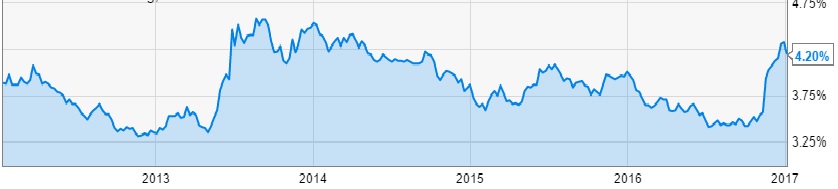
US 30-year Mortgage rate: Image via YCharts.com
Trump has been tipped to provide an impetus for growth in the real estate market, and given his widely-reported views on interest rates, there is a good reason why the US housing industry could go on a run as investors rush to invest before mortgage rates rise higher.
The rising interest rates have already begun to take a toll on the housing market with some properties now taking longer to sell than before. Per a recent statistical report by Trulia, the number of failed house sales increased over the last few years with 3.9 per cent of homes that moved from "for-sale to pending [and back] to for-sale again," nearly doubling in 2015.
However, the numbers were interesting when analyzed as per the specific housing categories with the older houses accounting for the larger percentage while premium housing units like condos for sale had lower failed sales.
This implies that people are looking to buy a property would easily qualify for a resale at a profitable rate as lending rates continue to rise in the foreseeable future.
In December, the average US prime lending rate increased to 3.64% up from 3.5% in the previous month following the mid-month interest rate hike.
It is expected to rise further in January as the December interest rate hike will be applied in full as compared to the partial application reflected in last month’s average rate.
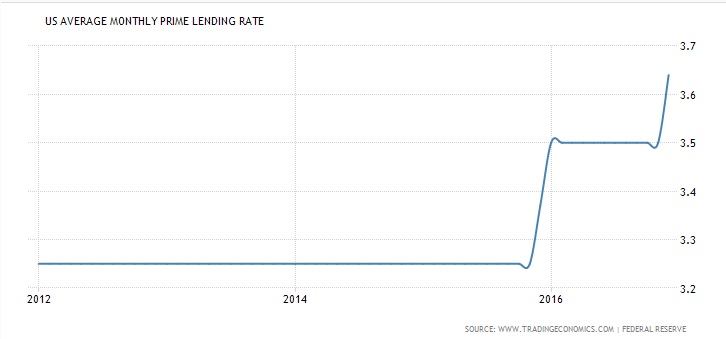
As illustrated in the chart above, the US average monthly prime lending rate has increased twice over the last two years to mirror the increment in the base interest rate. The US Federal Reserve has predicted a further 3 additional interest rate hikes in 2017. This implies that by the end of the year, the US average monthly prime lending rate could rise by as much as a full percentage point taking the rate to as high as 5%.
That’s a huge difference when compared to the average lending rate in November 2015 when it stood at 3.25%. The US Federal Reserve had indicated that there could be four rate hikes in 2016 but only ended up gifting investors with one at the end of the year. There are those who believe the same could happen this year, but given Trump’s bullish view on higher interest rates, chances are that we could see at least two rate hikes.
As such, this puts the US real estate market in the spotlight given its heavy reliance on credit facilities.
Note that, higher interest rates boost economic outlook, which in turn increases housing prices. This means that in 2017, we could witness higher property prices, as well as, high lending rates. These two are bound to make home ownership more expensive for buyers. Therefore, we could see increased activity in the property market as the rates remain lower during the early periods of the year. In turn, this market movement increases demand in the property market, which again, based on the law of supply and demand should push housing prices higher.
In the long run, it seems to be shaping out to be something close to what we witnessed nearly a decade ago, during the housing market boom of 2006-2007, when house prices skyrocketed resulting in the subsequent global financial crises of 2008/2009.
Conclusion
The demand of credit will be higher now as people anticipate increased lending rates in the near future, and given the attractive nature of the housing market, there will be a lot of activity there too.
In summary, the US property market appears to be at a crossroads after the election of Donald Trump as President, and a second rate hike in two years, which sets precedence for more in the coming months.



Comments
Log in or sign up to join the conversation.