

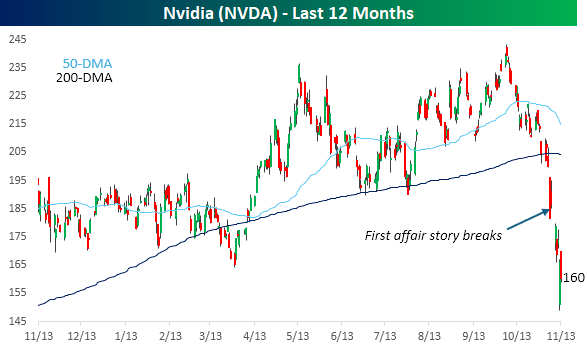
No one will be happier to see this week end than Nvidia (NVDA) shareholders. Heading into Friday afternoon trading, the stock is down 14% this week and trading at its lowest levels since last summer. News of former CEO Jensen Huang’s multiple affairs hasn’t been kind to the stock, but if you look at the chart, most of its roughly 40% peak-to-trough decline since early October came before Huang admitted to the affairs last weekend. You could argue that the scandal started to show up in the stock price before the headlines did (as often happens), but Nvidia was also dealing with other issues besides who Huang was sleeping with, including a broad chip-sector selloff and growing worries about how the AI buildout will be financed.
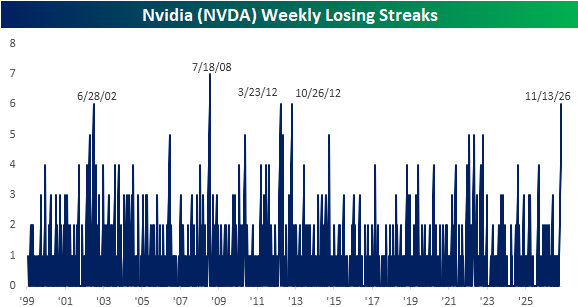
This week will be NVDA’s sixth straight down week, and over its entire history as a public company, that’s tied with three other periods for the second-longest losing streak on record. The longest streak of weekly declines lasted seven weeks and ended in July 2008.
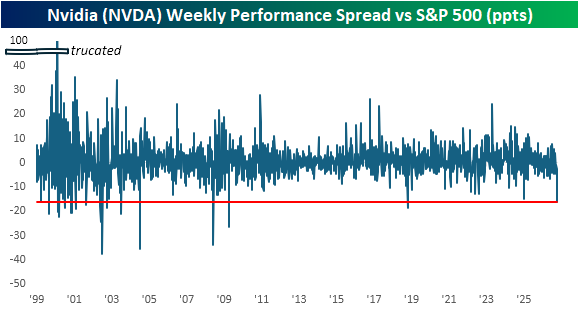
NVDA’s 14% decline this week doesn’t even rank as the worst week for the stock in the AI age that kicked off in late 2022. In January 2025, the stock had weekly declines of 15.8%, and in April 2025, it also fell just over 14%. Where the week’s decline does stand out, though, is how poorly it performed relative to the S&P 500. With the S&P 500 up just over 2% this week, NVDA is poised to underperform the index by over 16 percentage points, which would rank as the weakest relative performance since November 2018, and before that you have to go back to 2009.
NVDA is hardly the first large-cap stock to fall 40%, even if you account for how quickly it declined. What is notable about the company, however, is how invested its 42,000 employees are in the stock. In 2008, Jensen Huang established an employee stock purchase plan (ESPP) that gave employees the option to purchase stock at a discount to the stock’s lowest price in the prior two years.
As the market recovered from the financial crisis lows and the stock price rallied, it created a massive incentive for employees to max out the ESPP. By January 2010, for example, the stock had rallied more than 200% off its November 2008 low. With employees owning so much stock and the stock outperforming almost every other publicly traded company, employees at the company got rich. According to an article on Yahoo! Finance back in May, “roughly 50% of employees now have a net worth exceeding $25 million.” That share is obviously lower now, but employees are still doing very well.
The question for the company is how the employees will react. Long-tenured employees have taken a big hit to their wealth but are still sitting on massive gains. The turmoil and change of leadership at the company, coupled with loyalty to Jensen Huang, could cause some to simply retire and take a step back from the grueling schedule at the company. Where things will become more interesting is among less-tenured employees. Many joined during the AI boom and received stock grants at far higher prices, so they don’t have the same cushion of gains.
According to an Inc. article, Nvidia’s employee turnover rate was 3.7% versus a tech industry average of 21.9%. Nvidia may be the happiest place on earth, but a big reason for the low turnover rate was that the company was doing so well. Employees had a financial incentive to stay not only for the prospect of future gains but also for the richly valued unvested shares. The lower stock price at least partially erases one factor keeping them at the company, and the prospect of increased regulatory and political pressure on the company could cause an increase in turnover among the ranks of the less-tenured employees. Will they look for greener and less cloudy pastures or will they choose to stick it out?
When Nvidia reports earnings next week, investors will be focused on sales and guidance. But the more telling number over the next few quarters may be how many employees decide the stock is no longer a strong enough glue to keep them in place.

Comments
Log in or sign up to join the conversation.