

Things will likely look worse before they look better, but in the long term, AI has tremendous potential to become the world’s Great Equaliser of opportunity and equality
AI has the potential to be the Great Equaliser
Short-term macro analysis of AI is mostly focused on the current impact on trade, investment, spending, and inflation. Few would argue against AI being a major driving force this year for global markets and economic growth.
As the conversation shifts toward the long-term, predictions start to grow wilder. They range from an age of abundance, where AI and robotics end scarcity, to dystopian scenarios in which AI destroys human civilization as we know it.
Economists tend to gravitate toward a much less exciting but more plausible middle ground outcome. An OECD study estimates that labour productivity growth thanks to AI will be 0.4-1.3pp in countries with high AI exposure in the G7. A Dallas Fed paper has AI boosting trend growth by 0.2pp.
Rather than joining the debate over abundance, extinction, or the number of percentage points AI will add to growth, this report tackles the question of whether or not AI could become the Great Equaliser of the twenty-first century.
Although we remain in relatively early stages, we are already seeing several clear consequences of AI’s introduction to the economy.
Overall, we believe AI will have two transformative impacts on the world:
AI will help people do more in less time
AI will help people do things previously out of reach.
We explore below how these two factors will help bridge the gap of inequality, but also why things will likely get worse before they get better.
Will AI eventually help reduce inequality?
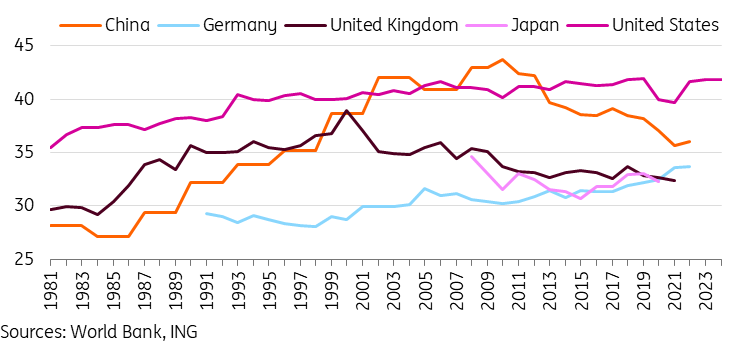
Gini coefficient of major economies
AI will help people do more in less time
The first theme is about increasing productivity.
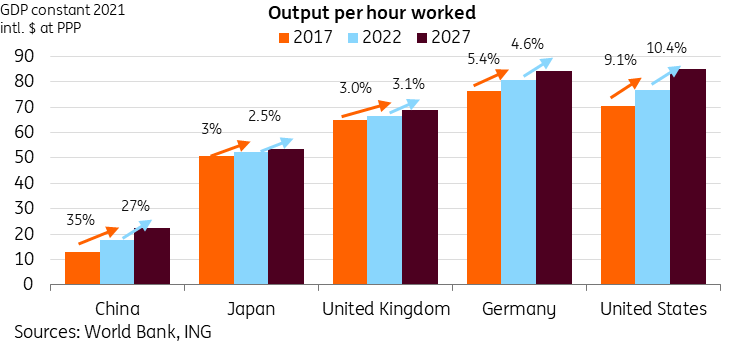
First, AI's impact on macro-level productivity looks fairly limited so far. While we do see productivity growth since the popularisation of GenAI, especially with China and the US, this hasn't meaningfully shifted from the pre-AI era trend. However, on a micro level, there are many notable examples of AI improving things, and as AI adoption grows, this should eventually translate into the macro data.
People will be able to work faster. We already see numerous anecdotal micro-level examples. Tasks such as coding, translation, writing, and data analysis can be completed much faster than before. Many tasks have seen improvement gains of around 50% according to survey data, and as agentic AI usage gains momentum, productivity improvements are likely to further increase as entire functions become automated.
People will be able to work smarter. The time spent on completing routine and repetitive tasks or struggling to learn a difficult task has also been significantly reduced for many fields. AI will help automate these processes, leaving more time for higher-value-added work.
People will get time back. One of the factors worsening inequality is that poorer individuals often need to pay with time. The quote from the Avengers that “no amount of money ever bought a second of time” might be true in the grander scheme, but one of the great advantages of the wealthy is that they can, in essence, buy their time back, usually in the form of buying services or skipping the queue. AI won’t eliminate this advantage, but it’ll help give some time back to those who may need it the most.
Increased productivity will likely be asymmetric. Among AI adopters, we’re likely to see a cohort of “superusers” who harness the technology to dramatically scale their output, and another group who misuse it, creating fresh problems with accuracy and reliability.
On average, we expect AI to allow average users to produce higher quantity and quality output and save time on routine work. This should bridge the gap between resource-rich large organisations and the rest of the market. Smaller and leaner teams will be able to increasingly compete with larger competitors.
Higher productivity alone won’t guarantee greater equality. The critical question is who captures the gains. Historically, productivity improvements such as machinery and automation have accrued to the owners of capital rather than to labour. Assuming AI follows a similar pattern, we might see productivity rise, but workers fail to capitalise.
AI's macro-level impact on productivity has trailed micro-level impact
AI will help people do things previously out of reach
The second theme is how AI will let people do things they previously could not. In short, AI will help improve capability and opportunity.
AI supercharges information and expertise democratisation. The internet was a breakthrough in democratising access to information, bridging knowledge and users from all over the world. However, users still needed to know where to search, overcome language barriers, and interpret information correctly. AI bridges this final mile by making content more accessible, intuitive, and easier to digest.
AI helps offset skill and knowledge deficits. Simply put, almost all of us have our own comparative advantages and weaknesses. Workers are increasingly able to compensate for things they are less proficient in by leaning on AI to fill the gap. A weak writer can use AI to communicate with professional clarity. Someone with no technical skills can “vibecode” their way through complex tasks using natural language prompts. And users with limited math ability can spin up sophisticated analytical models from a single prompt.
AI will lower the barriers to entrepreneurship. For most of human history, funding has been the defining bottleneck for entrepreneurship. Countless great ideas never made it past the kitchen table, and those that did secure a pitch meeting often had to surrender huge chunks of equity or bend their vision beyond recognition just to get capital. Turning an idea into a business required not only money, but access to specialised talent that many founders simply couldn’t afford. With time, one-man or resource-light companies will become increasingly viable. The barriers to entrepreneurship are likely to shift from capital-constrained to creativity-constrained. Successful entrepreneurship remains one of the best avenues for individuals to truly move up the socioeconomic ladder. Reducing these barriers to this will help reduce inequality.
For now, global discourse is still mostly focused on productivity gains. But in our view, AI’s role in allowing people to do things they previously couldn't will likely play a larger role in improving equality globally.
Wider access to expertise, the ability to overcome skill gaps, and lower friction in launching new ventures could expand economic opportunity far more than productivity gains alone.
As technology improves, and as generations of AI-natives come of age, these trends will likely intensify into the future, much like what we saw with the rise of the internet.
Inequality will likely get worse before it gets better
Despite this positive long-term outlook, we think it is likely that inequality may worsen before it gets better.
There are four key arguments for why inequality will first get worse before it gets better:
AI gains will be concentrated in fewer hands.
Workers may become more productive while losing bargaining power.
AI may hollow out the bottom rung of the career ladder.
AI will do little to address entrenched geographical disadvantages.
AI gains will be concentrated in fewer hands
The first and most obvious element is who stands to gain from AI adoption.
Currently, we’re seeing a fierce struggle in the AI race between China and the US, and more broadly, open source versus closed source AI. President Xi has called for AI to be a global public good, but it remains very much uncertain whether we will be truly headed in this direction.
For now, gains from the AI race and adoption are accruing at select companies and in select economies. This means there have been clear winners and losers from the AI race. A PWC study concluded that 75% of AI gains are being captured by just 20% of companies.
One clear impact is that we’re seeing increasing divergence of growth in countries worldwide.
For example, in China, we see that hi-tech sectors are attracting a disproportionate amount of capital and resources, resulting in a K-shaped economy where we see explosive expansion in a handful of tech‑driven sectors, while much of the traditional economy continues to stagnate.
This isn’t a new phenomenon. China has often strategically prioritised specific sectors. However, unlike in previous cycles, the supply chains for tech and AI are at least for now relatively shorter. As such, fewer people benefit from a tech boom compared to previous real estate and infrastructure investment supercycles, which lifted a myriad of industries along with their employees.
Governments now face a difficult question: if and how to intervene in distributing the gains from AI adoption. For example, amid the AI boom-driven surge, Taiwan paid out NT$10,000 per person in 2025 and will do so again in 2027 in a series of highly popular moves. Meanwhile, a “national dividend” proposal in May from South Korea suggesting redistributing revenue from the semiconductor boom to citizens shook markets.
Workers may become more productive, but lose bargaining power
We argue that AI’s role in improving productivity, capability, and opportunity will eventually help AI become the Great Equaliser. But for now, workers are already getting more competitive and productive, while not necessarily seeing stronger bargaining power as a result.
For the vast majority of jobs, doing more work doesn’t entail commensurate increases in compensation. This, too, isn’t a new phenomenon. Economic historian Robert Allen coined the term Engels’ Pause, which discusses the period of constant wages in the midst of rising output per worker during the first Industrial Revolution in the UK. Allen attributes this phenomenon to the rising share of capital in profitability. When labour’s share of profitability falls, bargaining power for wage growth is eroded.
We’re likely to see the same phenomenon play out in the AI age.
The flip side of AI allowing us to do more, and allowing us to do things that we could not before, is that labour’s share of profitability is likely to slip again. One of the most common anxieties we hear about AI is if and when it is coming to take our jobs, intensified by all-too-common headlines of layoffs and pledged targeted headcount reductions.
Companies may be more inclined to spend more on tokens than talent, and that could translate to less bargaining power for workers.
It’s likely too early to make judgements or conclude causality, but we have seen wage growth slowing in the past few years in major economies such as the US, China, and the EU.
AI transition could hamstring a generation of workers
One of the most common topics of AI discussion is job displacement. Many people have talked about AI replacing existing jobs. My colleague James Knightley writes about how AI is the leading reason for US job lay-offs for the past five months.
A less talked-about element is that of job creation. One common anecdotal observation that we have heard echoed by people from different industries is a decrease in entry-level hiring in the past few years. Though rarely made explicit, the underlying logic is simple: much of the work AI now replaces most easily is entry‑level employment.
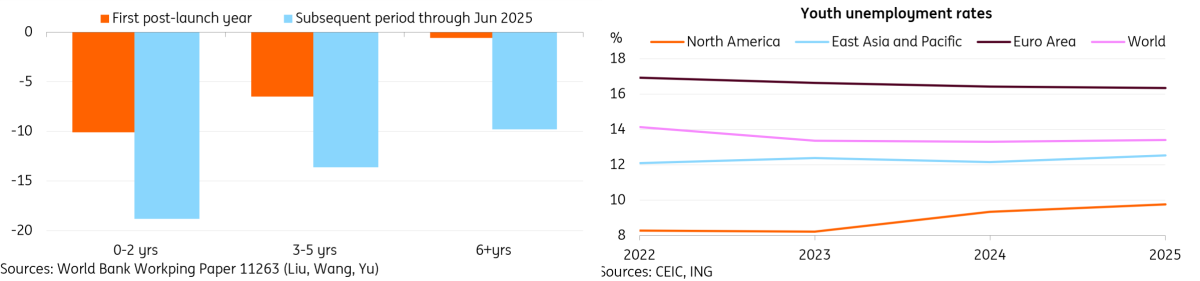
This could have significant implications for the future. Numerous studies have looked at the impact of youth unemployment and lower starting salaries on lifetime earnings and future consumption. A World Bank working paper argues that there is a greater negative impact of AI adoption on labour demand for entry-level as well as lower-educated workers.
The introduction of AI comes at an unfortunate time, when youth unemployment rates are already quite high. It's still too early to draw firm conclusions about how AI is affecting youth unemployment rates. But over the past few years, we've seen youth unemployment edging higher in Asia and North America, while falling in the Eurozone. It's still relatively stable in the world as a whole.
There’s a strong case to be made that we will need fewer white-collar workers in information-intensive fields, as well as administrative work.
This is before considering the impact of the next major shift, which we believe will be AI-linked robotics. These products are already gradually on the way to the market. The optimistic take is that dangerous, boring, or undesirable jobs will increasingly be filled by robots, but a more realistic view is that various highly paid or desirable jobs end up being replaced as well.
Every major technological paradigm shift has created new occupations and rendered existing occupations obsolete. AI isn’t likely to be any different. How issues like worker retention and employee protection are handled by governments will likely determine how big of a factor this is in amplifying inequality.
AI may disproportionately affect young jobseekers
AI will do little to address entrenched geographical disadvantages
Geographically, AI will also likely not do much in helping the most disadvantaged. Even if AI proves to be a drastic paradigm shift, it won’t do anything for those who have no access to it.
We need only look to internet penetration as an example of how technology we often take for granted is not universally available.
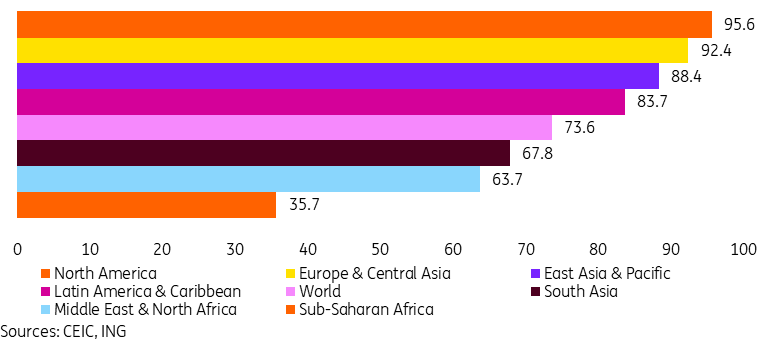
The International Telecommunication Union (ITU) estimates that around a quarter of the global population still doesn’t have reliable access to the Internet. Internet penetration in North America and Europe is over 90%, while it is just 35% in Sub-Saharan Africa. The Internet is probably the most important technological development of the past few decades, but over a quarter of the world remains without regular access to it.
As such, a good proportion of people in frontier economies will also likely be without access to AI and its associated benefits. This is even before considering elements such as token costs. This will likely worsen inequality before things get better.
The poorest regions may benefit less from AI due to access limitations
Conclusion: AI has the potential to become the Great Equaliser, but the road won't be easy
We think that AI does have the potential to become the Great Equaliser in time.
AI is already increasing productivity, helping workers overcome skill and knowledge gaps, and it looks likely to ultimately help lower barriers to entrepreneurship and improve access to opportunities globally. We expect that when the dust settles, we will have a more even playing field than where things were before the AI era.
However, historical evidence suggests that inequality will likely get worse before it gets better. Early beneficiaries of technological shifts tend to be concentrated among owners of capital. Broader social gains take years if not decades before emerging. As with previous waves of technology, there will also likely be demographics that are left behind.
Workers will become more productive, and people will increasingly become more capable. This is no doubt a good thing. But in this process, some occupations will disappear, new ones will emerge, and many workers may face painful disruption during the transition. We may not necessarily see workers gaining bargaining power as AI challenges labour’s share of productivity.
Nonetheless, we think that AI has the potential to level playing fields and become a so-called Great Equaliser. AI is set to bridge the final gap of democratising information and expertise that was started by the Internet, and it should help improve access to opportunity. Whether this vision materialises will likely depend on how AI is regulated, which development model ends up winning the race (open versus closed source), how fast AI+ products come to market, and how gains are distributed.
AI won’t make everyone equally wealthy. As much as most of us would wish for an age of abundance and end of scarcity, human nature makes this at best a long shot. Even in a world where machines can produce everything cheaply, it will be hard to tame the human desire to want more than others have. However, if AI succeeds in making expertise, entrepreneurship and opportunity more accessible, it may ultimately become one of the most important forces for levelling playing fields in the twenty-first century.



Comments
Log in or sign up to join the conversation.