


Chinese exports had another strong month in October, and year-to-date exports have already eclipsed last year's total. Import growth accelerated as crude oil import values rose on top of continued tech strength. China remains well on pace for a new record high for the trade surplus by year-end despite a miss in October
Exports already beat 2025 total as tech remains strong
China’s exports grew by 35.2% year-on-year in October, down slightly from 36.3% in September, and coming in a little softer than expectations (market: 36.3%, ING: 40.7%).
By product, auto exports slowed, falling to 37.6% YoY in October from 62.0% in September. This slowdown has not yet reflected the EU import quota on hybrid vehicles, set to take effect in December and potentially creating a headwind for auto exports in the months ahead. Household appliance exports also slowed in October, down to 20.9% YoY from 31.7% in September. The slowdown in these categories somewhat offset stronger export growth in tech categories. Hi-tech exports (66.6%), semiconductors (137.1%), and automatic data processing machines (114.7%) all saw export growth pick up in October.
By destination, export growth moderated slightly in October, but key export destinations continued to show strength. Exports to ASEAN (46.3%), the EU (24.3%), and the US (32.9%) all cooled slightly but remained well above year-to-date growth rates. One key exception was exports to South Korea, which surged to 92.4% YoY in October amid strong tech exports.
Overall, exports are now up 22.7% YoY over the first ten months of the year. Exports of $3.78tn so far this year have already eclipsed last year's total.
Tech, oil drove import outperformance in October
Import growth accelerated to 41.6% year-on-year in October, up from 31.0% in September and above both market expectations and our forecast (market: 33.9%; ING: 37.3%). This brought import growth in the first ten months of the year to 29.0% YoY, with total imports reaching $2.74tn.
The main areas of import growth remained tied to technology products, suggesting that China continues to spend heavily in the ongoing tech race. High-tech imports rose 72.1% YoY in October, up from 63.9% in September, bringing year-to-date growth to 50.8%. Imports of automatic data processing machines and parts surged 261.0% YoY, slower than the 296.5% growth recorded in September. Semiconductor imports also accelerated to 78.3% YoY, up from 74.7% in the previous month. Despite crude oil import volumes falling 13.3% YoY in October, higher prices pushed oil import values up 41.0%, the fastest pace since October 2022.
Trade surplus well on track to hit new high in 2026
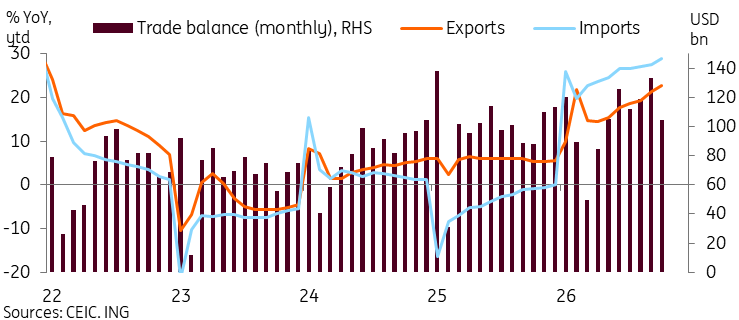
The trade surplus fell sharply from $133.5bn to $104.5bn, coming in weaker than market expectations (market: 125.8, ING: 131.2), thanks in large part to the stronger-than-expected imports.
October's trade surplus marked a 6-month low. Still, we remain on pace for China's surplus to reach a new record high by year-end.
Strong external demand has been a major driver of China's economic growth in 2026, helping offset soft domestic demand as consumption and investment disappoint. We may see trade growth moderate next year, given the base effect. But AI-related trade is expected to remain strong in the months ahead despite recent equity market volatility. China's trade outlook faces some uncertainty; the trade truce with the US expires in January unless a deal is reached to extend it. The next key window to watch on this front might be Trump's visit to Shenzhen for the Asia-Pacific Economic Cooperation (APEC) summit next week. There’s also some uncertainty on how trade with Europe might develop. Countries are debating new import quotas on products such as chemicals, plastics, and industrial machinery, among others.
China's trade balance fell to a 6-month low


Comments
Log in or sign up to join the conversation.