

Retail sales broke an eight-month growth streak in April, but there’s no cause for concern. After election-related one-offs, volumes have returned to a more sustainable trend, with further growth expected later in the year.
The first set of hard data for the second quarter was disappointing. The volume of turnover in the domestic retail sector fell by 1.2% month-on-month in April, bringing an end to an eight-month growth streak. Following the spike in March, a consolidation occurred year-on-year, with seasonally adjusted growth at 3.6%.
However, the longer-term trend shows that this dip is not a cause for serious concern. In April, retail sales volume exceeded the monthly average for 2021 by 6.1%. Examining this indicator's trend confirms that the March figure was a one-off spike, with April representing a correction that has pushed the retail sector back onto the sustainable trendline.
Retail sales volume in detail (2021 = 100%)
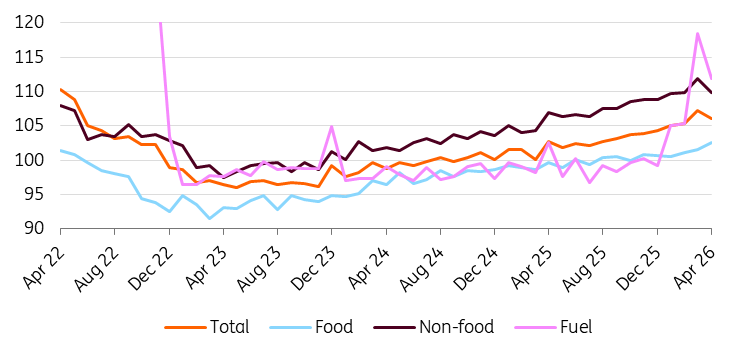
Examining the details reveals that sales at specialised and non-specialised food shops increased significantly on a monthly basis, most likely due to pre-Easter shopping. Therefore, the weaker performance is more attributable to non-food stores. In this segment, sales declined by 1.8% month-on-month. In other words, the exceptional growth in March was followed by a significant decline.
The Hungarian Central Statistical Office (HCSO) recorded a decline in sales volume across most sectors. Cosmetics shops and retailers of books, newspapers and stationery were refreshing exceptions to this trend. Of particular note was the sharp 7% monthly drop seen in clothing stores. Mail-order and internet sales also declined significantly, indicating that this retail segment remains highly volatile on a monthly basis.
Breakdown of retail sales (% YoY, wda)
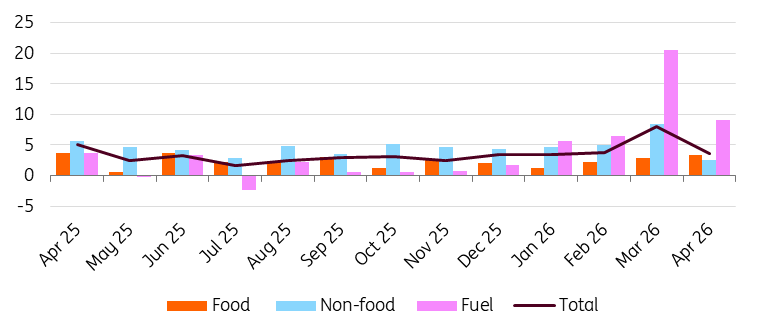
Although fuel sales volume has plummeted by 5.5% compared to the previous month, it has remained exceptionally high. Price caps mean that fuel consumption in Hungary is elevated and excessive, as evidenced by the rapid depletion of fuel reserves of the country.
Last month, we observed that domestic retail sales had increased significantly due to one-off, temporary factors. April’s retail statistics confirm this. At the same time, the overall picture remains favourable. High levels of consumer confidence, persistently low inflation and strong wage growth collectively provide a favourable foundation for sustained growth in the retail sector and, consequently, consumption.
Looking at the whole year, we expect retail sales to grow by around 5.0-5.5% on average in real terms, suggesting that consumption will remain the main driver of the Hungarian economy in 2026 as well.



Comments
Log in or sign up to join the conversation.