


In early June, I explained that the stock markets were giving a misleading impression of strength. The rise in U.S. indices was driven by an ever-smaller number of mega-cap tech stocks, while sectors directly linked to the real economy — energy, materials, infrastructure, and mining — continued to be largely neglected. I saw this less as a sign of robust economic growth than as evidence of an extreme concentration of capital flows on a few supposed beneficiaries of the artificial intelligence revolution.
I also wrote that this disconnect could not last indefinitely and that, as physical and financial constraints reemerged, the markets would eventually rediscover that an industrial revolution is never financed solely by promises of growth.
The first signs seem to be emerging now.
It’s tempting to draw a comparison with the dot-com bubble. However, one major difference sets the two episodes apart: the speed at which the first signs of strain appear.
In the late 1990s, it took nearly a year for the financing difficulties faced by telecom operators to gradually spread to equipment manufacturers and then to the markets as a whole. The vendor financing programs implemented by Lucent, Nortel, and Cisco had certainly artificially prolonged the cycle, but the deterioration in credit quality had remained relatively gradual.
Today, we feel as though we are witnessing a dramatic compression of time.
In just a few weeks, several signals — usually observed much later in a market cycle — have appeared simultaneously. Bonds issued to finance artificial intelligence infrastructure are now trading at significantly higher spreads. In other words, investors are demanding additional compensation to continue financing projects related to data centers and digital infrastructure.
At the same time, CDSs (Credit Default Swaps) — which measure the cost of insuring against the risk of a borrower’s default — have reached new highs for several major beneficiaries of the AI revolution:
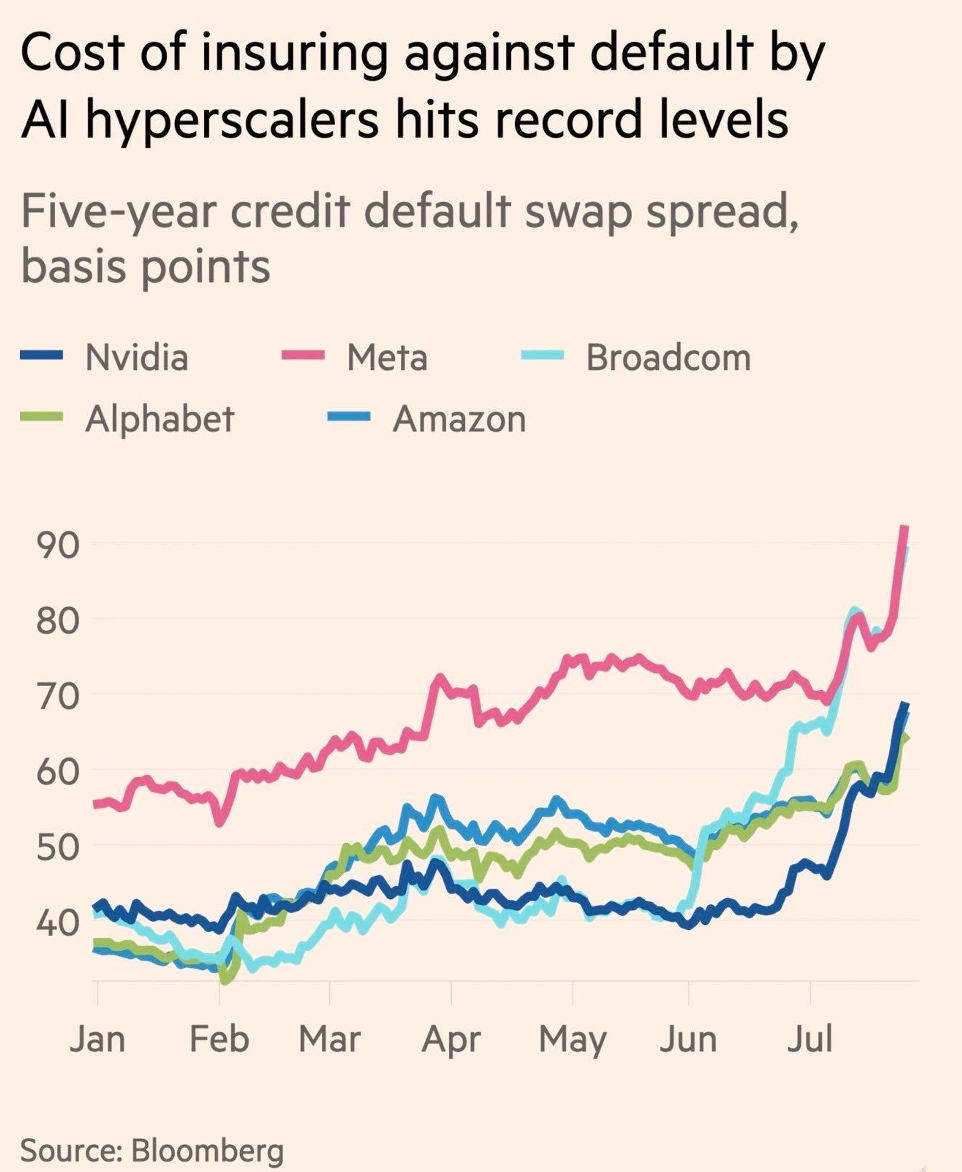
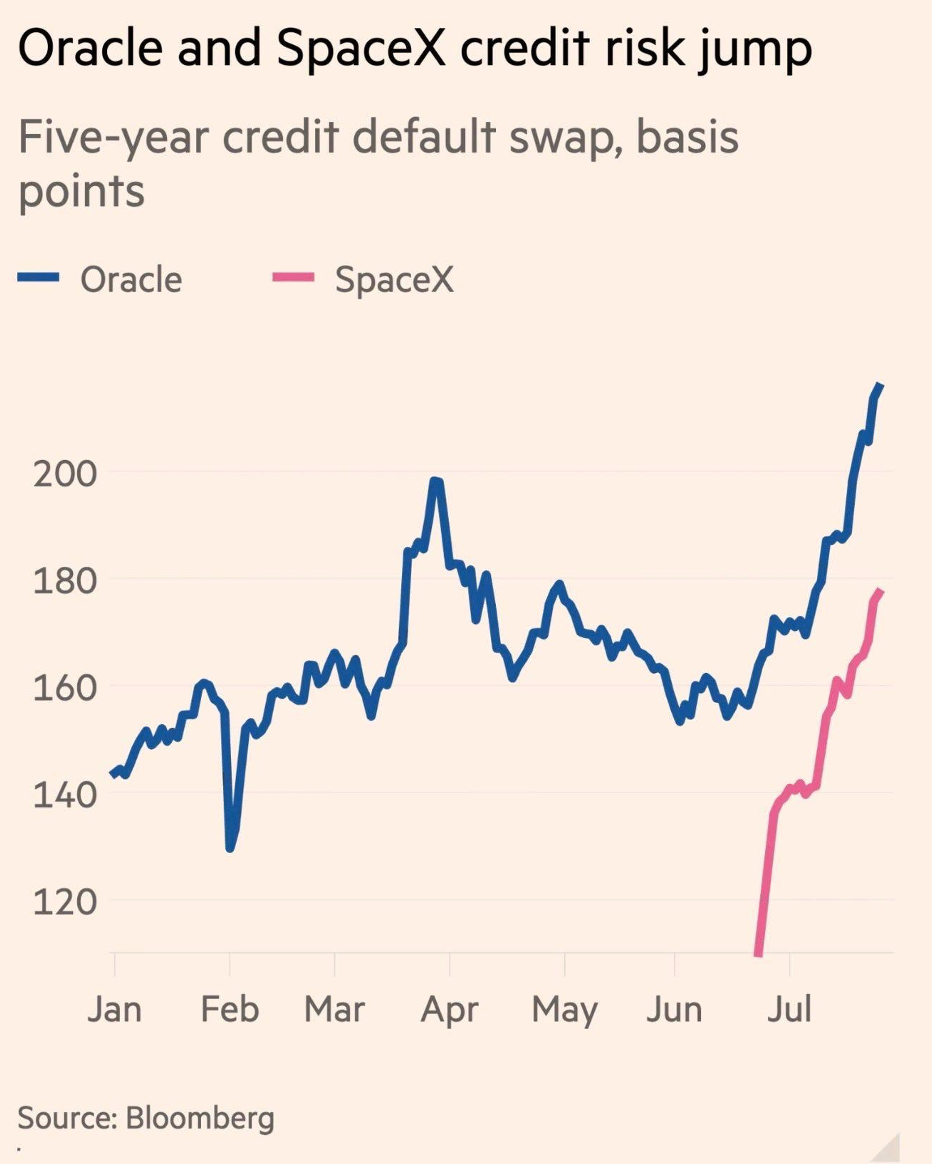
This is obviously not to say that Nvidia, Meta, or Alphabet are at risk of going bankrupt. However, the market now believes that the risk associated with their massive investment programs is higher than it was just a few weeks ago.
Finally, this shift in perception is beginning to be reflected in the stock markets themselves: several of the most iconic stocks in the AI ecosystem have seen their prices fall despite announcements of solid earnings or new investment plans.
In other words, the debate is no longer about companies’ ability to invest, but about the ability of those investments to generate a sufficient return to compensate for the capital committed.
Why has this trend accelerated so rapidly?
I see at least four explanations:
1. Capital markets have become infinitely faster
The first stems from the very structure of financial markets.
In 2000, a large portion of investment decisions remained discretionary. Portfolio managers needed to see several earnings reports before adjusting their asset allocations.
Today, information circulates instantly. Quantitative models constantly recalculate risk premiums, ETFs mechanically track index movements, and bond markets adjust their spreads in near real time.
In other words, the time lag between a change in expectations and its impact on prices has been significantly reduced.
The speed at which information circulates naturally shortens the duration of cycles.
2. The amounts committed are no longer comparable
The second difference lies in the scale of investment. In 2000, telecom operators were already spending considerable sums to deploy Internet networks. But the amounts being invested today are simply on a completely different scale.
The five major players in the U.S. ecosystem — Alphabet, Microsoft, Amazon, Meta, and SpaceX — alone plan to invest a cumulative total of nearly $1.4 trillion over the next few years. Alphabet is now talking about a program worth nearly $360 billion, Microsoft nearly $350 billion, Amazon about $330 billion, Meta $250 billion, and SpaceX more than $110 billion.
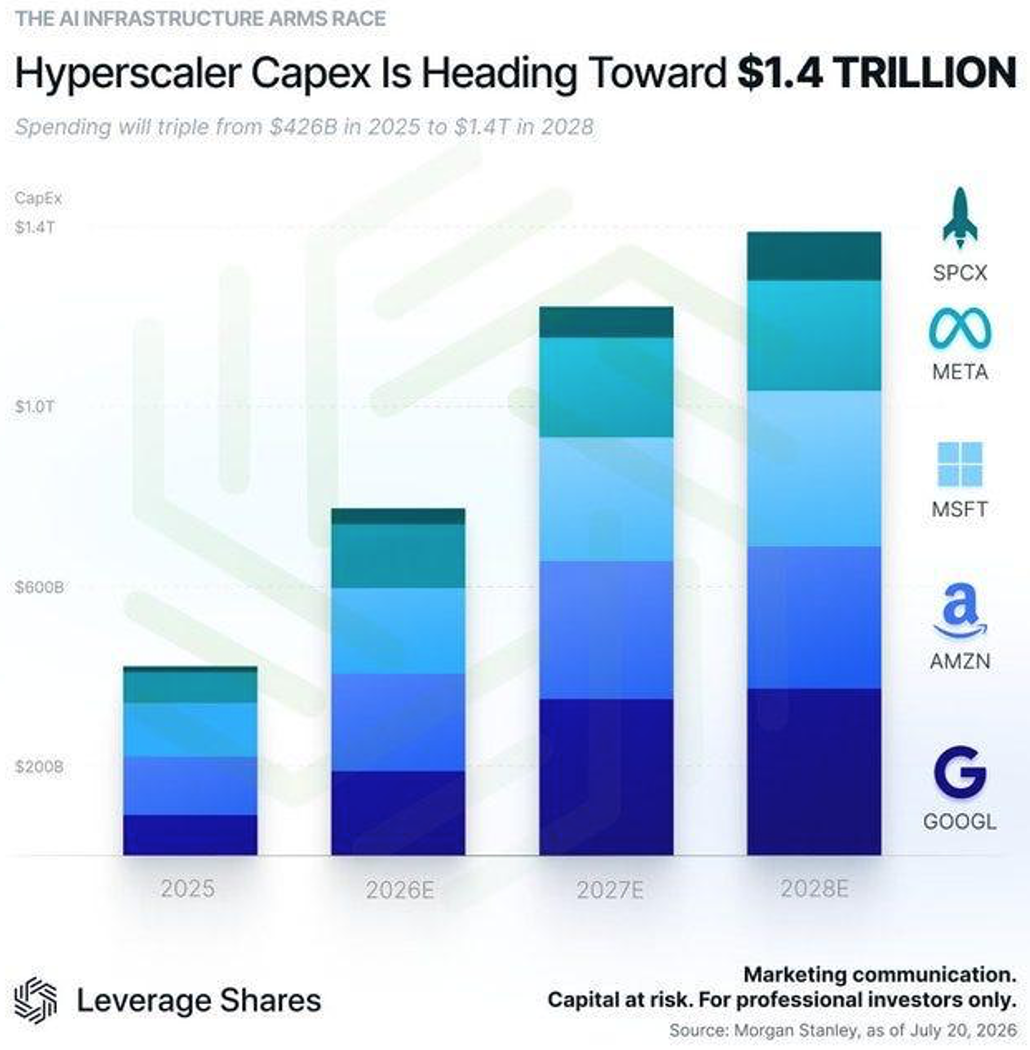
Never before has a technological revolution mobilized such a large amount of capital in such a short time.
Proponents of this strategy put forward a simple argument: the dawn of the era of inference fully justifies these investments. According to them, every dollar spent today on data centers, GPUs, and digital infrastructure will form the foundation upon which tomorrow’s economy will rest. Artificial intelligence applications, autonomous agents, and new digital services will ultimately create value far exceeding the cost of the infrastructure that makes them possible.
It is precisely this assumption that the market is now beginning to question — not because it doubts the future of artificial intelligence, but because it is questioning the optimal scale of these investments. If advances in models, inference, and algorithmic efficiency ultimately make it possible to produce more intelligence with far less computing power, then the marginal profitability of the next data center or the next billion dollars invested naturally becomes more uncertain.
The larger the amounts committed, the more a slight revision to assumptions about demand or returns can have significant consequences for valuations and the cost of financing. It is likely this line of thinking that the credit market is now beginning to factor in before the equity market does.
3. New financing vehicles are making the market much more sensitive to credit
The third difference is probably the least well understood.
The AI revolution is no longer funded solely by the balance sheets of hyperscalers.
Over the past several months, specialized funding vehicles have begun to emerge.
The best example is Beignet Investor LLC, created around Meta’s Hyperion project.
The goal of this structure is simple: to raise tens of billions of dollars from institutional investors to finance the construction of data centers even before they generate any revenue.
This is very similar to the project financing used for energy infrastructure or highway concessions. Investors are now advancing capital on the assumption that future cash flows will repay this debt.
So when the spreads on Beignet’s bonds begin to diverge, it’s not just Meta that’s affected. The entire premise of financing AI infrastructure is beginning to be reevaluated.
This mechanism is similar to the vendor financing of 2000, with one key difference: bond markets now have much more liquid and responsive instruments to express their doubts.
4. The technological paradigm is being challenged even before the end of the investment cycle
This is probably the most significant difference.
In 2000, no one really disputed the need to build the Internet. The problem was that telecom operators were unable to monetize the networks they had deployed fast enough.
Today, doubts are emerging much earlier.
Over the past few months, a series of Chinese open-source models — DeepSeek, Qwen, Kimi K3, and those developed by Moonshot AI — have demonstrated that it is possible to achieve performance levels extremely close to those of the best Western models using far fewer computational resources.
The shift is significant.
For two years, the consensus was based on a simple idea: the more GPUs there were, the better the models would perform.
Chinese research labs are now demonstrating that better model organization, more efficient architectures, model distillation, inference optimization, and improved algorithms can deliver greater intelligence without a proportional increase in computing power.
But this reevaluation now extends far beyond models alone. With DeepSeek, Kimi K3, Qwen, and several other players, China is demonstrating that it is possible to compete with the best Western models at a fraction of the cost. At the same time, Beijing is accelerating the development of the entire technology chain — from domestically produced DUV lithography equipment to locally designed AI accelerators — in order to gradually reduce its dependence on U.S. technologies.
In other words, it is no longer just the supply of models that is becoming more efficient; the entire Chinese ecosystem is seeking to produce more intelligence with less capital, fewer GPUs, and less expensive infrastructure.
For investors, this shift is fundamental. If each new generation of models ultimately requires far less computing power than expected, the marginal return on the hundreds of billions of dollars currently being invested in data centers and semiconductors naturally becomes more uncertain. It is not the future of artificial intelligence that is being called into question, but rather the expected return on the investments made to support it.
In other words, China isn’t just challenging U.S. leadership. It’s challenging the demand assumption that currently justifies the hundreds of billions of dollars in capital expenditures announced by the hyperscalers.
The question is no longer:
“How many data centers will we need to build?”
It has become:
“Will we really need that many GPUs if the models become two or three times more efficient?”
It is precisely this question that explains why the credit market seems to be reacting much more quickly than it did in 2000.
Back then, the credit market was gradually realizing that borrowers would never generate enough revenue.
Today, it’s already beginning to wonder whether the industry isn’t building more computing capacity than the next generation of models will actually require.
It is likely this combination — much faster-moving markets, unprecedented capital intensity, sophisticated financing structures, and a technological disruption that is undermining demand even before the end of the investment cycle — that fundamentally distinguishes the current bubble from the telecommunications bubble. If this analysis is correct, then the revaluation cycle could be much faster than the one observed in 2000.
Perhaps the most dramatic consequence of this deterioration in sentiment can be found in South Korea. The Korean market, which had become one of the main vehicles for global speculation in semiconductors and artificial intelligence, is now in the midst of a full-blown crash:
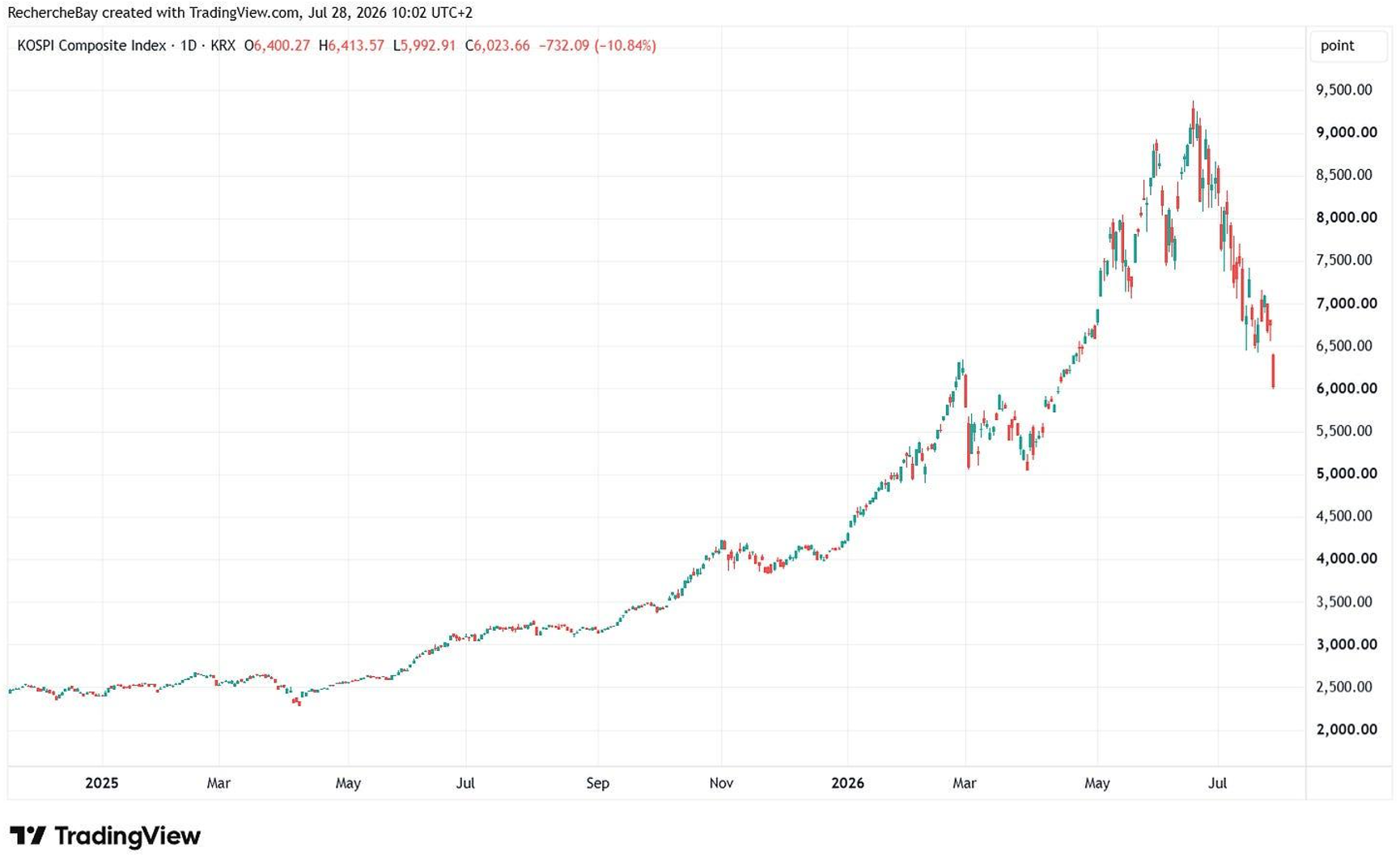
In just five months, authorities have already had to trigger seven circuit breakers, a sign of exceptional volatility and a sharp pullback by investors. Long viewed as a local phenomenon, this trend now appears to be gradually spreading to the U.S. credit market. Nvidia’s CDS spreads are rising again, joining those of Oracle, Meta, Amazon, Alphabet, and Broadcom:
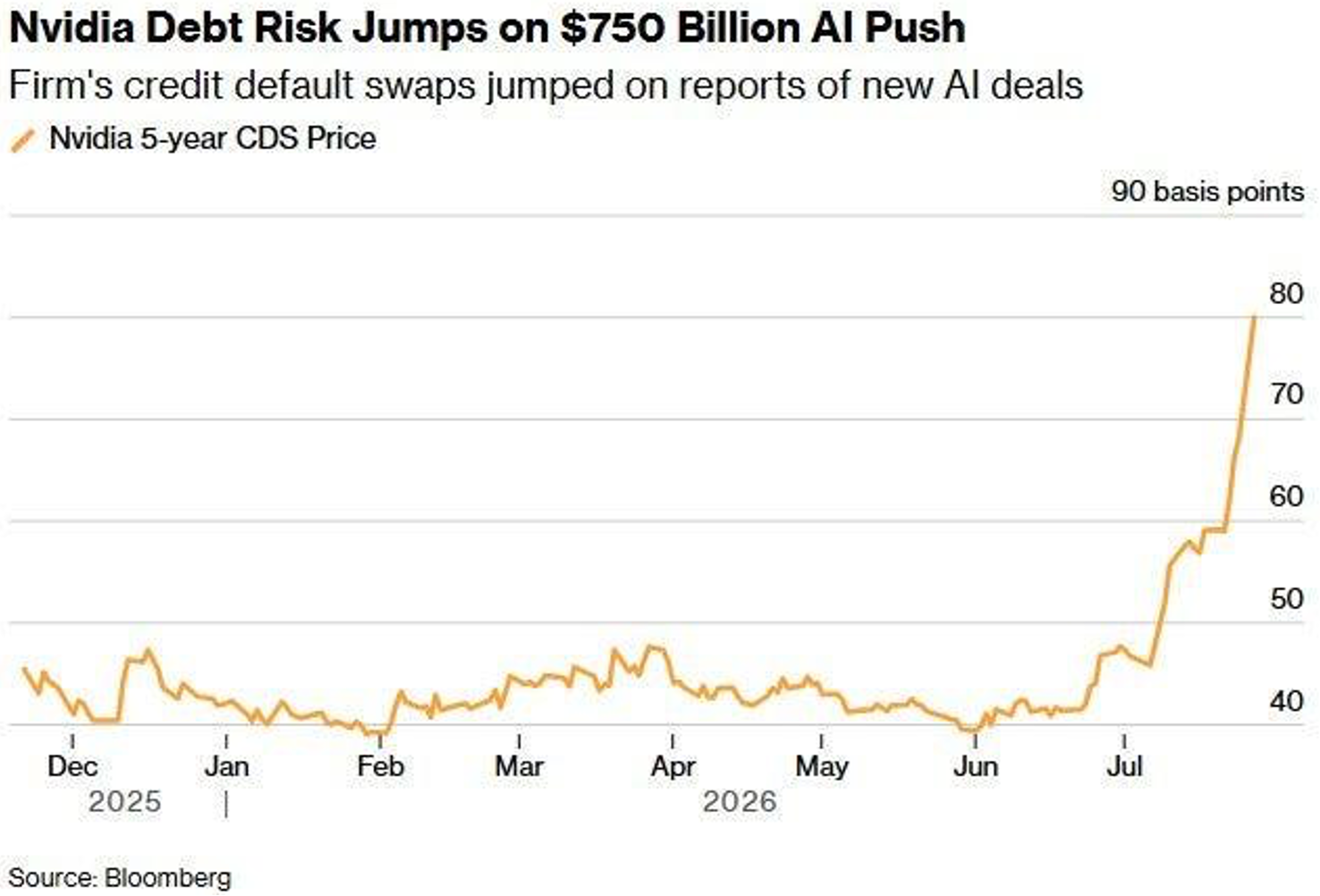
Taken in isolation, each of these signals could be considered anecdotal. Taken together, they tell a very different story: that of a market that does not yet question the future of artificial intelligence, but is beginning to reassess the price it is willing to pay to finance this revolution.
This shift in sentiment, in fact, perfectly explains the portfolio shifts observed over the past few days. Capital is not yet fleeing the technology sector en masse. It is simply shifting within the sector itself. Traditional software is regaining interest, while Apple is emerging as the preferred safe haven for major institutional investors:
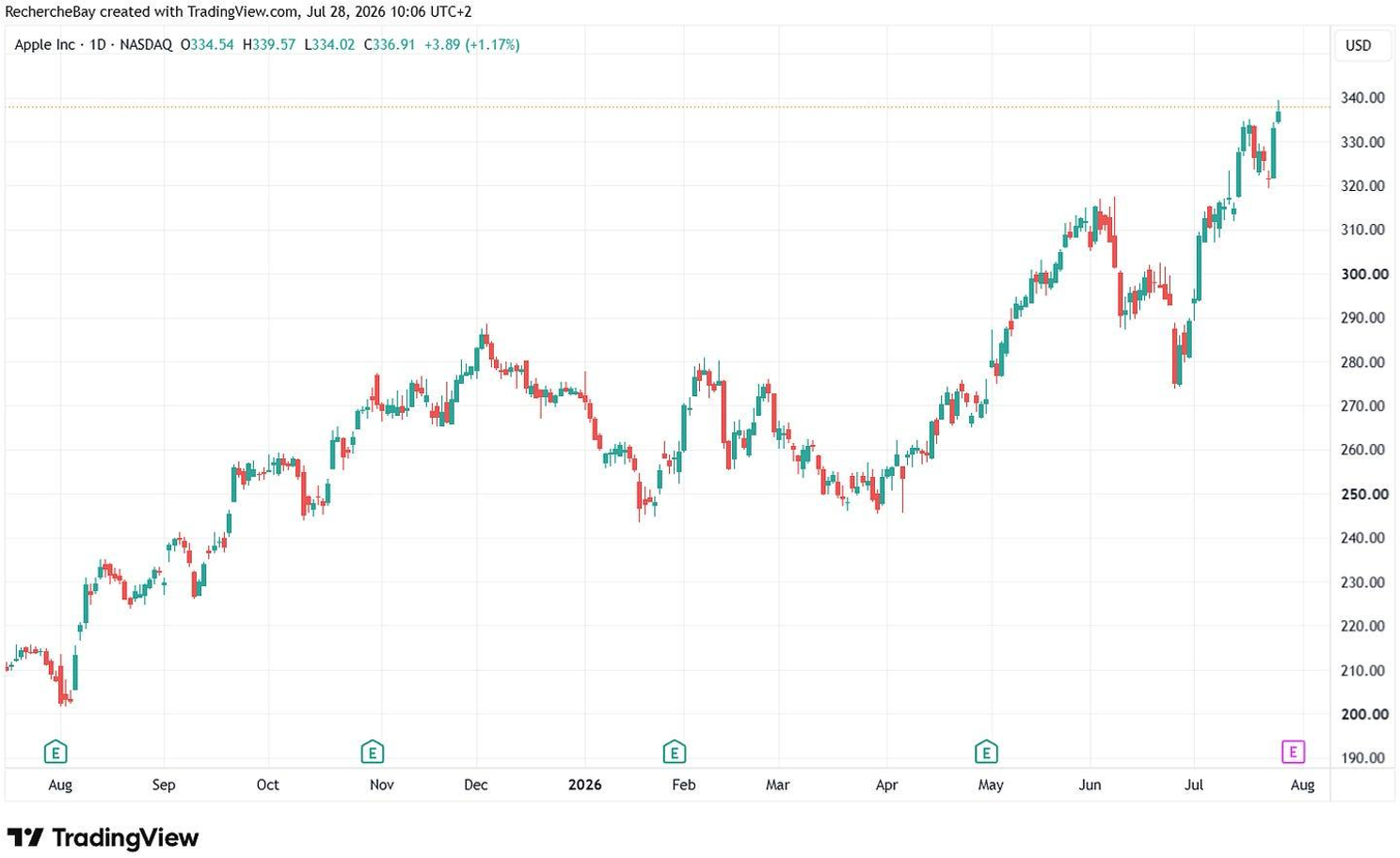
This choice is by no means insignificant. Apple is neither the leader in AI models nor the champion of infrastructure spending. And that’s precisely the point. Its business model relies above all on its ecosystem and its ability to generate recurring cash flow without having to invest hundreds of billions of dollars in data centers.
In a market where the main risk now centers on the return on AI investments, Apple stands out as the ultimate liquidity haven: a company large enough to absorb tens of billions of dollars in capital flows without forcing investors to exit the tech sector.
This rotation suggests, however, that the real deallocation has likely not yet begun. Institutional investors are reducing their exposure to the most speculative aspects of the AI narrative, but remain invested in the same indices and large-cap stocks. We are not yet seeing a flight from technology comparable to that observed after the bursting of the dot-com bubble. Rather, we are witnessing a frantic search for liquidity within the sector itself.
Meanwhile, one asset appears to be weathering this reallocation with remarkable calm: gold. Since early July, the yellow metal has been trading within a relatively narrow price range, despite rising long-term interest rates, geopolitical tensions in the Middle East, the gradual deterioration of sentiment toward AI, and volatility in the equity markets.
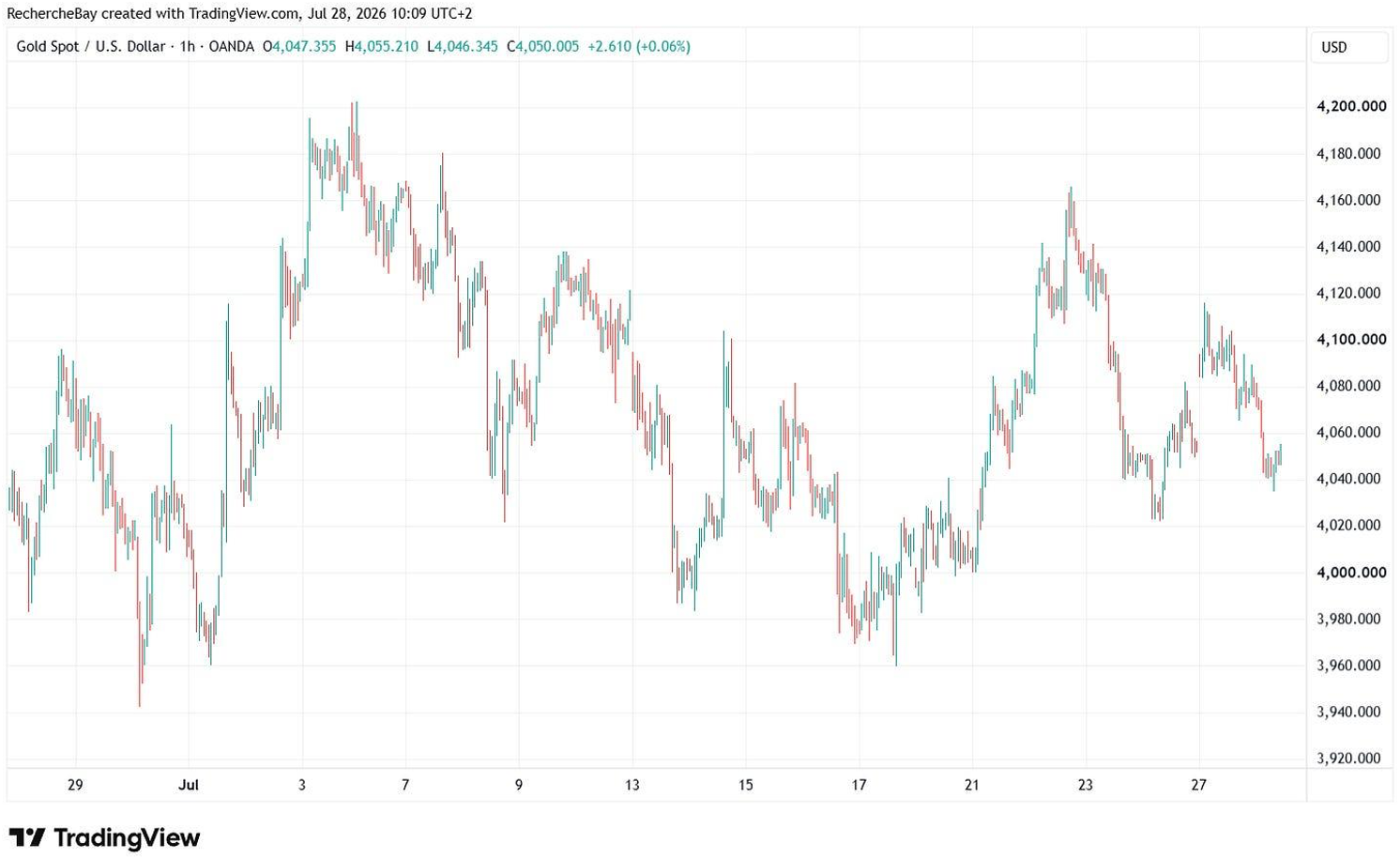
Unlike tech stocks, gold does not need to convince investors of the future profitability of an investment plan or a new business model. It simply needs to wait until mistrust of financial assets becomes widespread enough for it to once again become what it has been for centuries: the true ultimate safe haven.
As long as capital is merely shifting from Nvidia to Apple, or from semiconductors to software companies, gold may appear to be taking a back seat. But if doubts about AI financing were to spread beyond a few flagship stocks to affect all financial assets, then the rotation toward safe-haven assets would likely not stop at Apple.
It would ultimately — as is often the case during major shifts in the market — lead investors back to the only asset that depends neither on a valuation multiple, nor on bank financing, nor on a promise of future growth.
This is precisely what could make the coming months decisive.


Comments
Log in or sign up to join the conversation.