


Somewhere in your portfolio (or in one you’ve since tried to forget) there’s a chain you bought last cycle because it was going to be the next Ethereum. Better tech, and a founder who was very convincing on a podcast... you weren’t stupid to buy it. Plenty of smart people did.
But go and look at it now. Most of those chains are ghost towns... a few validators still running, a few hundred wallets moving dust around, a token a very long way below where the believers bought it...
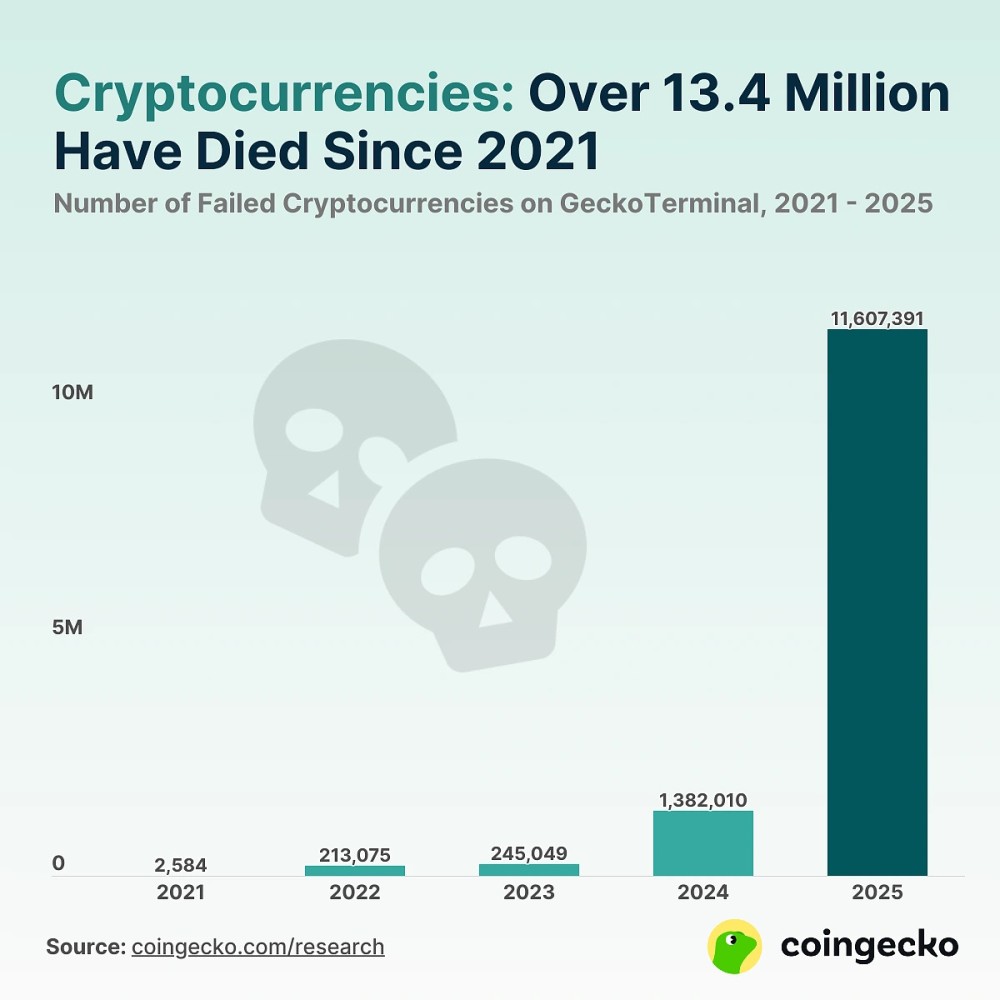
CoinGecko counted more than 13 million tokens that had stopped trading by the end of last year, most of them in 2025 alone, and plenty of the chains underneath them are in the same state.
I know how that reads, because I've read it on my feed every bear market for thirteen years. Crypto's a scam, it was always a casino, told you so.
But that carnage isn't a scandal. It's a base rate.
I wrote this down in December 2020, when it seemed obvious to me and apparently to nobody else. Tokens are just VC bets marked to market in real time. If you owned early-stage seed investments and someone priced them every second of every day, you'd see exactly the same thing: roughly 80% go to zero, 19% add some value and 1% make all the money. Crypto just lets you watch it live, and real-time marks freak people out.
I applied it to myself at the time, because it's only fair. If Real Vision had been marked to market every day from the moment we started it, I reckon it would have gone to near zero probably six times. The value comes from adoption and eventually from revenue, and most things never get there. Most don't survive. It's normal… like it or not that’s capitalism.
So the question was never whether most chains die. They do. The question is which ones don't, and how you tell before the price tells you.
We've watched this movie before
Twenty one years of writing GMI teaches you to go looking for the precedent, and the one to hold in your head here is the dot-com bust.
I was watching Bitcoin (BTC.X) in November 2018, deep in that bear, and what I wrote was that it reminded me so much of the dot-com in 2000 and 2001. Great ideas on flawed business models, but eventually, out of the ashes, the Phoenix rose. I felt sure it would be the same with crypto, but I had no idea which businesses would turn out to be the Phoenix and which would be the ashes, and I said so at the time.
Not knowing was the right answer, because nobody could have picked the winners in 2000 either. The infrastructure was wildly overbuilt, the Nasdaq fell 78% from its peak over the following two and a half years, and most of the names on it went to zero. What came out the other side was a handful of companies that became the largest in the world, built on the fibre the dead ones had paid for. Looking back, the crash was a detail on the way up. While it was happening, it felt like the end of the idea.
Every broad platform market since has ended the same way. Cloud compute has about five players, operating systems and mobile phones look the same, and most of the value sits in the top four. Blockchains are a platform market like all the others.
A chain is an economy, not a coin
OK, so if it's a platform market, what's the product?
Well, blockspace of course.
The winners make their blockspace more attractive, through technology or through narrative or both, so that more users and more dollars move through it. Everything else is marketing.
Which is why you can't think of a general-purpose chain as a company, and you definitely can't think of it as a coin. Ethereum, Solana and Sui are sovereign economies, with their own GDP, their own money supply and their own monetary policy, and you value them the way you'd value an economy… by how much happens inside it. I went through the vault-versus-rails split properly in Where Crypto Fits in the Exponential Age, so I won't rebuild it here. Bitcoin is the vault and the smart contract platforms are the rails. This piece is about which rails survive.
The four ways to stay alive
The geography is simpler than people think, because there are only four ways a project stays alive.
The first is to be a sovereign economy. Ethereum, Solana, Sui and a handful of others have the throughput, the composability and the developer density to plausibly host the global token economy.
The second is to be a specialist. Hyperliquid is the cleanest example, a vertically integrated exchange that happens to use a chain as its execution layer. Specialist exchanges always make money, but the upside is bounded by the niche, so you value it like an exchange with a deep moat rather than an open-ended economy.
The third is to be a layer two, a business built on top of an L1 that rents its security. Some of these will be fabulous businesses, but they're franchises, a shop built on top of Shopify (SHOP), and if a layer two dies its state reconstructs somewhere else, which is exactly why they don't accrue value the way the parent chain does. The L1 owns the persistence and the L2 rents it.
The fourth is the awkward one, and it's BNB. The market prices it like a sovereign economy and it isn't one, because it isn't decentralised, which means its real persistence layer is the Binance balance sheet. A perfectly good business, but one to be valued like a centralised exchange token wearing L1 clothing.
Why most chains die
Now look at everything else, which is most of the chains that launched over the last two cycles.
They fit none of the four buckets. They're general-purpose enough to compete with the sovereign economies but they don't have the ingredients to win, they're not specialised enough to own a niche, and they're not centralised enough to ride somebody else's balance sheet. They're just chains. And chains without a moat trend to zero.
That's the structural reason. The thing that kills them in practice is the launch.
I've been writing about low-float, high-FDV tokens since the summer of 2024 and the pattern hasn't changed. The market hates them, so they fall on the initial float, usually by 70% or more, as everyone prices in the unlocks still to come. In a bull market a low float with real demand behind it can be explosive. But when the bear arrives these tokens underperform badly unless the unlocks are mostly done or the demand is real, and for a chain with no moat the demand is never real. It had attention for a season, and attention has to persist to turn into adoption. Most of it doesn't.
So the launch structure does to a commodity chain what the market would have done anyway, just faster.
The race to zero
This is where almost every valuation framework in the industry goes wrong.
The entire competitive surface of a blockchain is efficiency, which means the chain that wins the coordination race is, by definition, the one that drives the marginal cost of a transaction toward zero. Run that through a discounted cash flow model and it tells you the dominant chain should be worth less than its challengers, because it earns the least per transaction. The framework gives you the opposite of the right answer.
The right way to value a chain is to invert it. Imagine turning Ethereum off. Every layer two goes, most of the stablecoin market goes, all of DeFi, every NFT, every tokenised asset, and the entire future ability of the financial system to build on those rails. That's the value of Ethereum. Nobody values TCP/IP by counting revenue per packet. You value it by the internet that runs on top of it.
And the race gets faster from here, because of who the next users are. I laid out in The Invisible Economy why AI agents can't use the banking system and have to settle on these rails. An agent has no tribe. It routes to the cheapest, fastest, most efficient network available every single time, and it will self-select away from any chain that charges it a fee it doesn't have to pay. Solana and Sui are already pushing stablecoin transfers toward a cost of zero, which is Wright's Law playing out in front of your eyes... Some activity needs the security of Ethereum's base layer and some needs raw speed, so different chains will carry different things and this is winner-take-most rather than winner-take-all. But the tail doesn't get a vote.
Everyone's reading the wrong scoreboard
I'll tell you how I know the industry is measuring the wrong things, because I measured them too.
Earlier this year I set out to build a proper valuation framework for L1s, and I started where everybody starts, with fully diluted value against the metrics every analyst tracks: total value locked, fee revenue, DEX volume, stablecoin market cap. The correlation was near perfect, and I thought we had something.
We didn't. The whole exercise was circular. TVL is denominated in the token whose price I was trying to explain, DEX volume rises with speculation and fees rise with volume, so I was regressing price against things that were functions of price. Measuring the reflection, not the object.
So I stripped it out, converted everything into ratios that cancel the price effect, measured them across twelve chains at the January 2025 peak, the week the TRUMP memecoin launched, and asked one question. Did any of them predict which chains would fall least over the next thirteen months?
Fee yield predicted nothing, because fees in a bull market tell you how much speculation is happening, not how much value is being created. TVL against FDV, the crypto version of book-to-market, predicted nothing either.
The only thing that predicted returns was velocity, how fast capital churned through each chain's exchanges, and it predicted them backwards. Capital was churning through Solana at roughly 200 times its locked value that January, and through Ethereum at roughly seven. The chains where capital churned fastest had the worst thirteen months, and the chains where it sat still had the best.
The way I think about it now is that velocity is entropy and stickiness is coherence. Capital that arrives and stays, that gets lent, borrowed against, swapped and restaked, is building relationships that make the next relationship more likely. Capital that arrives and churns is treating the chain as a casino and leaves nothing behind when it goes. So the speculation everyone celebrates at the top of a cycle is the warning sign, and the boring chain where nothing much seems to be moving is the one that holds.
What a survivor looks like
Which gives you the three things I actually watch, and none of them is price.
The first is whether economic density per user holds when the price collapses. Between the December 2024 peak and February 2026, one of the chains I follow lost 83% of its price and 78% of its total value locked, and active addresses fell by three quarters. Yet the capital deployed per active user barely moved, roughly $2,100 at the peak and roughly $2,100 at the trough. The tourists and the bots left, and the people who stayed were doing exactly as much as they'd done before. Only three layer ones held their density through that drawdown, Ethereum, Solana and Sui. Every other chain I measured lost density along with price, and one serious, well-funded L1 lost 83% of it, meaning the users who stayed stopped doing anything.
And before anyone points it out, yes, I sit on the Sui Foundation. I found Sui in that group of three after I did the work, not before it, and the numbers are the numbers.
Then there's whether stablecoins keep growing while the token is falling. A dollar on a chain doesn't shrink when the token does, so when dollars flow in and stay through a crash, that's external capital making a deliberate choice. All three of those chains grew their stablecoin balances through their drawdowns, by roughly half in the case of the one that had fallen 83%.
The third test is whether developers keep arriving, and it's the one I'd weight most, because developers are the scarcest capital on a chain. A user deploys money and can pull it out in minutes. A developer deploys years of expertise in a specific language and architecture and can't easily redirect it, so when developers migrate toward a chain in a bear market, you're watching the most informed people on the network make a high-conviction move with the highest switching cost in crypto. No price chart will show you that.
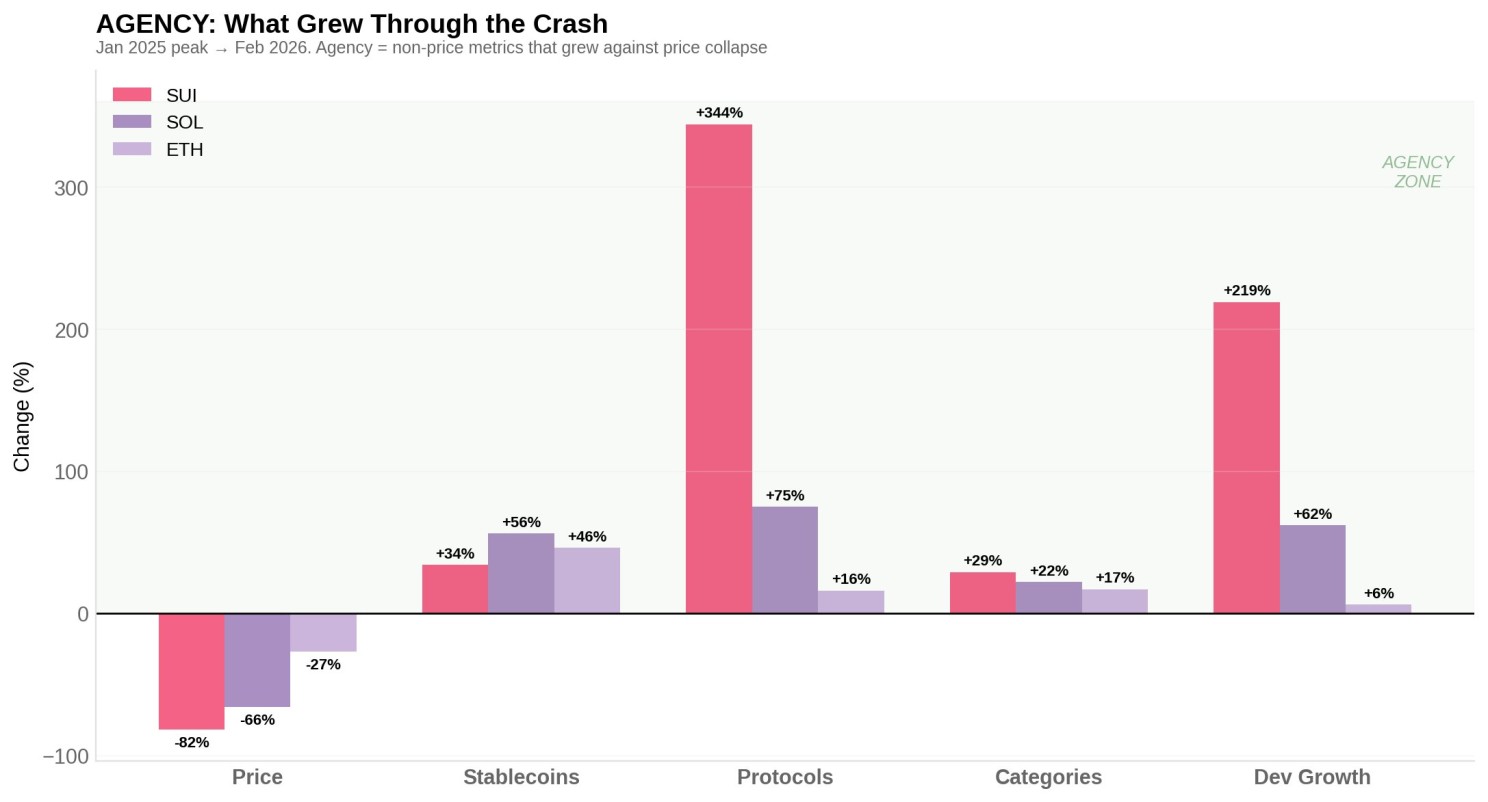
Growing wallets and growing value transacted, with developers arriving ahead of both, and all of it persisting through the drawdown... that's a survivor. Prove that and you're onto something. If you can't, you're holding a commodity.
Own the survivors, ignore the graveyard
The S-curve for any of these can include 90% downside in price, and the exponential curve of the ones that do survive drives them to new heights over time. Thousands of projects go through the same survive-or-die, then the network effects kick in, and the entire ecosystem rises.
So I don't spend my time in the long tail. It gets longer every cycle because there's so much issuance, and people convince themselves their hundred-x is out there somewhere in it, and while they're looking they miss the main trade sitting in plain sight. Focus on the adoption, not the price.
Most of it will die. The few that don't are the whole game.
This is one chapter of the framework I've spent twenty-one years building, and the whole of it, from the debasement that forces capital out of cash to the networks that catch it, is in my book, The Everything Code, out November 3rd and available to preorder now. You can pick up your copy here.


Comments
Log in or sign up to join the conversation.