


You did what you were told to do, and it hasn't worked.
Some savings, a pension, a tracker fund, a house if your timing was good... Once a year a statement turns up with a bigger number on it than last year's and you file it away, vaguely reassured. Two decades of that can go by while the number climbs and nothing about your actual life changes. You still can't take a year off. You still can't turn down the work you don't want. You should be freer by now than you are. You aren't, and you've probably concluded somewhere along the way that this is your own fault.
It's not. You were told to build the traditional portfolio. Some bonds for safety, a bit of gold, property if you could manage it, an index fund for growth, and the whole thing spread out so nothing single could hurt you. That was good advice. But it was for a different world, and that world has gone.
I know, because building those portfolios was my job.
I worked as a hedge fund manager, and that way of building a portfolio wasn't a preference I held, it was the water I swam in. You construct something that survives whatever happens next, you balance one kind of risk against another, and you sleep at night because nothing single can hurt you badly. I ran that playbook for years. Then I spent twenty-one years writing a research letter to hedge funds and family offices about how the world underneath it was changing.
So here is what I think you should do instead, and why the alternative isn't the reckless option people assume it is.
The number underneath it
Start with how an economy grows, because everything else follows from it. A country gets richer in three ways. It adds workers, those workers produce more per hour, or it borrows. That's the entire recipe.
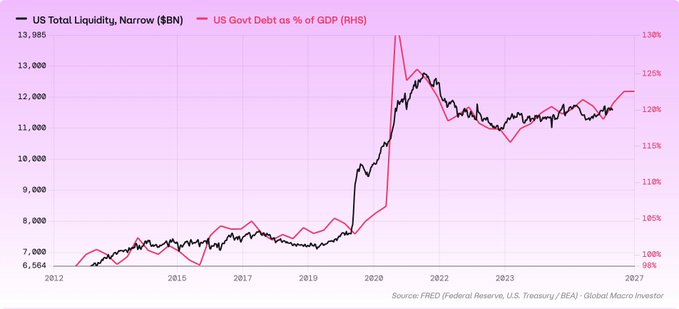
For most of the last century the first two did the heavy lifting. Populations grew, technology made each worker more productive, and debt was a supporting act. Neither of those engines works now. Birth rates fell decades ago and productivity growth has been sliding for years. So the third engine is doing almost all of it, and the third engine is a trap, because debt has to be serviced and the only politically survivable way to service it is to create more money.
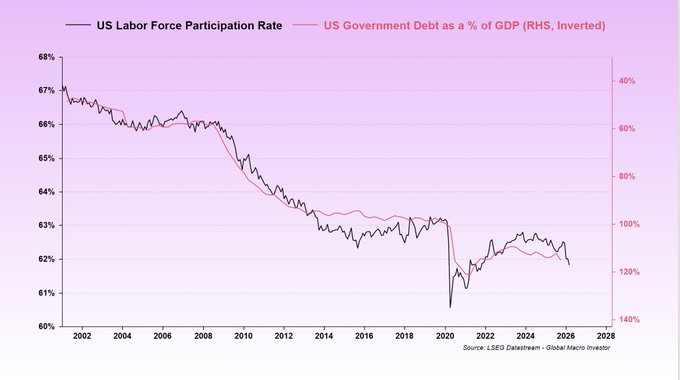
That's the machine. Governments borrow, the interest compounds, central banks create the money to absorb it, and the money you hold gets diluted a little more each year. Over time all of my work on this distilled into one framework: I call it the Everything Code, because once it clicks it does seem to explain most things. The full framework is in my upcoming book, also called The Everything Code, is coming out Nov 3rd but I’ll give you the headlines here
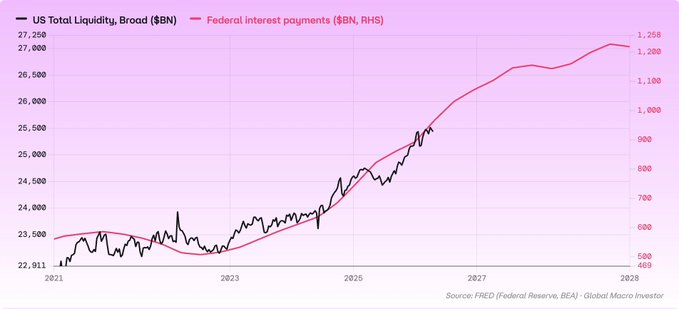
Global liquidity, meaning the total quantity of money and credit in the system, grows at around 8% a year. That’s the debasement of money. If there’s 8% more money in the system each year, then your money becomes 8% less scarce, and ultimately 8% less valuable every single year. Then add ordinary inflation on top. That's the two or three percent in the news, the shopping and the rent, and it's the number nearly everyone thinks they're supposed to beat. Beating it means you can still afford your life. It says nothing about whether you're getting anywhere.
Add the two together and you get the figure that actually decides it. Call it 11% a year.
Above that line you're building purchasing power. Below it you're losing it, whatever the statement says, because the statement is priced in the thing that's shrinking. Eleven percent a year, every year, just to stand still.
Which collapses the whole question of what to own down to a single filter. The question stops being what feels safe, or what looks sensibly balanced, and becomes what clears 11%.
So let's go through the options honestly, one at a time.
Walking the field
Start with bonds, because most people own them without ever being told what they are.
A bond is a loan. You hand over your money, you receive a fixed payment every year, and at the end you get the original sum back. That's the whole product, and the fixed payment was set by whoever issued it, priced against inflation rather than against debasement. So a government bond paying you 4% is a contract to receive 4% a year in money that's diluting at 8%, and then to be handed back your original sum, which by then buys considerably less than it did when you lent it. You can hold it to maturity, collect every penny you were promised, and end up poorer.
Property is the one people argue with me about, and they're half right, so let me be careful here.
The mechanism still works. Borrow at a fixed rate against something priced in a currency that's being diluted, and your debt shrinks in real terms every year while the asset drifts up with the money supply. That's a decent debasement hedge and I'm not going to pretend otherwise. I own property myself.
But what made a generation wealthy on housing wasn't the house, it was the timing of the mortgage. Take that leverage at the start of a forty-year fall in interest rates and the asset gets re-rated upwards every year you hold it. That trade can't be run again, because rates already went to zero and came back.
Most people can't get the mortgage now anyway. Property prices are too high against wages, and mortgage rates are too high on top of that.
And even if you can get one, the house itself is a weaker hedge than it was. Liquidity has grown so much faster than house prices since 2007 that the ratio between them fell and stayed down. Your house costs more in dollars and buys you less than it used to.
Then gold, and I want to be fair to gold, because the last twelve months make me look silly if I'm careless here.
Gold has had an extraordinary run. It went through $5,500 an ounce in January, a record, and sits near $4,600 as I write in late August, up roughly a third over the year. The financial press has even given the driver a name. They're calling it the debasement trade. On the face of it gold has just cleared my hurdle by a distance while I've been telling people it doesn't.
Here's the distinction that survives that. Divide gold by the size of central bank balance sheets across the last fifteen years and it has broadly kept pace. Which is precisely the job gold exists to do. It has held your purchasing power against the printing, and that's worth having. I'm not sneering at it.
But holding your purchasing power and growing it are different activities. Gold has no adoption curve. Nobody builds anything on top of gold. Its price moves with how frightened people are about money, and people are frightened right now, so it's expensive. What it does not do across decades is compound because more of the world uses it every year. Gold protects. It doesn't build.
Which leaves equities, and here the index everyone owns does better than the assets above it. The S&P 500 has compounded at something like 13% a year over the past decade. That clears 11%, just, and it took the single most successful decade in the history of the most successful index in financial history to do it.
Two things have cleared it properly.
Technology and crypto.
Why those two
Put them side by side, annualised over ten years, because a decade is long enough to contain a crash and short enough to sit entirely inside the debasement era.
Gold, around 12% a year. The S&P 500, around 13%. The Nasdaq 100, around 20%. Bitcoin, depending on whose measure you use and where you start it, somewhere between 58% and 70%.
Against a hurdle of 11%.
That's the answer to the question, and it isn't close. One of those is a rounding error above the line and one of them is a different order of magnitude.
Now the part that matters more than the returns, which is why it happened, because if the reason is luck then none of this is worth acting on.
It happened because both of those things are adoption curves rather than assets. A network gets more valuable to everybody already using it every time somebody new joins, which is Metcalfe's Law and it's the oldest observation in networked technology. Adoption doesn't proceed in a straight line either. It runs as an S-curve: slow, then very fast, then saturated. And for as long as you're on the steep part of that curve, the thing compounds faster than the money is being printed, structurally, not because sentiment favours it.
So the question stops being whether technology and crypto have outperformed, and becomes whether the adoption curve is finished. It isn't, and the reason it isn't is that the next wave of users arriving isn't human. I'll come to that, because it's the single most underpriced thing I know about.
Why the traditional mix stopped protecting you
The traditional portfolio rests on an assumption. Bonds, gold, property and equities are four different kinds of risk, so owning all four means no single event can take you down. That was true for a long time. It stopped being true somewhere after 2008, once liquidity became the dominant force setting prices, because if one thing is driving all four then you aren't holding four kinds of risk at all. You're holding one, priced four different ways.
Your bonds are a liquidity trade. Your gold is a liquidity trade. Your property is a liquidity trade. Your index fund is a liquidity trade with better marketing.
I'm not telling you that owning several things is a mistake. Spreading your money about is sensible and I do it myself. The problem is what the traditional mix is made of, because we've just walked through it and three of those four don't clear 11%, while the fourth clears it by a whisker in the best decade it has ever had. So you took the trouble to own four things, and every one of them is the same bet, and most of them lose to the money supply while they're making it.
Which means the useful question was never how many positions you hold. It's whether the part of your money that's meant to grow is sitting in anything capable of growing. Spread your money across as many secular trends as you can genuinely find. Spread it across four things that all sit below the hurdle and you've achieved nothing except the sensation of having been careful.
Where the value actually sits
Inside crypto, the question is which layer to own, and I want to be honest about the trade-off rather than pretend it away.
Applications can absolutely make you money. If you pick a protocol that finds real product-market fit, it can beat the base layer it runs on.
The problem is picking them. The base layers are the infrastructure everything settles on, so it captures the activity regardless of which applications win. You don't have to be right about who wins. You only have to be right that the economy moves onchain at all. That bet might make you less money than a correct application bet, and I'd rather say so than sell you certainty. It's just very much easier to get right, and there's still spare capacity in it.
Which is also why the industry's valuation tools don't work here. It imported them wholesale from equity analysis and never asked whether they transferred. Fee multiples, revenue growth, price to total value locked. We tested all of it at GMI across twelve major chains and none of it predicted returns. The only thing that did was whether capital that arrived actually stayed.
That makes sense once you accept what a blockchain is. It isn't a company selling a product and skimming a margin. A network's value comes from everything built on top of it, not from the fees it charges to let them build. Valuing Ethereum on its fee income is like valuing the internet in 1998 on what it charged you per email.
Which brings me to why I'm writing this now rather than in two years.
Every estimate of how large any of this can become carries the same buried assumption, which is that the user is a human being doing human things at human speed. A few transactions a day, a couple of payments a month, a handful of queries when something needs looking up.
That assumption is about to stop being true. AI agents, software that perceives, decides and acts without being asked each time, are arriving as economic participants rather than as tools. The forecasts I've seen have non-human identities outnumbering human employees inside enterprises by something like eighty to one.
An agent can't open a bank account. It has no legal identity, no branch to walk into, and no tolerance for a settlement system that shuts at five and takes three days to clear. What it needs is programmable money on rails that never close, and that is the thing the base layer does natively and nothing else does at all.
The plumbing is going in publicly, right now. Anthropic built the Model Context Protocol and then gave it away. Google has built Agent2Agent and previewed WebMCP, which lets a website expose its functions to an agent directly rather than making the agent pretend to be a person clicking. Coinbase brought back x402, which lets agents pay each other over HTTP.
That is a demand forecast for settlement capacity, and it arrives whether or not a single speculator shows up.
The objection worth taking seriously
Concentration is survivorship bias, and anyone who waves that away is selling you something.
You hear from the man who put everything into one position and never worked again. You don't hear from the thousand who did the identical thing and were wiped out, because they've gone quiet. Go and read the anonymous confessions accounts sometime. It's bleak, and it's a far truer sample than any success story you've been shown.
So I'm not telling you to put everything into one thing. That has never been the argument.
The argument is that once you've identified a genuine secular trend, the number of positions you hold is close to irrelevant. Two dials decide your outcome. How much of your capital sits in the trend, and how long you leave it there.
Then a third rule, which is a prohibition rather than a dial. No leverage. Not a little, not carefully, not with a stop. Leverage removes the one thing this whole approach depends on, which is your ability to sit through a 50% drawdown without being forced to act. You can be completely right about the decade and still be liquidated inside a fortnight, and the market will not give you credit afterwards for having been right.
For most people the sensible shape is a split. Keep an allocation to the conventional portfolio, the one that lets you sleep. Put a meaningful allocation into the secular trends. Then size the second one so that it halving doesn't force you to do anything at all, and go and spend your attention elsewhere.
Because the pattern I've watched for thirteen years in crypto is that the people who compound are almost never the busy ones. A 40% drawdown is an event while you're inside it and a wobble on the chart afterwards. Doing nothing is a strategy. It's also much harder than it sounds, which is why so few people manage it.
Comments
Log in or sign up to join the conversation.