

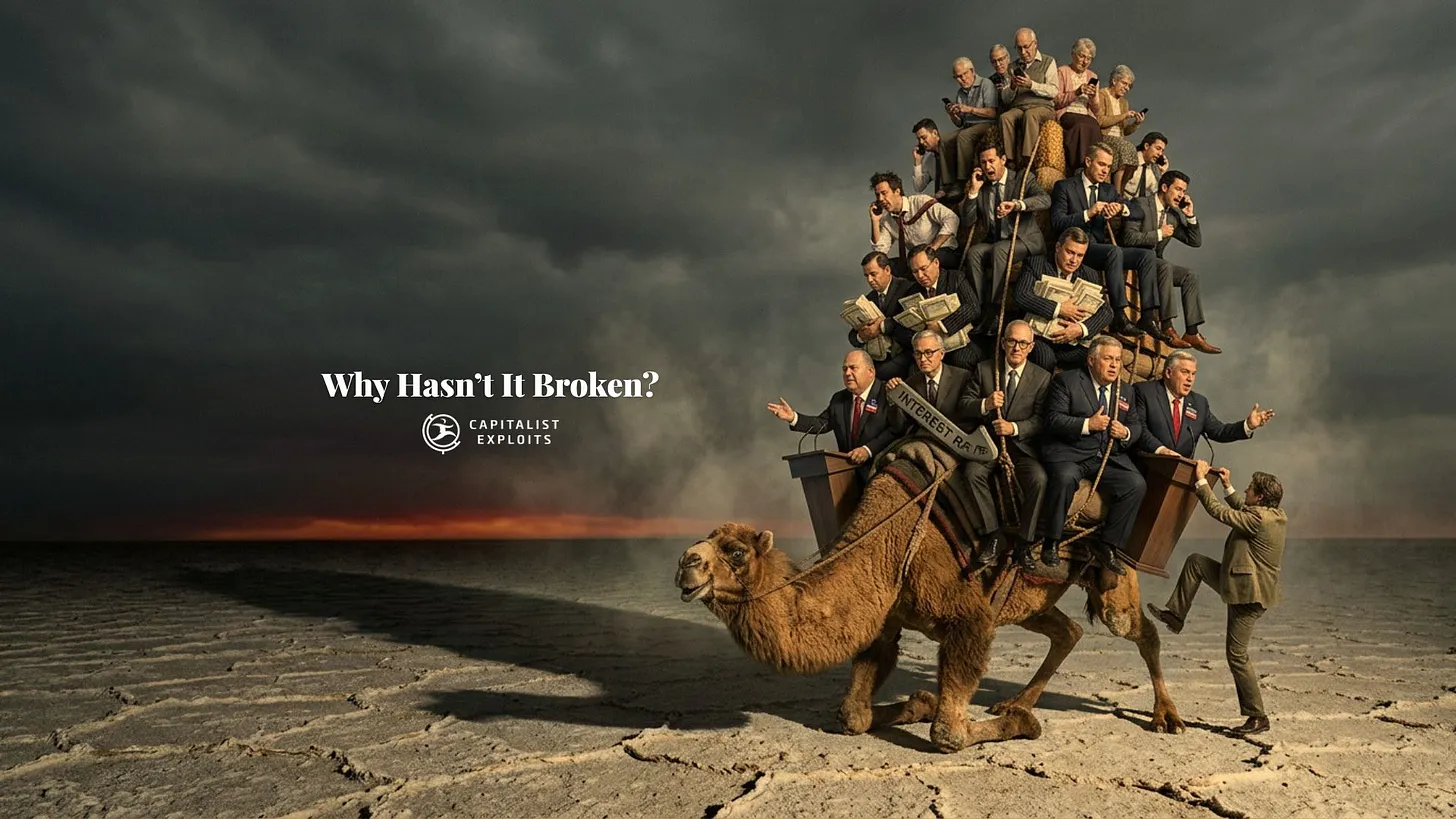
Every straw that should have broken the camel’s back has already landed. It’s still standing. That should worry you, not reassure you.
Everybody wants to know when it breaks. The bond market, Japan, the AI mania, the next war...pick your straw, and someone will tell you it is the one that finally breaks the camel’s back.
It is the wrong question. The interesting one, the one worth actually sitting with, is the reverse. How has it stayed together this long?
Ask that, and the whole picture changes.
The Power Nobody Talks About
The honest answer is that it has stayed together because of a single power, and that power is the ability to lean on the price of money.
Almost the entire world runs on a dollar credit system, and the lever that sits underneath all of it is the short-term interest rate. That is the rate a central bank sets directly, and it is the price of money itself: the cost of borrowing, the cost of carry, the yield you earn on cash. Hold it down near zero for long enough, and you do not move one stock or one bond; you lift the price of everything at once, because cheap money makes every asset look attractive and cheap to finance…equities, bonds, private credit, property, the lot. The assets themselves are still valued off the long end of the curve, the ten- and thirty-year, but the short rate is the ground the whole structure is built on. It is a phenomenal power. Like any phenomenal power, it gets used, and this one has been used to its absolute limit.
Which is another way of saying it is nearly spent. A tool used to its full extent is a tool with nothing left to give.
And here is the part that matters for you, sitting there with a pension or a brokerage account. That same power, held down for forty years, did something quietly enormous. It funnelled the entire planet into the same trade.
Everybody Owns the Same Thing
We run money for a living, and we see the evidence of this every week. A prospective client comes in from Ohio. Another from Tokyo. Another from South Africa, another a family office in the Gulf. Different continents, different tax codes, different currencies. We look at what they already hold, and it is, by and large, the same thing. The S&P 500 (SPY), or a fund that quietly mirrors the S&P 500, given a clever name and charged an extra two or three percent a year for the privilege.
It is not a coincidence. It is mechanical, and the machine is the passive index fund.
Here is how it works, without the jargon. Say you put a thousand dollars a month into your retirement plan, and a chunk of it lands in an S&P 500 index fund. That fund is market-cap weighted, which means it buys the most of whatever is already biggest. So more of your thousand dollars goes into the largest company than into the five-hundredth. That buying pushes the biggest company’s value up further...which tells the fund to buy even more of it next month. Bigger begets bigger. It is a feedback loop with no brake and no judgment about whether any of it is worth the price.
Run that loop for long enough with the whole world plugged into it, and you arrive where we are now. The ten largest companies are roughly 40% of the entire S&P 500, a bigger share than at the peak of the dot-com bubble, when the top ten were 26.6%. Around two-thirds of the entire MSCI World index, every developed market on earth added together, now sits in one country. Even Chinese and Middle Eastern institutions, buying “global” funds, end up funnelled straight back into the same handful of American names.
So when people ask how the market held together, that is the answer. Cheap money for forty years, and a machine that herded everyone into the identical position. The scariest part is not that everyone owns it. It is that most of them have no idea they do. I have sat across from pension fund managers who genuinely could not tell me what was inside the products they had bought. They saw a yield, they saw a label, they ticked the box.
Which raises the obvious question. If everyone already owns it, who is left to buy it?
Three Bubbles, One Nail
Hold that thought, because the concentration is only the visible half. There are really three bubbles inflating at once, and they are all hanging on a single nail.
The first is the private credit bubble. In the past, private credit and private equity were the playground of institutions and the very wealthy. Then, under the Trump administration, the rules were changed to let ordinary retirement plans in. It was sold as opening the velvet rope, letting you into the magic room. It was nothing of the sort. It was the smart money exiting at rich prices and handing the risk to the peasants on the way out.
The second is the AI and mega-cap equity bubble, the one everyone can see. The capex is going vertical. It was funded first with equity, and now, increasingly, with debt...because there are no profits underneath it to fund it with. It has curdled into something close to farce, with the chipmakers now lending money to the customers so the customers can keep buying their chips. That is not a growth industry. That is lending money to the neighbour with a drinking problem and no job so he can keep buying beer from your shop. Meanwhile, the broad market sits near 40 times its cyclically adjusted earnings, richer than almost any moment in a century.
And the third is the one nobody counts as a bubble at all, because it is the thing that is supposed to be safe. Government bonds. The “safe” bucket in your pension is arguably the most stretched of the lot.
Now here is why all three are really one. The nail they all hang on is the interest rate. Private credit was financed three, four, five percentage points cheaper than money costs today. As that debt matures and has to be refinanced at today’s rates, the borrowers need fresh cash they do not have, so they are forced to sell...and discover their assets are not worth what the marks claimed. That is why hundreds of these funds are now gating, which is a polite word for telling you that you cannot have your money back. The AI debt faces the same wall when it rolls over into higher rates. And the government-bond bubble simply is the interest rate.
So watch the rate. Specifically, watch the long end, the thirty-year, because that is the one the central banks cannot easily control. They can pin the front of the curve. The far end is a market, and a market votes. The US thirty-year yield is now above 5%, a level that used to flash danger and now barely makes the news, and German thirty-year yields have broken out the same way. The long end is the tell, and it is telling you the power to hold the price of money down is failing.
It is worth being precise about that thirty-year, because it is not the number most people think it is. It is not your mortgage. A thirty-year mortgage actually takes its cue from the ten-year, because almost nobody holds a mortgage for the full thirty...people move, they refinance, they pay it off early, so the ten-year is the honest yardstick. The thirty-year Treasury is a different animal. It is the price the government itself pays to borrow for the long haul, and it is the rate against which pension funds and insurers discount the promises they have made to pay you decades from now. Nudge it, and you change the value of every one of those promises at once.
It is also the number a central bank can do the least about. The short end it sets by decree. The far end it can only plead with, because that yield is the market pricing three things it cannot fake...where inflation settles over the long run, where the government's borrowing is actually headed, and whether the sovereign can still be trusted to pay in money worth having. That is why a thirty-year that climbs and refuses to come back down is not really a rate move. It is a verdict.
The Nail Is Being Pulled, and It Is Being Pulled in Tokyo
You do not have to take the theory on faith. You can watch the power fail in real time, and the place to watch it is Japan.
Through August, the US Treasury and the Bank of Japan spent billions trying to prop up the yen. Go back over that sentence, because it is stranger than it looks. Why would Washington spend its own money defending someone else’s currency?
Not because anyone in Washington cares about the yen. Because Japan is the largest foreign owner of US government debt, and to defend its own currency, Japan has been selling US Treasuries. Washington cannot allow that. It has a mountain of its own new debt to sell, and it needs every buyer it can find, not its biggest creditor heading for the exit. So it is spending real money to stop Japan from having to sell the very bonds it needs the world to keep buying.
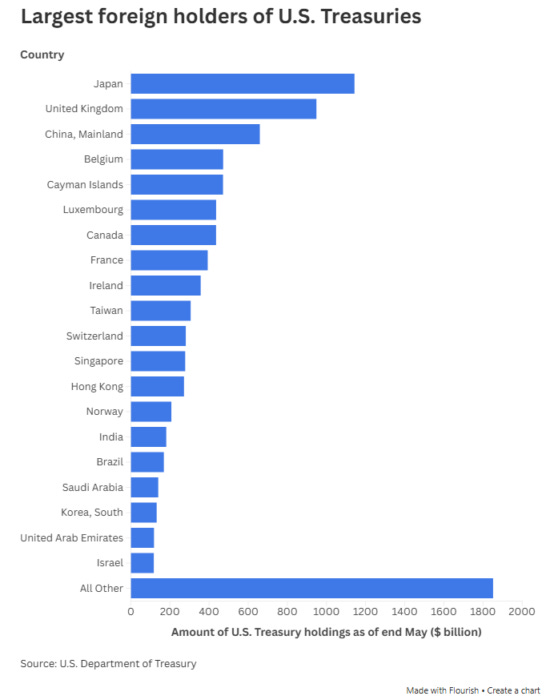
Largest foreign holders of US Treasuries. Japan sits at the very top of the list...and it is the one being forced to sell.
And how did Japan end up forced to sell? Because the war in the Middle East drove up the cost of the energy Japan imports, which hammered the yen, which forced the defence. In other words, the US lit a fire that singed the pockets of its own banker, and is now frantically holding that banker upright. It shot its own banker in the foot, and is carrying him to the hospital because it cannot afford to let him fall.
That is what the end of the power looks like. Not a crash on the news. A government moving heaven and earth to stop one creditor from selling.
Where the World Isn’t
None of this is a counsel of despair. It is the opposite, and this is the part the doom merchants always miss.
If two-thirds of the world’s money is crammed into one trade, then by simple arithmetic the opportunity is everywhere that money is not. And the map of where it is not is not hard to read. Commodities, measured against the Nasdaq (QQQ), are sitting at multi-decade lows, in some cases the lowest in almost fifty years. Energy is around 3% of the S&P 500, close to the smallest slice in its history, at the exact moment the world is destroying refining and production capacity. Emerging markets and cheap Asian equity trade at a fraction of the American multiple, with the MSCI China index (MCHI) at roughly 11 times forward earnings against nearly 40 for the US.
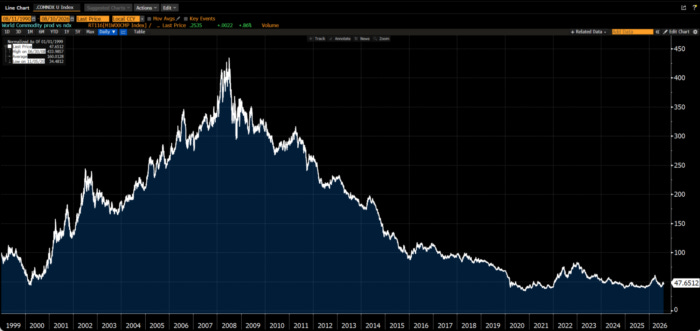
Commodity producers measured against the Nasdaq. You have to go back decades to find them this unloved.
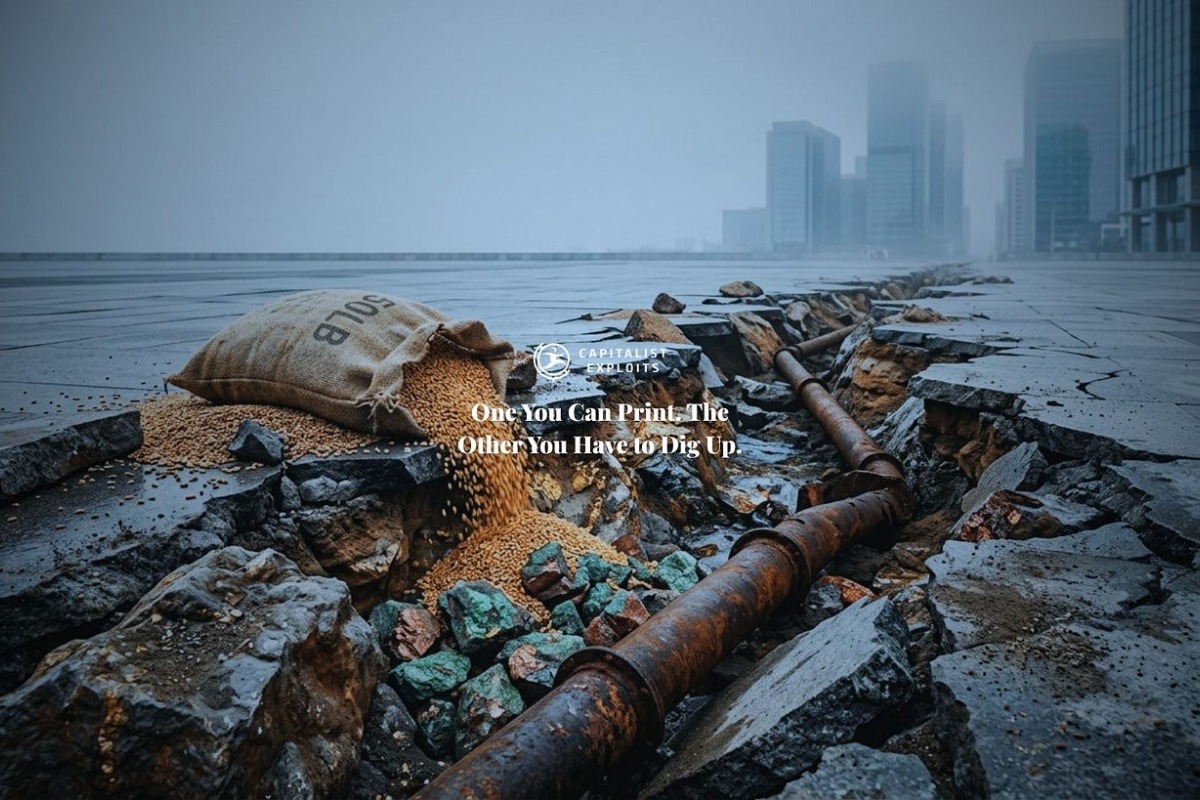
These are the things that cannot be conjured into existence by an administrative pen or a piece of paper from a Wall Street desk. You cannot print a barrel of oil, a tonne of copper, or an acre of farmland. On a relative basis they are the cheapest they have been in decades, precisely because everyone is standing on the other side of the boat. That is what asymmetry looks like: modest downside, because the price already reflects that nobody wants it, and serious upside when the crowd is eventually forced to turn around. None of this is a recommendation, and you should do your own research. But that is where we have been positioned for some time, and it is not an accident.

Comments
Log in or sign up to join the conversation.