

It’s now close to eight months since the US Federal Reserve increased the base interest rate from 0.25% to 0.50%. Many people were expecting a similar increment this past July, but it never came. Now, the attention has been turned to September, but I have a feeling that FOMC will again take a pass.
This leaves December, as the most realistic date for another increment, in which case, it would be 12 months since the previous hike. However, former FOMC Chairman Ben Bernanke feels that it may take a while before the Fed increases interest rates again.
While high interest rates are magnificent for investors, sometimes they are not the only catalyst for investor attraction. Consumer spending ranks highly amongst the key economic drivers in an economy and the higher the spending, the better the market for investments.
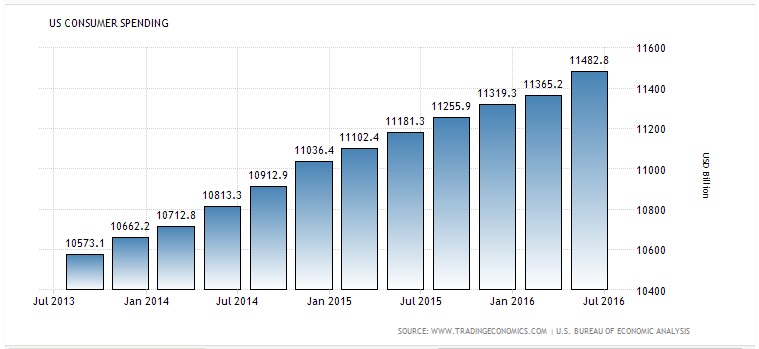
Simply put, if consumers are willing to spend more on products, it means that there is increased demand for that particular product. In return, companies selling the product will experience topline growth as sales increase. This growth then trickles down to earnings and into the pockets of investors in the form of dividends.
On the other hand, interest rates offer investors an opportunity for higher returns on fixed income investments like bonds and notes. Stocks also ride on this yield thereby becoming an attraction to investors. However, high interest rates have also appeared to coincide with high credit defaults, a good example being the pre-global financial crisis period of 2008/2009.
Many people have moved to repair their credit scores in a bit to lowering their effective borrowing rate. According to this review on CreditMarvel.com, people with a bad credit score can now easily repair their FICO scores significantly by simply disputing some of the non-issue items cited, within a month’s time.
Increased consumer spending—especially when most of it is financed by debt—can also lead to high default risk. Remember the mortgage bubble of 2007/2008? That was one of the sources of the 2008/2009 global financial crises.
While both attractions can be present at the same time, this rarely happens. With high interest rates, it means that people are less likely to spend more and instead opt to add to their savings. High interest rates mean high returns on fixed deposit savings and related products.
On the other hand, when interest rates remain low, borrowing activity increases as people look to capitalize on the low cost of doing business. As such, businesses tend to grow during such times, which in turn lead to increased consumer spending. This case scenario suggests that we are more likely to see high interest rates and low consumer spending than we are likely—high interest rates and high consumer spending.
Nonetheless, the fact is that with high consumer spending, you could expect to witness increased interest rates down the line. This is the current situation in the US. The law of investing states that it is good to invest when prices are low and sell when they are high.
As such, markets that have low interest rates but experience high consumer spending stand out as the best attractions for long-only investors. The low-interest rates make investing in a particular market cheaper while the high consumer spending acts as an incentive for a future increase in interest rates, which then boosts returns.
For instance, when you look at the US stocks, last year they rallied to new record highs with the S&P 500 (SPY), the NASDAQ (NDQEMT) and the Dow Jones (INDU) all touching new levels. That was in July and also just before the rate hike. After the rate hike in December, stocks descended as questions arose regarding how justifiable the hike was.
Since February, most of those losses have been regained with another rate hike on the horizon. Meanwhile, consumer spending in the US remains strong thereby, supporting a case for a second rate hike. But with stocks having recovered significantly, there are questions on whether or not the market has already priced in next anticipated increment.
If that’s the case, then it would mean that consumer spending which has remained strong throughout the year, has played a major part in restoring faith and banishing panic in the US stock markets.
In summary, consumer spending in the US has been a major attraction to investors over the last three years and this is demonstrated by the fact that even when interest rates remained low—and all that we had was a promise of a rate hike—stocks continued to rally.



Comments
Log in or sign up to join the conversation.