

From an email from Tim Congdon, at the International Institute for Monetary Research (9/20):
I suggest that a more plausible figure for end-year PCE annual inflation is between 5½% and 6%. (The consumer price index – up by 4.5% in the first seven months of 2021 – may finish the year with a rise somewhere in the 6½% – 7½% area.)
The conclusion is based on the following reasoning:
In the background here is the huge overhang of excess money balances. In the year to mid-May 2021 the M3 measure of broad money increased by 35%. The evidence over many decades is that – in the medium term – the growth rates of money, broadly-defined, and nominal gross domestic product are similar. So – unless that 35% number is now followed by a big contraction in the quantity of money – the US economy will continue to be affected by two conditions, specifically,
• ‘too much money chasing too few assets’, and
• ‘too much money chasing too few goods and services’.Of course the two conditions are interrelated and also interact with each other. Our research emphasized last year that rapid money growth was likely to boost asset prices first, and that has been right. (Incidentally, to attribute the behaviour of the prices of US tech stocks to bottlenecks and supply shortages would be daft. Does one have to say these things?)
What’s the implied path of the PCE deflator, relative to nowcasts and forecasts? See Figure 1, where I’ve used the mid-point of Congdon’s forecast (5.75% December y/y), shown as the red square.
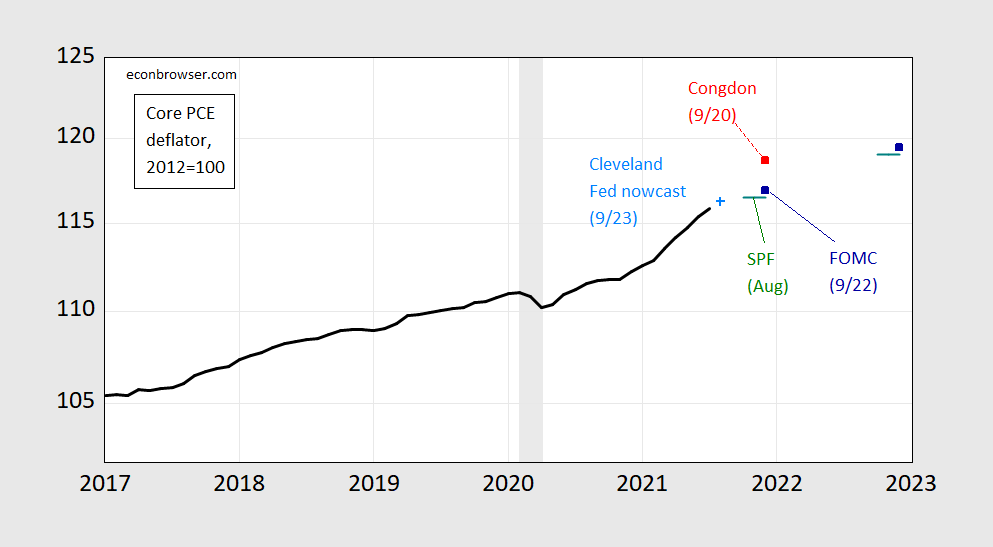
Figure 1: Personal Consumption Expenditure deflator (black), Congdon midpoint forecast (red square), Cleveland Fed nowcast as of 9/23 (sky blue +), Survey of Professional Forecasters August median forecast (green line), FOMC 9/22 projections (blue square). Source: BEA, Cleveland Fed, Philadelphia Fed/SPF, Federal Reserve, and author’s calculations.
The FOMC median forecast is surprisingly similar to the Survey of Professional Forecasters’ median forecast from the preceding month (mid-August). The FOMC members then still perceive a deceleration in inflation in the last half of 2021.
Congdon’s forecast looks plausible given the August PCE deflator nowcast (and even more using the September). However, it’s far outside of the range projected by the FOMC, as shown in Figure 2, which includes the high/low inflation forecasts.
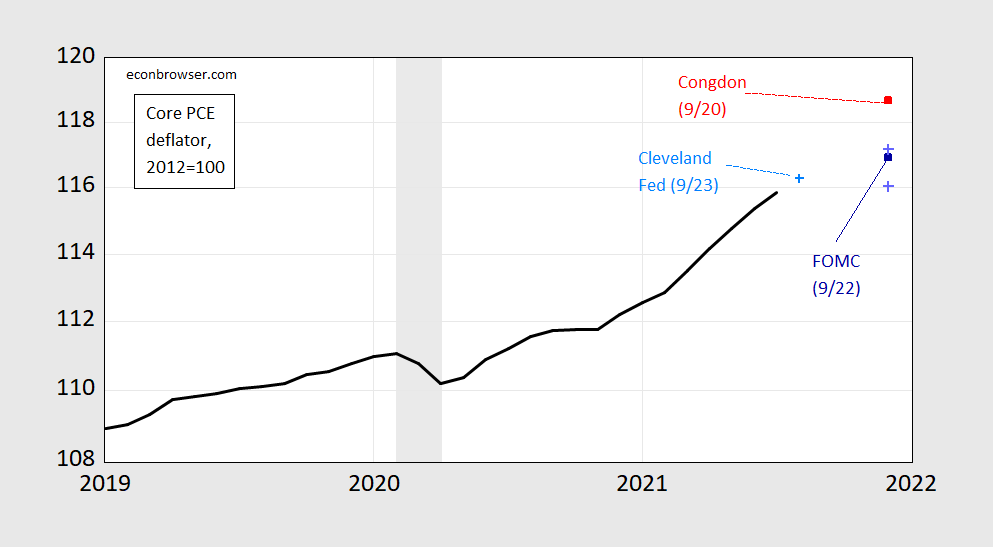
Figure 2: Personal Consumption Expenditure deflator (black), Congdon midpoint forecast (red square), Cleveland Fed nowcast as of 9/23 (sky blue +), FOMC 9/22 projections (blue square), high and low forecasts (dark blue +). Source: BEA, Cleveland Fed, Federal Reserve, and author’s calculations.
In other words, the monetarist view (if I can use Congdon’s view as a proxy) differs from both a mixed bag of mainly mainstream economists (proxied by the Survey of Professional Forecasters) and policymakers (the FOMC).

Comments
Log in or sign up to join the conversation.