

Markus Winkler- Unsplash
Recessions appear only to the naked eye long after they are fully underway. Economists use a rather lame definition of a recession, namely, two back-to-back quarters of economic contraction. However, proof of a decline is only made available a couple of quarters after the fact, often too late to adopt changes in monetary policy . Policymakers are at a distinct disadvantage when it comes to relying on timely data releases. Nonetheless, businesses and consumers are living daily through a recession while waiting for some action by central bankers.
In the case of Canada, the most recent job numbers clearly point to a recession underway, putting considerable pressure on the Bank of Canada when it meets on March 18th. The start of 2026 has been dismal, as there has been a wholesale retreat in the private sector employment growth. Overall, the economy shed 109,000 jobs, cumulatively in January and February, included are:
Wholesale and retail trade lost 18,000 jobs in February, making a grand total of 52,000 lost jobs in the sector since October, 2025;
Manufacturing lost 28,000 workers in February
Education, once an important growth sector, experienced a loss of 24,000 positions and
12,000 construction workers were no longer needed, as construction declined.
The drop of 84,000 jobs in February pushed the unemployment rate from 6.5% to 6.7%. More worrisome is that the job losses were widespread across industries, with private sector employment down by 73,000, and public sector jobs decreasing by 17,000.
Canada’s overall economic performance has generally been lacklustre, barely keeping up with the growth in population. Overall, growth in 2025 was an anemic 1.7%,both business investment and exports declined. After a real decline in growth in 2025 Q4, the job losses this year strongly suggest that 2026 is off to a poor start.
Canada’s economic performance
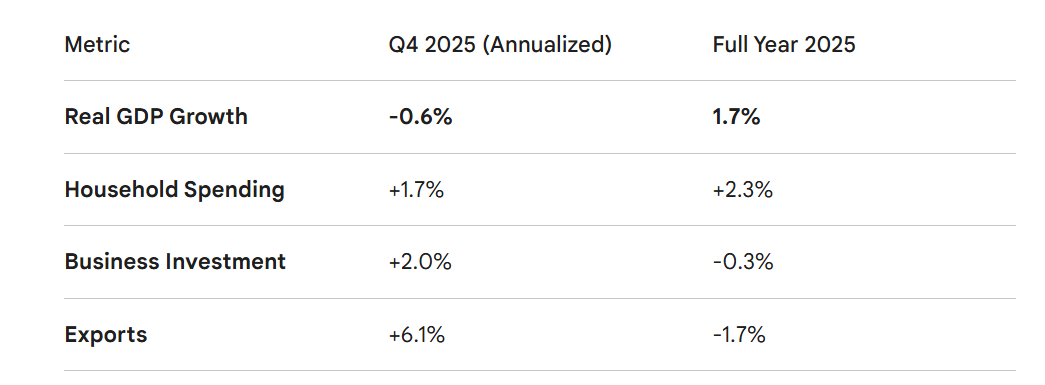
So, as children on a car trip say “ are we there yet ?”, has the recession started? This is the issue before the Bank of Canada at its next rate meeting on March 18th.
The task before central bankers everywhere is overshadowed by the outlook for inflation as energy prices move all over the map in response to daily events in the Middle East. It would not be a surprise to anyone if any central banker felt like hiding behind the curtain ,avoiding any public appearance. At this moment, the odds-on bet is that central bankers will stand pat and not drop rates. The lack of clarity regarding oil prices means the bankers have no clear vision regarding both inflation and economic growth. Recent inflation numbers for Canada have been running at slightly below target, but with the spike in oil prices yet to show up fully in the economy, the recent past is no guide to the future. In addition, spending more for gasoline at the pump means consumers will likely cut back elsewhere. The current oil shock could work in either direction, making life even more difficult for a central banker.


Comments
Log in or sign up to join the conversation.