

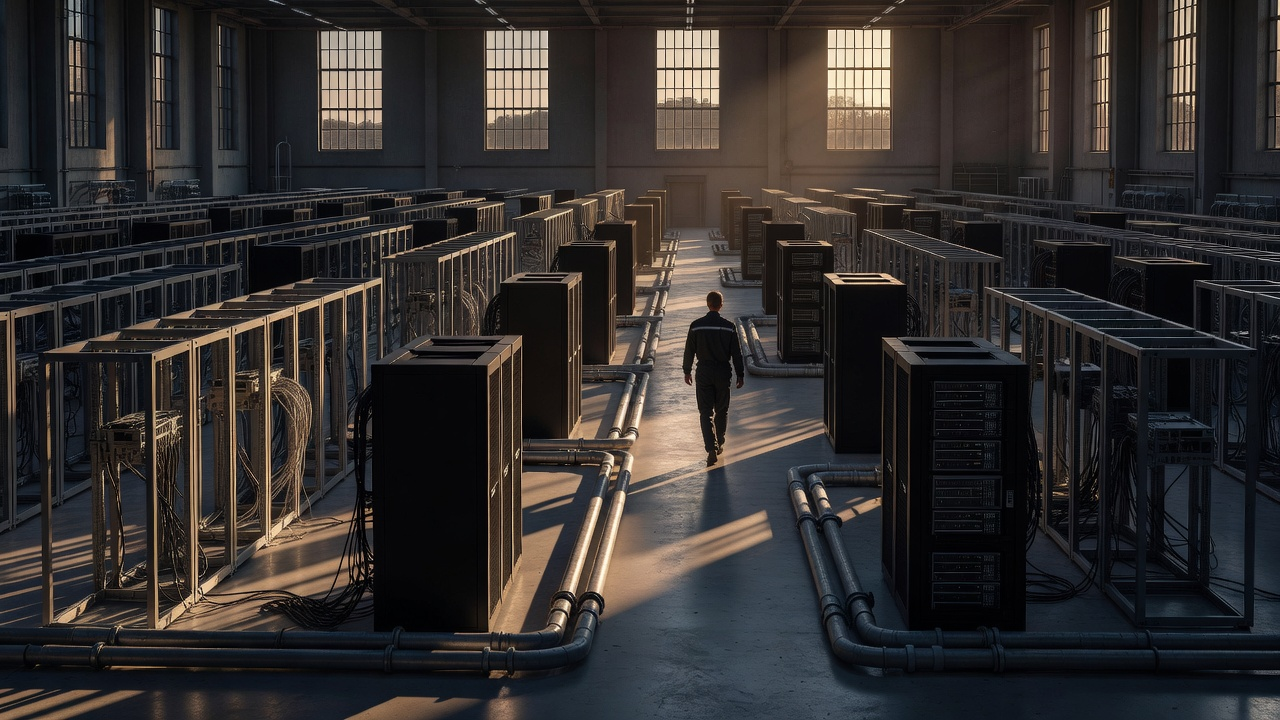
Wall Street keeps arguing about whether America is building too many AI data centers.
That is the wrong frame.
The real risk is simpler and meaner. We can still be short of usable power in the places that matter and still pour hundreds of billions into factories that stop earning their keep before the next generation of silicon and rack design takes over. Dark fiber could sit in the ground and wait. A GPU rack does not wait politely for demand to catch up.
My take: overbuild looks like speculative campuses, duplicate power requests, and this-generation hardware priced as if the current AI stack lasts as long as a power plant. It does not.
What “too many” actually means
Start with the money, because the money is what the market is underwriting.
The big cloud and platform names have guided toward something on the order of $700 billion to $800 billion of capital spending for 2026, with a huge slice aimed at AI factories, chips, cooling, and the concrete that holds it. That is a construction boom wearing a software logo.
Then look at the press-release map. Analysts tracking announced AI capacity have floated figures in the 150-plus gigawatt range of projects talked about for this decade. One widely cited cut puts only about 84 gigawatts of that pile as likely to get built by 2030. The gap is half a dream list.
Real demand did not vanish. Vacancy in many primary markets is still tiny, and a lot of capacity that actually breaks ground is already spoken for by hyperscalers. Power, transformers, switchgear, and interconnection queues are still the hard wall. In plenty of U.S. metros, the date you get megawatts is years out, and no spreadsheet moves that date.
So the honest split is this. Usable, powered, pre-leased capacity can stay scarce while the announcement pipeline is bloated. Speculative shells without interconnection, tenants, or financing that survives a rate bump die first. Local overbuild can show up as empty halls in the wrong city while Northern Virginia still cannot get enough juice. For the grid, the near-term worry is often underbuilding relative to AI load. Buildings and silicon are a different story.
Why this generation can go stale
Here is the part Wall Street still soft-pedals.
An AI data center is a stack.
The building and the grid hookup can last decades. The chips, boards, networking, and cooling layout turn over on a much shorter clock. Public filings and industry practice still talk about useful lives in the roughly four-to-six-year band for a lot of this gear. Nvidia (NVDA)’s architecture cadence is closer to an annual product cycle with step-change performance jumps. Amazon (AMZN) has already shortened assumed lives on a slice of servers, citing how fast AI hardware is moving. Other hyperscalers still book longer schedules. That fight is a bet on how long today’s racks stay the economic best tool for the job.
Older GPUs can cascade into cheaper inference and fine-tuning work, and rental markets have shown older generations can still book. That helps residuals. It does not save a campus designed around last year’s power density, liquid cooling plan, and interconnect if the next training cluster wants a different shape of building. A poorly designed AI hall can age before the ribbon cutting finishes, even while the megawatt interconnection stays valuable. The shell can be reused. The specialized guts can turn into a write-down with a nice view.
The late-1990s fiber boom is the rhyme people reach for. Carriers spent on the order of half a trillion dollars laying glass, and huge stretches sat dark for years. Fiber could wait underground. A financed GPU fleet is closer to a fleet of expensive phones bolted into a warehouse. When utilization slips or a newer chip makes the power-per-token math ugly, the clock runs in months and years, not decades.
If you own stocks
Treat the AI buildout as three seats, not one ticker.
Power and interconnection are the long-life layer. Scarcity there can stay real even if chip demand wobbles. Hyperscalers sit in the middle: they can still grow through the mess, but free cash flow, lease commitments, and depreciation assumptions matter more than revenue slogans. GPU landlords and neo-cloud names live closest to the obsolescence blade. Their story needs utilization, residual values, and customers who are not only friends on the cap table.
What would change my mind is boring and public: AI revenue that covers the depreciation stack, older fleets that keep booking without endless balance-sheet help, and power projects that energize on schedule. Until those show up clean, I treat “we are building the future” as half true and half marketing for this quarter’s concrete pour.
Bottom Line
America can underbuild usable AI power and still overbuild this generation of AI factories. The grid and the site can outlive the silicon. The expensive risk is infrastructure that stops paying for itself before the next generation is ready to replace it.


Comments
Log in or sign up to join the conversation.