

With all the gloom surrounding Chinese financial markets in the wake of the trade war escalation, we point out in this article (what may be a surprise to some!) that it’s not all bad news in China. The chart in focus for this article shows there has been strong growth in property prices as well as a recent rebound in producer price inflation. In a world that was obsessed with deflation a couple of years ago, this interesting inflationary increase is something worth keeping an eye on for a few key reasons.
The chart below shows, as alluded to earlier, there has been strong growth in property price but it seems to be stabilizing now. Also shown is a recent rebound in PPI and on face value it appears this is linked to the uptick in property price growth.
(Click on image to enlarge)
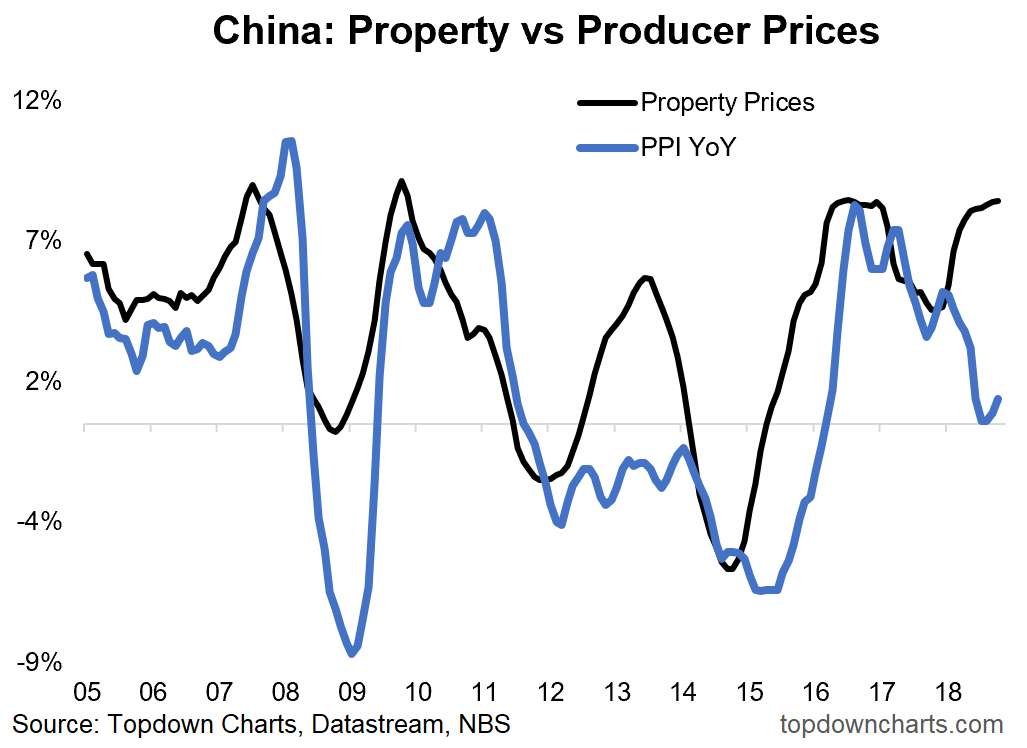
Specifically, the chart shows the average property price growth across the 70 major cities against the YoY growth in the headline PPI (producer price index).
Some might point out that the PPI index is mostly driven by commodity prices, and there is a lot of truth to that, but it shouldn’t be lost that the Chinese property sector (and China as a whole) is one of the largest drivers of commodity prices globally from the demand side, with property in particular heavily consuming industrial metals. So there is an economic logic in the link between the two series.
What’s not shown but is also worth mentioning is that according to our data, much of the recent acceleration in property price growth is coming from ex-tier-1 cities. These smaller cities have benefited from reforms/easing of local residency requirements (i.e., another mini-wave of urbanization). But most importantly, the smaller cities have an out-sized impact on real estate FAI (fixed asset investment), which is key for commodity demand and remains an important driver of growth in China (as it does for many other economies).
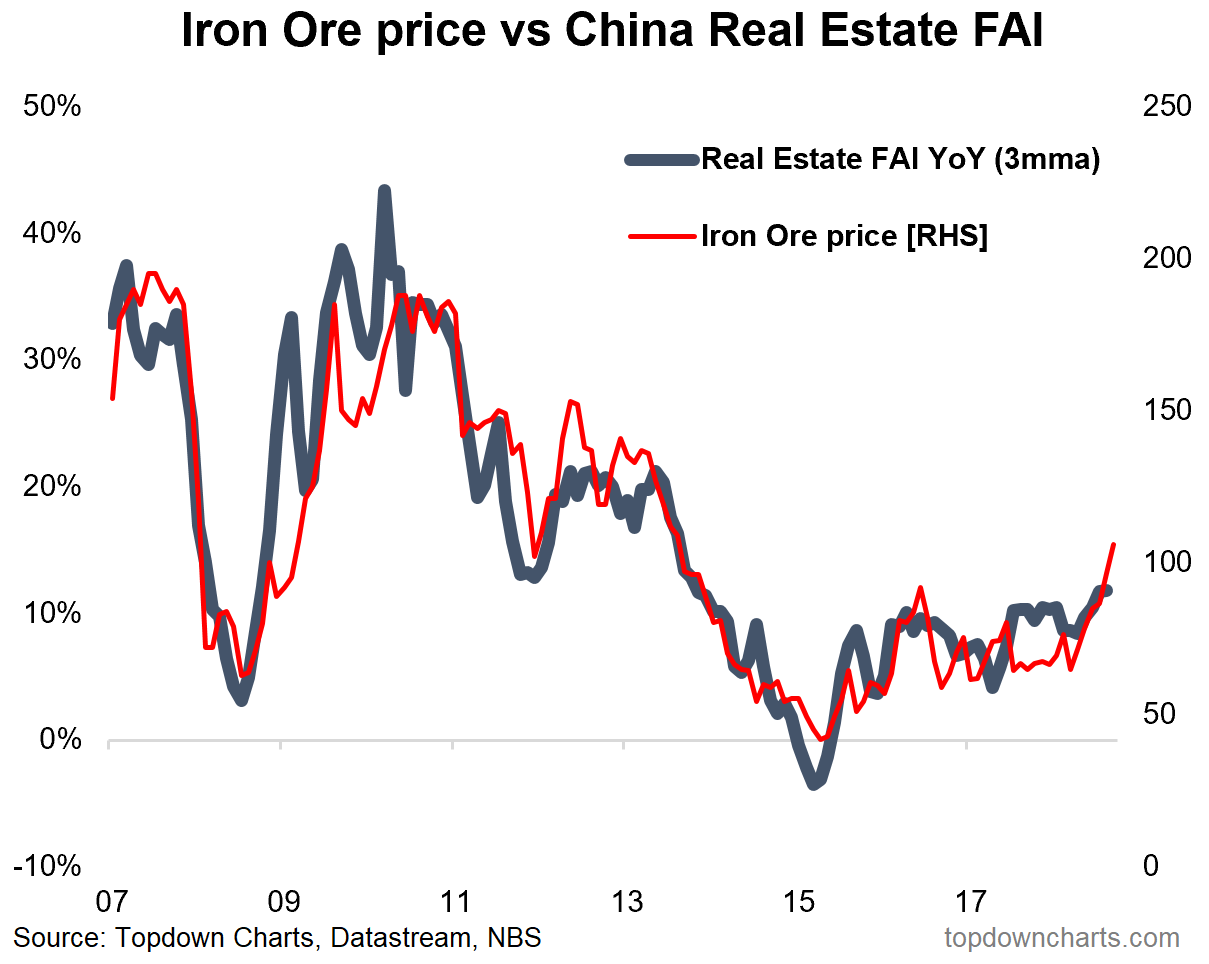
Indeed, this next bonus chart shows how Chinese real estate FAI growth has been accelerating. Interestingly enough, iron ore prices have likewise been picking up, and although there are also some supply-side issues in Brazil which have added to the rise in prices, there is clearly also something going on with demand.
(Click on image to enlarge)
It’s also worth highlighting that even with the gloom of the war, consumer confidence in China has been resilient, running at multi-decade highs. Although the trade war is a clear and definite negative for China, it’s not the only game in town for China’s economy.
Speaking of the trade war, with both countries playing hardball it is hard to see a possible trade deal being signed between the two nations in the near term. If and when it does come, obviously it will be a positive, but it’s probably sensible to have a no-deal as the base case for the time being.
So while there are clear and definite headwinds to China’s economy from the trade war escalation, it’s not all doom and gloom, and if anything from a cyclical standpoint Chinese property and commodities could stand to gain further as animal spirits get stoked by rising property prices, nationalist sentiment, and likely further ongoing stimulus measures.


Comments
Log in or sign up to join the conversation.