

This is going to be a very big week, make no mistake. This week will compact the ISM and Jobs data into three trading days, all ahead of a holiday weekend. This data will likely tell us rather loudly whether the Fed could begin to taper in September or if it gets pushed out to November.
The Jackson Hole summit revealed tapering is coming and if the current pace of economic growth remains, tapering is coming before year-end. I think it will take a massive slow down in the economic data to push off a tapering announcement and commencement into 2022. I don’t see that happening.
While economic data is slowing, it is not suggesting recession; it is slowing to the historical GDP growth trend. Currently, the Atlanta Fed GDPNow model suggests that the third quarter is growing at 5.1%, which is much slower than current estimates based on polls compiled by Refinitiv, of 7.0%.
Make no mistake, a 5.1% GDP growth rate is too dire of a growth rate, but that follows a weaker-than-expected second-quarter reading. Even if growth continues to slow, it will not derail the Fed from moving to zero asset purchase. The prospects of higher interest rates are another topic.
The equity market’s rise on Friday was because Powell did not note the 'when' regarding the timeframe in his speech. However, the Fed governors have been growing increasingly hawkish in recent weeks and months, and these are whom you should be paying attention to, not Powell. These governors carry the message for Powell, as taper talks first started with Kaplan in May, and the list has continued to grow.
It is a game of good Fed, Bad Fed governors, with Powell playing the good guy, while governors play the bad; it is staged this way, in my opinion, to keep the markets calm.
A slowing growth rate will not derail the Fed from reducing asset purchases, and the market saw Powell giving them another month. But should the data this week remain strong, which is very likely, it will make a powerful statement that September is when the Fed will indicate that tapering is to commence in November. Therefore, one could expect volatility to ramp up this week.
My latest update notes that:
"Regardless, over time as the Fed begins to reduce its asset purchases, it should result in tighter financial conditions, which can very easily lead to volatility in the equity market. Financial conditions that measure leverage have already shown signs of significant tightening, and it has been noted in recent days that the FINRA Debit Balances of Margin Accounts may have peaked. The data shows that as conditions for leverage approach neutral and tighten beyond neutral, it has an adverse effect or margin and generally leads to lower margin levels."
VIX
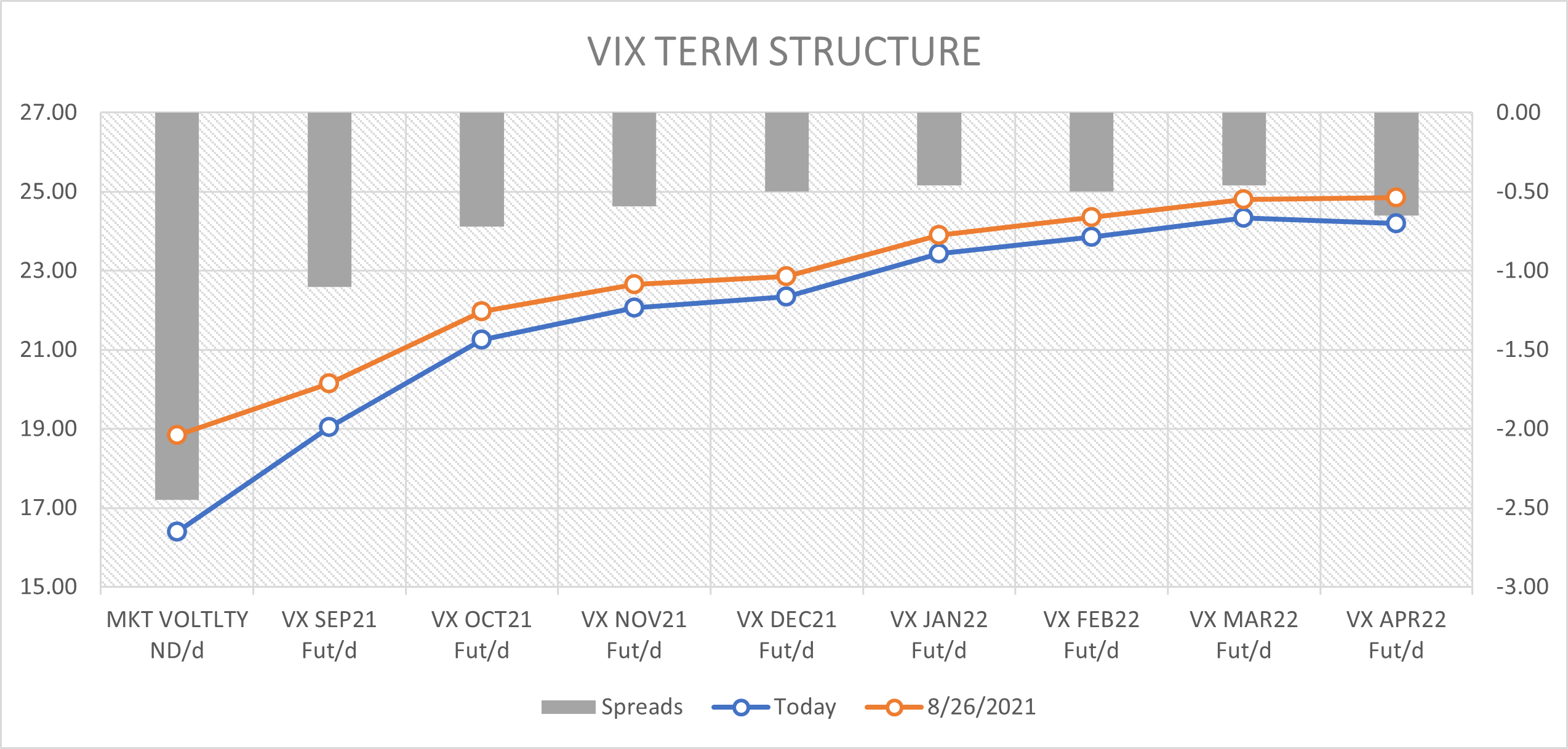
The term structure of the VIX was most impacted on the shorter end of the curve on Friday at the spot level, but notice that the VIX hardly budged once you got in October, with the spread between Thursday’s and Friday’s levels nearly unchanged. This would suggest that the rise we saw on Friday in the S&P 500 had more to do with a relief of Powell not being overly hawkish.
However, this feeling may change as the data for this week comes out. Powell made it pretty clear that the data is pretty much where it needs to be to begin to reduce asset purchases.
S&P 500 (SPY)
The S&P 500 this past week continued to remain trading its channel since mid-July, bumping up against the upper trend line while reaching overbought levels on the Bollinger bands. The RSI remains firmly in a downtrend, and the advance/decline continues to diverge from the record-setting prices.
These are warnings that the S&P 500 is losing some key internal momentum and that a pullback to the lower end of the trading channel remains highly likely, towards 4380 to 4400.

Additionally, multiple unfilled gaps remain all the way down to 3,850. While these gaps are not always filled right away, they do tend to get filled over time.

Rates (IEF)
Rates moved lower on Friday, but I do not expect that to persist, and I still believe rates may rise to around 1.5% over the next few weeks before resuming a move lower. The RSI broke out of a very long-term downtrend and has shown a higher positive move, suggesting higher yields are still going to rise over the short-term.

Dollar (DXY)
The dollar also remains firmly in an uptrend on both the index level and the RSI level. The region of resistance for the dollar will not likely come until 94.60.

Square (SQ)
After Amazon (AMZN) teamed up with Affirm on the installment payment side of things, we will see how the market feels about Square this week. Everyone knows the deal for Afterpay will be dilutive to existing holders of the Square, and with the stock sitting on the uptrend of around $265, it feels like it's only a matter of time until the shares are revisiting $200.

Apple (AAPL)
Apple’s stock has really stalled out here, and the RSI has turned decisively bearish over the past several weeks, with a move lower back to the 200-day moving average and the uptrend highly likely, as the stock continues to consolidate its big 2020 move higher.

Zoom (ZM)
The path for Zoom is not looking strong at the moment, with a potential double top on the verge of confirmation. The stock need fall below support at $340 for a return back to $280.



Comments
Log in or sign up to join the conversation.