


Image Source: Unsplash
In a recent Economist article, Gita Gopinath considered the implications of a AI bust similar in magnitude to the 2001 dotcom bust for the global economy.
I thought I would consider a more narrow question of a what happens to US household wealth. Consider household equity and mutual fund wealth as a component of net worth.
(Click on image to enlarge)
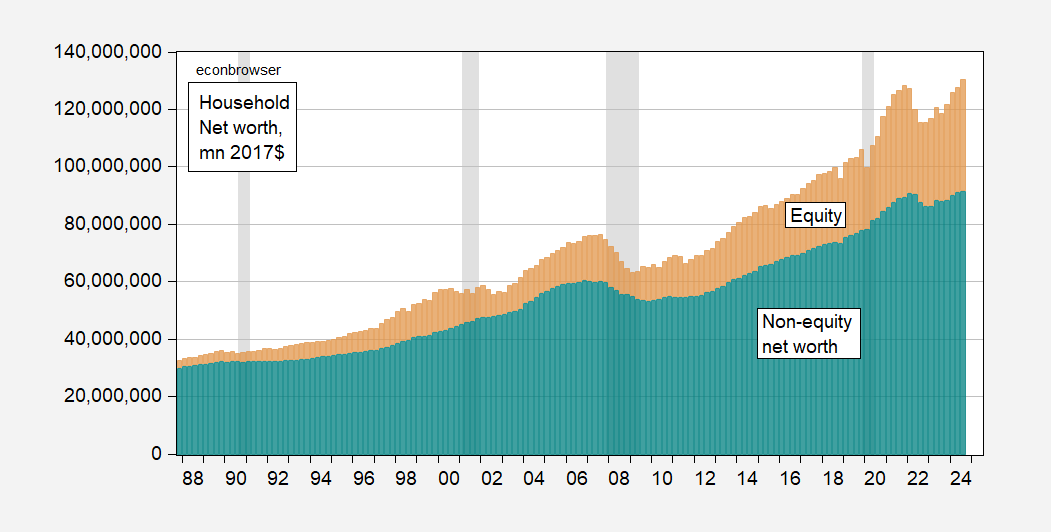
Figure 1: Household net worth ex-equity+mutual funds (teal bar), household holdings of equity+mutual funds, mn. 2017$. Deflated by PCE deflator. NBER defined peak-to-trough recession dates shaded gray. Source: Federal Reserve Flow of Funds, and BEA via FRED, NBER, author’s calculations.
Mid-2025 household wealth in equities and mutual funds is approximately $51 trillion. A 26% drop in capitalization — as took place 2000Q4-2001Q4 — would reduce that by $13.3 trillion (all ballpark figures).(Gopinath’s calculation was likely based on total capitalization, including stocks held by rest-of-the-world).
If the sensitivity of consumption to wealth is 5 cents on the dollar, then that translates to a reduction of some Ch.17$ 526 billion, or about 3% of mid-2025 consumption, distributed over several years. Using a sensitivity of 3 cents on the dollar (might be more appropriate for equity wealth), then a reduction of about 1.9% is implied.
For reference, here are the forward P/E ratios for the Magnificent 7 and the S&P500, including and excluding the Magnificent 7:
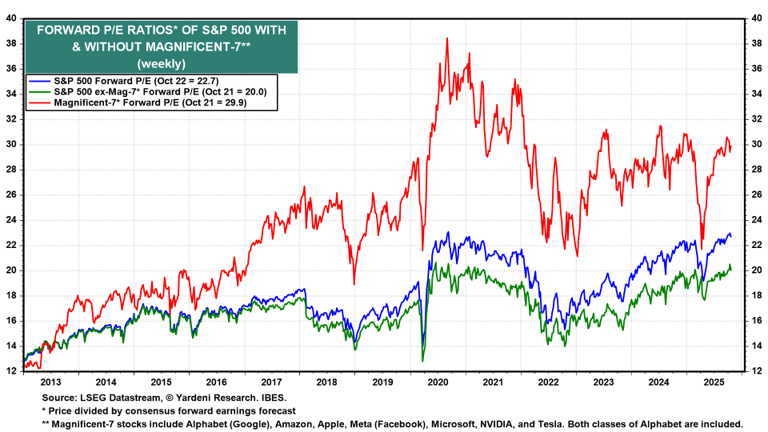
Source: Yardeni.com.
More By This Author:
The Fog Of Uncertainty, Ag EditionEconoFact: “The U.S. Agricultural Sector Under Stress”
What Releases Have We Missed? What Will We Miss? And What Will Be the Impact?



Comments
Log in or sign up to join the conversation.