

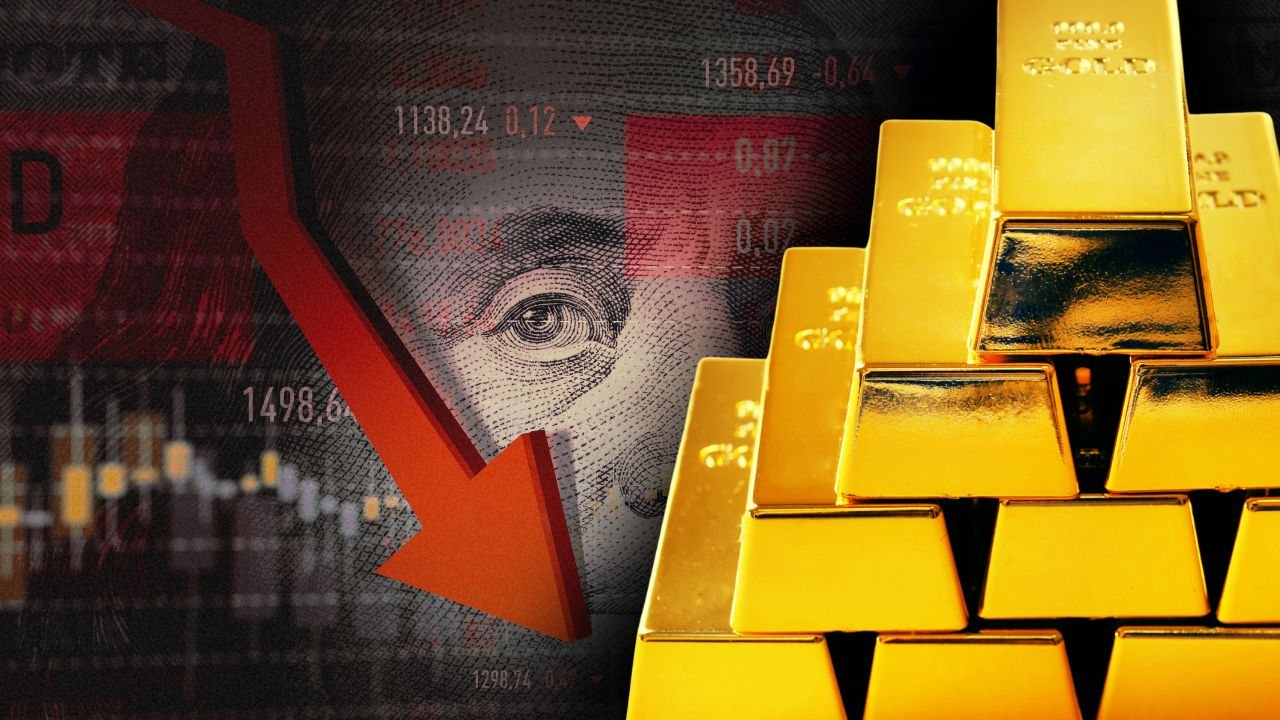
The gold price during a recession has usually gone up. In the 1973–75 downturn, gold rose 83% while stocks fell 18%. In 2020, gold finished the year up about 25% higher than it was prior to the COVID lockdowns.
But the record is not perfect. In 2008, gold dropped nearly 30% before it recovered. That drop caught many investors off guard. It also taught a lesson worth knowing.
We will explore how gold has performed in all the major recessions since 1971. By the end, you will understand why gold usually rises when the economy falls … and what really happened in 2008.
Does the Gold Price Go Up During a Recession?
Gold typically goes up during a recession. Gold has risen in six of the seven U.S. recessions since 1971.
There are some caveats to this. First, gold does not rise in every recession. It is also worth noting that it does not rise in a straight line.
Nevertheless, the pattern holds. Investors tend to move money into gold when the economy shrinks.
You may wonder why we're starting the count at 1971. There is a simple answer.
Before that year, the question has no real answer. The U.S. government fixed the gold price at $35 an ounce. The price could not move. President Nixon cut the dollar's tie to gold in August 1971. Only then did the market set the price.
This is a crucial factor to note, even if it may sound unnecessarily technical. Other sites claim gold gained in six of eight recessions since 1970. That count includes the 1969–70 downturn, when the law still froze the price. In that instance, gold did not gain in any real sense. It just sat where the government put it.
One more note on the numbers. Different sources measure different windows. Some track gold from the first day of a recession to the last. Others measure six months before the start to six months after the end. The window changes the result. We use the official dates from the National Bureau of Economic Research| New Window.
So the honest record starts in 1971. Since then, gold has gained during recessions more often than not. Some gains were large, while others were more modest. Notably, 2008 saw a significant collapse in the gold price before it rose again.
The next section shows the numbers for each recession, side by side with stocks.
Gold Prices in Every Recession Since 1971
Here is gold's price in each U.S. recession since 1971. We use the official start and end dates from the National Bureau of Economic Research. We measure gold from the first month to the last. No cherry-picked windows.
Gold vs. the S&P 500 in every U.S. recession since 1971
Recession (NBER) | Gold at start | Gold at end | Gold change | S&P 500 change |
|---|---|---|---|---|
Nov 1973–Mar 1975 | $97 | $178 | +83% | −18% |
Jan 1980–Jul 1980 | $675 | $614 | −9% | +13% |
Jul 1981–Nov 1982 | $409 | $415 | +1% | +7% |
Jul 1990–Mar 1991 | $362 | $364 | +1% | +3% |
Mar 2001–Nov 2001 | $263 | $276 | +5% | −4% |
Dec 2007–Jun 2009 | $803 | $946 | +18% | −36% |
Feb 2020–Apr 2020 | $1,597 | $1,683 | +5% | −10% |
Recession start and end dates are the official peak and trough months published by the National Bureau of Economic Research. Gold prices are the London fix monthly average for those months. Prices are nominal and not adjusted for inflation. Past performance does not predict future results.
What 2008 Actually Teaches Investors
Gold peaked near $1,000 an ounce in March 2008. Then it slid down throughout much of the spring and summer. By mid-September, days after Lehman Brothers collapsed, gold traded at $692.50.
That represented a drop of about 30 percent from the peak. Stocks were falling hard at the same time. For a few weeks, gold looked as though it had failed at the one job people expected it to perform.
Then it turned around. Gold recovered most of its losses before the year closed. It crossed $1,000 again in early 2009 while stocks continued to decline. By September 2011, gold traded above $1,900.
So why did gold fall in the middle of a panic?
The answer is margin calls, not lost faith in gold. When markets crash, investors who borrowed to buy get a call from their broker. They have to raise cash within days. They cannot sell what no one wants to buy.
So they sell what they can, and gold sells easily. Funds dumped gold in the fall of 2008 to cover losses somewhere else entirely.
That distinction matters. A forced sale is not a judgment on an asset. It is a cash problem at a firm that happens to own it.
Two lessons come out of this.
First, gold's worst stretch in 2008 lasted weeks, not years. Anyone who sold near the bottom locked in the loss. Anyone who waited watched it reverse.
Second, plan on seeing it again. The same mechanism is likely to repeat in the next severe crisis. A sharp early drop in gold is a normal feature of a liquidity panic. It is not proof that the case for gold has broken.
Why Gold Tends to Rise When the Economy Contracts
We have shown what happens to gold in a recession by using historical data. Now, let's talk about why these trends play out. Four forces do most of the work in changing gold's price, and they do not always pull in the same direction.
Safe-Haven Demand
When stocks fall, money looks for shelter. Gold provides something that many other financial assets cannot: no counterparty risk.
Stocks can fall drastically if a company fails. Something that was once worth hundreds or thousands could be worth nothing in a single bad turn. Likewise, a bond can default if the borrower cannot pay. Bank deposits depend upon the bank.
Gold, on the other hand, is simply gold. Its value is intrinsic, and it does not rely on anyone's promise to retain that value. That's why many investors buy gold in times of economic uncertainty.
Falling Interest Rates and Real Yields
This is the strongest driver, and it works like a seesaw.
Unlike stocks, bonds, or bank deposits, gold does not pay interest. Spending money on gold requires you to give up funds that could generate yields if invested elsewhere.
However, central banks almost always cut rates during a recession. What matters in these instances is the real rate, which is the interest rate you actually gain after inflation. When real rates drop, the cost of holding gold drops too.
In that scenario, gold usually rises. The reverse also holds. In 1980 and 1981, gold fell as real rates soared.
In that scenario, gold usually rises. The reverse also holds. In 1980 and 1981, gold fell as real rates soared. -Currency Debasement and Stimulus
Recessions bring increased spending, and it comes from several fronts. Governments send checks. Central banks buy bonds and expand the money supply.
The trouble is that more dollars chase the same goods. Each dollar buys a little less because of the decline.
Gold works differently. Mine supply grows by only one to two percent a year. No one can print more gold like they can paper money. That gap is why gold and inflation tend to move together over long periods.
Central Bank Buying
This force is relatively new in the history of gold. For most of the 1990s, central banks were net sellers of gold, rather than buyers.
This trend changed in 2010. That year, they transitioned to being steady net buyers of gold. In recent years, central bank gold buying has hit record levels. In 2025 alone, central banks bought a total of 863.3 metric tons of gold| New Window. That figure was down 21% from 2024.
That demand does not switch off during economic downturns. This is a significant development, as it gives gold a floor that did not exist in previous recessions.
These four forces typically work together. Sometimes, they play against each other. In 1980, high real rates beat safe-haven demand and gold fell. In 2020, every force pushed the same way and gold set records. Reading which force is strongest tells you more than the word recession does.
Gold vs. Stocks and Other Recession Assets
No asset wins every recession. However, gold has done fairly well when compared to the usual alternatives.
Stocks are the most obvious example. These fall in most economic downturns, as demonstrated in the table above. There, the data records the S&P 500 dropping in four of the seven recessions since 1971. Over long stretches, stocks have beaten gold. However, their worst losses tend to occur at the worst moments, when jobs and salaries are also at risk.
Bonds are gold's toughest competitor. Rate cuts push bond prices up, and Treasuries held their value well in 2008. Bonds have one clear weakness. They lose ground when inflation runs high. You can see that trend borne out in the 1970s and in 2022.
Cash often feels safe and steady because it is a stable, legal tender asset. However, the catch for cash is purchasing power. A dollar held through a decade of inflation buys noticeably less at the end of it.
Real estate is slow to sell. In 2007, it was also the source of the crisis rather than a shelter from it.
Gold has a real drawback worth naming. It pays no dividend, no interest, and no rent. You can only gain if the price rises. However, in exchange, you hold an asset that cannot default and does not depend on anyone else keeping a promise.
So what is the best investment during a recession? There is not a single answer. The type of downturn plays a major role in this decision. Bonds tend to do well when inflation is falling. Gold tends to do well when it is not.
Mining stocks are a separate question. They track gold loosely, but they also carry company risk that physical metal does not. They can have exponentially higher growth, but the downside is that they can also have exponentially sharper falls. Experienced investors may choose to invest in mining stocks, but newcomers should strongly consider consulting a financial advisor beforehand.
What This Means for Investors Today
No one knows when the next recession will start. History is an unpredictable affair, and economies do not rise and fall on a clear schedule. However, the data above demonstrates a few key principles.
Timing has usually mattered more than a recession itself. Most of gold's recession gains went to people who already owned gold. Buying it after the recession headline arrives usually means paying more for the metal. Gold premiums over spot tend to widen in cases of demand spikes, so the total cost rises twice.
The 1980 lesson continues to hold. Gold has reached significant highs in recent years, and that higher starting price changes the math. It does not rule out further gains. However, it does mean that reaching further gains can be significantly more challenging.
The form of gold you hold matters too. Fund and futures track the gold price, but they still depend on a counterparty. Much of gold's recession case rests on the fact that physical metal does not. If that is the reason for owning gold, the type of ownership is part of the reason.
Steady buying removes the timing problem. Buying a fixed dollar amount each month means you buy more ounces when prices dip and fewer when they climb. You never have to guess the top or the bottom.
None of this is a forecast, and none of it is investment advice. It is what the last seven recessions show. What you do with it depends on your own situation, your time frame, and what the rest of your savings look like.
Conclusion
Gold has risen in most U.S. recessions since 1971, but not in all of them. The 1980 downturn showed that a high starting price can cap the upside.
The 2008 panic showed that gold can fall hard before it recovers. Neither case broke the longer pattern. Real interest rates, inflation, and the depth of the crisis decide the outcome, not the word recession.
You can check today's gold price and current premiums any time. Buying a set amount each month also spares you from guessing what comes next.

Comments
Log in or sign up to join the conversation.