


The piece is an analysis of Q2 10-Q filings from six companies, reading ERCOT grid conditions out of Level 3 fair value disclosures rather than market data. Every figure is cited to an accession number in the text and can be checked on EDGAR. The central finding is that Riot Platforms (RIOT) is paid more to switch off than it earns from its fixed-price power contract, and that the congestion signal is specific to ERCOT: Vistra's (VST) settlement point basis mark moved from +$7 to −$12.50 while PG&E's (PCG) CAISO equivalent stayed flat at $2.
The PG&E number is what’s annoying me, and I’ll get to why.
Riot (RIOT) first. They lost $60.3 million on electricity in the first half and then made $31.1 million on electricity in the same half on the same grid, with both of those things being power. That is where this all started.
The $31.1 million is the amount ERCOT pays them for being willing to switch off. That is all against 145.8 million in power spend, so 21.3% of the bill comes right back. That is up from 161.% the year prior.
Keep all these numbers in mind.
$60.3 million is really a contract. Rockdale has a fixed price for 245 megawatts. It has two blocks to 2030 and one to October 2027. This really had me cackling, as it’s carried as a derivative rather than a normal power purchase because Riot’s accountants decided that “physical delivery is not probable through the entire contract.” In simpler words, they don’t even expect to use the electricity rather just sell it on. This leads me to believe that the whole thing is an energy trading fiasco with a mine attached to it, just sitting there casually, undisclosed for years.
This part, I need to write it down carefully because I got it wrong the first time and mixed up the closing and opening balances. 147,026 in January, minus 60,301 from the price curve, plus 1,740 from time passing, 88,465 in June. The price curve line is the one that really matters.
Texas power. December average was 55.70 a megawatt-hour; June, 48.60. Corsicana, Riot's other contract, flipped from an asset to a liability on “a significant decline in forward power prices.”
On the low, 12.7%, specifically in the year everyone, including me, has been saying that AI makes power scarce.
Vistra (VST) marks the price gap between one settlement point and another, which is plus 7 in December, minus 12.5 in June, and the floor of that range went from -12 to -45. NRG’s (NRG) capacity contracts, being the payment for availability rather than output, went from 270 to 331 per MW-day.
So I had a piece: electricity being cheap, delivery being expensive, everyone’s mispriced it.
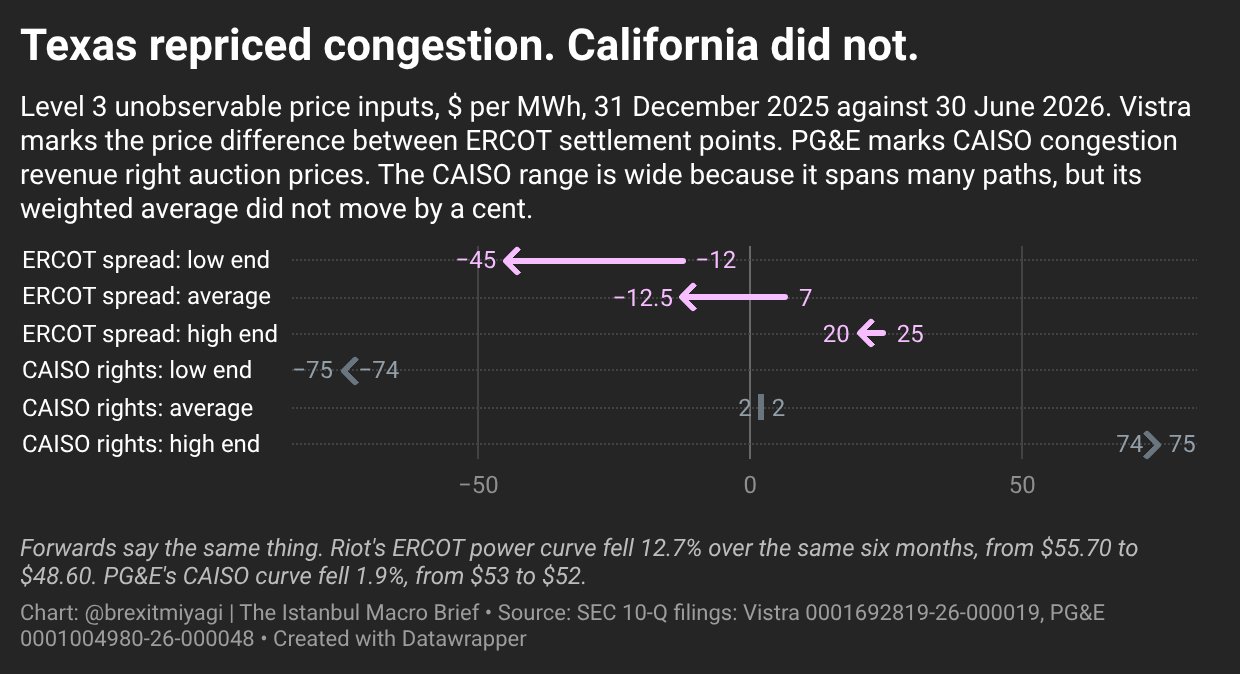
Then PG&E (in California). Congestion revenue right, December range being -74 to +74, with a weighted average of 2 dollars; June -75 to +75, with the weighted average at 2. That forwards 53 to 52.
It is FLAT. Completely flat, over exactly the six months Texas went to -45 at the floor.
I really have been going back and forth on this for a while now because the clear answer is that it’s an ERCOT story rather than a grid nuisance; Texas takes the loads, Texas takes the crypto fleet, Texas is barely interconnected, so of course it binds first, and California doesn’t. That’s probably right. It’s also exactly the kind of reasoning you reach for when your bigger claim just died, and you want something left over, so I don’t fully trust myself on it. Two filers isn’t a lot. One of them twitched, and one didn’t, and there are plenty of reasons: two companies, level 3 marks might diverge, and that has nothing to do with the physical grid. Overthinking yet again.
The forwards do the same thing, though. Riot’s ERCOT curve is down 12.7, whilst PG&E remains relatively unchanged. This is the second instance. Second instance of the same divergence in a different instrument, and this is the one tiny thing that keeps me from raising the white flag and calling it a day.
I looked for a second Texas filer marking basis the same way and there isn’t one. Vistra’s the only one who uses that language. So the -45 has ONE witness.
Volatility is not a savior here either. NRG marks implied volume at 110% in December and 131 in June. Vistra marks theirs at 563, and the similarities on both dates are striking. They have different books and tenors, but one of them says the world repriced, and the other says nothing ever happened.
The 4CP thing makes the miner side of this work. ERCOT sets your transmission charge for a whole year based on your load during four 15-minute intervals in summer. 4 of them. Be near 0, and next year’s transmission bill mostly goes away. Riot describes it as credits “toward transmission costs on future power bills, reducing overall power costs for the subsequent year” and notes it runs indefinitely.
A tenant serving inference can’t be absent during those four windows. Obviously.
So when Riot markets “power capacity for large-scale data center purposes, including artificial intelligence and high-performance computing,” they’re proposing to give that up, along with the ability to resell contracted power into spot, and probably the derivative classification too, because once someone takes delivery hourly, the physical delivery becomes probable and the accounting basis for a 2030 contract goes. That last part, i haven’t seen anywhere and might be missing something.
TeraWulf’s (WULF) done the conversion already. Mining revenue was 12.8 million in Q2 from 47.6. HPC lease: 31.9 from nothing, just two buildings “repurposed or placed out of service to support the HPC development.” Demand response: 2.8 in Q2, 14.1 in Q1.
Which looked like proof for a good hour. Riot’s quarters went from 21.0 to 10.1 over the same window with nothing converted, so whatever happened in Q1 happened to everybody, a cold snap, probably, and TeraWulf’s in New York anyways, which, after the PG&E thing, I’m not going to assume is comparable to Texas.
Year over year, the same exact quarter, Riot went up 21%, and TeraWulf went down 10%. That is the residue, bro.
CleanSpark (CLSK) never took a position at all: “We do not have scheduled downtime for our miners.” No demand response line ANYWHERE in the filing, running flat out and selling hash rate, and they’re going into HPC too, so for them the whole question is moot.
Riot’s filing carries a line for casualty-related charges of $3000 in the quarter, and believe me, I spent a copious amount of time trying to work out what that was.
I don’t really know where this ends up. Most likely they go hybrid, and it’s a non-event; part of the campus is converted, and the rest still biding into 4CP, and the credits just hold while HPC revenue grows on top. Or it bleeds out slowly enough that nobody notices because the headline keeps rising even as credits per megawatt fall. The version where the programmes themselves reprice because too much ERCOT load goes firm is the interesting one, and I’ve no idea on timing.
I have 4 calls, and the Q3 filings land in early November, so it scores itself.
Vistra’s settlement point price difference prints below minus 12.5 dollars per MWh. That’s the whole thesis in one number, and it’s the one I’d lose most on.
PG&E’s CRR weighted average stays between 1 and 3 dollars. If California starts moving too, then this doesn’t stay an ERCOT story; the control breaks, and everything above needs rewriting.
Riot’s Q3 power curtailment credits print above the 10.054 million from Q2. Texas summer is peak 4CP season, so seasonality already favours this, which makes it the weakest of the four. If it prints below, I’ve got the flexibility repricing backwards.
Riot’s weighted average forward price input prints below 48.60.
The first two are the real test. The Riot ones are corroboration.
Riot 0001104659-26-093448, Vistra 0001692819-26-000019, PG&E 0001004980-26-000048, NRG 0001013871-26-000020, TeraWulf 0001083301-26-000166, CleanSpark 0001193125-26-338382.
Still might be that the minus 45 is a Vistra portfolio artifact and not a grid signal at all. I don’t have a way to separate those from outside.



Comments
Log in or sign up to join the conversation.