


Here are some things I think I am thinking about this weekend.
1) The Robots Are Really Coming.
This week felt different for me. I’ve been very optimistic about AI for the last few years, but I feel like I am becoming even more optimistic about it. Over the last few weeks, I’ve found myself having real conversations with Claude. My wife hates it, which is weird because she doesn’t like hearing me ramble on about macroeconomics, leg day, cycling or most of the things I ramble about. You’d think this is a needed respite, and I actually think she’s just jealous of how I refer to her as “Jennifer” (Marty’s girlfriend from Back to the Future). But I find myself having extremely human-like conversations with AI now. Its ability to think and answer things on the fly is just incredible. And it now knows me so well that it can answer incredibly sophisticated questions about my life and even things like Defined Duration Investing. But this week felt different. And it feels like things are about to start changing much, much faster.
I’ve long said that the robots were the game changer. And the robots appear to be coming much faster than I thought. Last week we saw the China robot games where the robots were racing and exploding into walls. People were mocking it, but this is incredible stuff, even if the robots can’t stop running before they hit a wall. And then we had the unveiling of the Cyber Cabs in Austin this week. These things look incredible and I saw someone compare a $12 fare on Cybercab to a $35 fare on a human driven Uber (UBER). Ruh Roh. And then there are rumors that Tesla (TSLA)’s Optimus is coming out in 2027. Oh, and then GPT announced Astra, which can do some incredible things. We may not be at AGI, but damn it feels close. Of course, right on cue Bernie Sanders released a proposal to ban anything that’s smarter than humans. Bernie, bad news my friend – these things are ALREADY smarter than all of us so you’re a little behind the curve here.
I gotta say that there’s only one technology I’ve ever been so excited about that I sat in line to get the first edition and that was the iPhone 1. This is the only other time I’ve ever felt like that. The Optimus robots are not a game changer. They are a world changer. I’m sure the first few versions will be flawed so maybe I won’t jump on V1, but the later versions are going to change our lives in unimaginable ways. It’s just crazy to think how all of this is coming together. In 20 years most households will own an Optimus, the Optimus will communicate with your car, your HVAC system, your pool, everything. It will be capable of doing almost anything you need it to. And it will do most of those things better than you can. And it will all run on some form of AI in an interconnected fashion. A household’s primary asset, aside from their house, is a car. But in 10 years (maybe less) you won’t need a car, but you will very much need a personal robot.
It’s a little scary, but it’s mostly exciting in my opinion. We live in the most incredible time. I can’t wait to see what happens next.
NB – 30,000-foot macro thesis on this is: long equities for the wealth inequality this will cause, long short and intermediate duration bonds for the disinflation that will come in the decades ahead, unit labor costs stall or fall, inequality rises, innovators and entrepreneurs flourish, large firms face a crippling legacy labor-based business model, etc., etc.
2) Investing in a Time of Uncertainty.
I am sorry in advance. I promised I would be publishing a new research piece last week about the “price of (un)certainty”. There are some things that are so clear to me in the macro outlook ahead. Then again, the world is moving so fast that I know that increases the asymmetry of the potential outcomes. And that creates a lot of uncertainty.
The research piece analyzes the trade-off over time of our current investing options and puts things in a nice neat temporal perspective. But I’m still climbing out of my vacation hole so I am behind on that. Plus it ended up being 40 pages which is way too damn long. So I need to cut it back and create a 5-10 page summary version, which Jennifer will help with, but it’s going to take some time. I’ve said this a million times in the past, but time is the solution to all investing problems. When you understand how time relates to your investing strategy you gain certainty. And certainty is the destroyer of behavioral biases.
One of the cool things about working on this paper was that the research convinced me that I should be changing my asset allocations a little bit because the environment has changed so much. With the recent jump in interest rates short-term and intermediate term TIPS have become a lot more attractive. But that doesn’t mean they’re a no-brainer.
The way I frame this in the research piece is that you have two types of asset-liability matching – explicit and implicit. Explicit ALM is when the investor requires absolute certainty. If you need 50K for a new car purchase in 9 months that has to be pinned exactly to an inflation adjusted asset value like a 9-month TBill. That’s explicit ALM. If you need $500K in assets to last 20 years of retirement, but you’re 10 years from retirement then you can afford an implicit ALM approach. Maybe you allocate that to a Target Date Fund or a 60/40 allocation. It doesn’t have to be perfect and in fact, it can’t be perfect because the range of potential liability changes is wider and the asset allocation could benefit from the potential probabilistic upside that a less certain allocation (like equities) gives you. You don’t need an explicit ALM approach for longer time horizons because the range out outcomes is wide and the upside is typically weighted towards riskier assets. Stocks aren’t guaranteed to beat 10 year TIPS, but they typically do and they typically do by a huge margin.
But that also introduces some tail risk to the outcome, which you might not like. Well, in that case you might prefer an explicit ALM approach and that’s where the TIPS argument becomes more compelling because, at 10 years, a 2.5% TIPS is pretty damn compelling. But you see, it’s all about the investor’s risk capacity and liability needs. I’d argue that most investors don’t need that much certainty outside of 5 years and I argue pretty aggressively in the paper that longer time horizons can benefit from more equity exposure even though the tail risk is higher. But that’s a risk most investors should be willing to take in my opinion. But not always! If certainty is your main goal then nominal bonds, TIPS and even things like annuities become more compelling. It depends of course.
Anyhow, I think you’re gonna like this one. Hopefully I’ll wrap it up by next week and provide a summary version that doesn’t put you to sleep. Stay tuned.
3) 90/10 Increases Uncertainty.
Speaking of asset allocation and uncertainty let’s talk about an asset allocation that triggers me – 90/10 stocks/bonds. UC Investments manages $200B of assets on behalf of the University system and announced this week that they were launching the UCBG ETF, a 90/10 stock/bond allocation that they currently offer in the plans. The fund launched with a whopping $2.5B in assets. This asset allocation triggers me, probably more than any other. And here’s why.
A 90/10 allocation inside a single instrument is really just a bad stock allocation. The problem is the 10% bond allocation isn’t big enough to do anything so you end up with an instrument that has 95% of the volatility of the stock market and 100% of the return drag from the bonds. So you’re capturing almost all of the downside volatility and you get a permanent long-term return drag from the bonds. For instance, if you’d put $10K into a 90/10 vs a 100% stock allocation in 1950 you’d currently have about $42MM in the 100% stock portfolio and just $30MM in the 90/10. That’s what 0.5% of return drag per year does to you. And worse, you captured almost all of the downturn along the way. Here’s the drawdown chart showing how similar the two return profiles are.
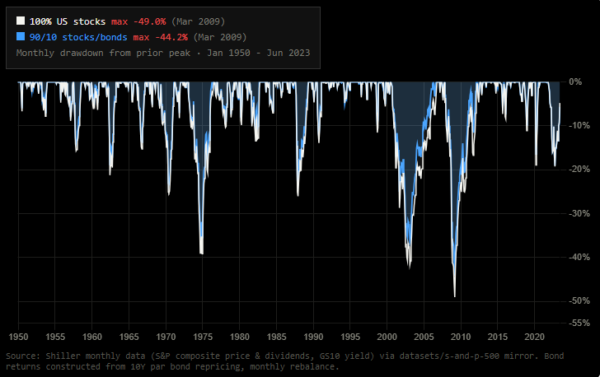
The reason this is a problem is because putting the 90 and the 10 together into a single instrument functionally blends the instruments into one instrument. But when you mix stocks and bonds the volatility profile of stocks dominates bonds. So in order to make the bonds mitigate the stock volatility you either need a large bond allocation or one that has a very long duration. Thinking of this thru the lens of Defined Duration helps because a diversified bond index is generally close to a 5 year instrument. And let’s call the stock market a 30 year instrument today. When you blend those instruments at a 90/10 weighting you get an instrument that has a Defined Duration of 27.5. That’s an equity instrument by any measure. But it’s an equity instrument where you intentionally chose to throttle the return with an instrument that has a short duration and poor return profile for a 27.5 year period. That makes no sense. 90/10 should not even be a thing unless you do 90/10 the way Warren Buffett does by disaggregating the 90 and the 10. You see, Buffett holds an extreme barbell position where his 90 is high risk public and private equities. And then he’s got 10% in Tbills which basically operates like his emergency fund. In case of stock downturn, break glass. That’s what Buffett does. But the kicker is that the 90 and the 10 are two separate buckets where the 10 is actually accessible if you need it. When you wrap it into an ETF like UC did you remove the liquidity benefit (because when you sell the ETF you sell stocks as well as bonds when you really just want to sell the bonds/cash) AND you dilute the returns without improving the return profile.
The natural question is, at what point do bonds actually benefit enough to hold them inside a multi-asset instrument? Well, the answer depends on the amount of duration risk you’re willing to take on the bond side, but if you’re using a diversified index then the answer is probably well over 25%. Anything between 0-25% bonds just doesn’t mitigate the equity risk to even bring the instrument down to an aggregated volatility level that is below something like value stocks. Once you get over 30% bonds and closer to 40% you’ve actually created an instrument that throttles the stock volatility enough to really reduce your sequence of returns risk. This also explains why 60/40 is so popular – the 40 actually does something meaningful over time.
I’m obviously a huge fan of multi-asset instruments, but they need to be blended well enough so that each component of the blend is actually playing a relevant role. Otherwise you get a blend that is blended for no good reason.
Anyhow, guys, next time you want to splash $2.5 billion around give me a ring first. I am just down the road!
Well, that’s all I’ve got for you all this weekend. As always, stay disciplined out there.
NB – I am going to be at the Future Proof Festival in Huntington Beach in two weeks. It’s the best finance conference in the country in my opinion so if you’re planning to be there please let me know.


Comments
Log in or sign up to join the conversation.