


Well, it’s the scariest week of the year and it’s only right that Halloween fell on a weekend. Buckle up for three very scary things I think I am thinking about.
1) Is the AI Trade Imploding?
I was in Austin this past week visiting some family and eating BBQ. Okay, I admit, I was mostly eating BBQ, but between my pit stops at BBQ joints I became rather obsessed with Waymos and robotaxis. I have been blown away by everything AI has done so far, but this was the first time where I felt like I saw it firsthand inside a piece of hardware that actually changed my life. Robotaxis are everywhere in Austin and, my God, are they amazing. My first autonomous ride was after the UT football game last weekend. I had eaten way too much BBQ and needed a ride home from the bar. A funny-looking white car pulls up with your initials flashing, you step in, it greets you, and it starts driving away. It is a totally surreal experience. The car drives so well it is hard to believe that it is not being driven by a professional driver. Like most things in AI, it simply does things a little bit better than actual humans do, except this is a much more tangible version of that. You feel like the future is here, and it is incredible.
It is fascinating to me how this is happening in Austin, because Austin presents such a sharp contrast of the old and the new. It is an old cowboy town, but everywhere you look you see the future contrasted with the past. I remember the first time I visited Austin about 25 years ago, and there was no skyline. Today it is a shiny row of skyscrapers that rivals any big city in the United States. That contrast is exactly what the stock market is grappling with these days. We are transitioning rapidly from the old world into a new future, but it is all happening so fast that we do not know how to price that future. This is where the AI bottleneck becomes important, and it is the same pattern that occurs every time we have a huge transformational investment boom, whether it was railroads in the late 1800s, electrification in the 1920s, the internet boom of the 1990s, or the AI boom of the 2020s. The same dynamic plays out every time: public markets fail to reflect private investment booms because investors aggressively pull forward decades of terminal value into present asset prices, creating an artificially cheap cost of equity capital that floods the sector with speculative overinvestment and generates severe structural overcapacity. This deluge of excess capacity crushes pricing power and destroys operational profit margins across the industry, sparking a sharp valuation boom-and-bust cycle.
So, the question is: are we busting now? Does it matter? It certainly matters if you are running a leveraged total return strategy where your portfolio is heavily exposed to technology. Of course, if you operate a Defined Duration methodology, this probably does not matter that much because, in the current environment, technology is the longest-duration instrument possible. What that instrument does on any given day, month, or year is relatively meaningless in the grand scheme of things. That makes this a good time to put things in perspective, because the current drawdown in stocks is modest. If it is scaring you, you probably have a duration mismatch. That is, after all, what happens when you get scared by stock market downturns. Downside volatility is always uncomfortable, but if you are overly exposed to equities, large downturns will expose that mismatch and tempt you to make emotional changes. If, on the other hand, you have sufficient, income, cash and shorter-duration instruments on hand to weather a decline, equity downturns become relatively unimportant because the whole point of asset-liability matching is to allow long-duration assets to remain at work while they absorb this volatility.
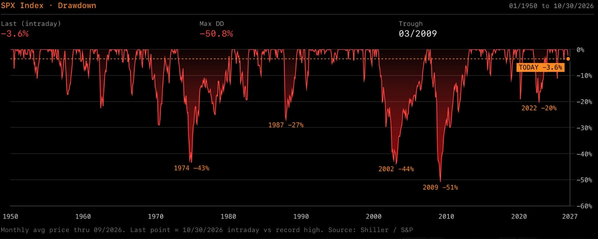
The attached chart puts all of this in perspective. While tech stocks are down about 10% from their all-time highs, the S&P 500 is only down about 3.6%. This is the AI trade at work. While we can expect higher long-term returns from this technological shift, the short-run price you pay is the uncertainty of all that near-term volatility. Again, that is exactly what our research shows. Higher valuations do not mean low future returns; they mean the time horizon of those returns becomes more uncertain because there is so much near-term optimism built into prices, making the sequence of returns more volatile. That is why you have to treat stocks as long-duration instruments, especially so in today’s environment where valuations are elevated.
I do not pretend to possess special knowledge of what lies ahead. I do believe AI is every bit the transformational technology advertised. But I also know that the US stock market is expensive, and as we noted in our last research piece, that means you have to be much more patient with it than normal. The volatility we are seeing is uncomfortable, but it is entirely expected..
2) The Inequality Kerfuffle.
Let’s change gears a bit, kind of.
There was a big dust-up in the economics world this week after Tyler Cowen published an AI “audit” of Emmanuel Saez and Gabriel Zucman’s research on wealth inequality. If accurate, the findings are devastating. The review reported consistent biases and widespread methodological errors. When challenged, Cowen published a follow-up arguing that AI research referees are already proving superior to traditional peer review.
None of this surprises me, yet I hesitate to dismiss Saez and Zucman’s entire body of work. Economics is a social science precisely because it involves massive amounts of subjectivity. That is what makes it so interesting. It sits halfway between empirical math and human behavior. Economic data is never as clean as we want it to be, and conclusions must naturally evolve alongside changing societies. If you unleash a strict AI model on almost any complex economic paper, it will undoubtedly flag dozens of errors and inconsistencies.
Still, the debate is timely. California voters face Proposition 40 this week, a billionaire tax heavily championed by Zucman himself. Bluntly put, it is a deeply flawed proposal.
On paper, Proposition 40 is framed as a one-time 5% tax on California billionaires. In reality, the fine print permits the state to alter the tax scope to target other assets without voter approval, and it includes retroactive enforcement. Move out of California today, and the state can still pursue you for that 5%.
This gets the entire economic engine backwards. California was built on raw innovation and wealth creation: the Gold Rush, Hollywood, Napa Valley, the Central Valley, and Silicon Valley. These ecosystems were created by builders who realized they could build world-changing companies in a state with unmatched geography.
Crucially, private wealth creation generates the very tax base that funds ambitious public programs. Market capitalism provides the funding that makes social safety nets possible in the first place. When you invert that priority, you risk repeating France’s recent trajectory: constructing an enormous safety net, watching street protests multiply over demands for more, seeing sovereign spreads widen, and learning the hard way that social spending without robust private enterprise is unsustainable.
A healthy economy requires balance. Unchecked capitalism invites the exact populist backlash that pushes the policy pendulum to the opposite extreme. Zucman is not wrong that American inequality has generated widespread public frustration. But there are sensible ways to address wealth disparities, and there are counterproductive ones. Europe tested wealth taxes extensively throughout the 1990s, only to see capital flight, lagging domestic investment, and disappointing revenues. The historical reality is that 9 of the 12 European countries that had a wealth tax in 1990 ultimately eliminated or fundamentally narrowed it.
3) Real Estate is Dead Money
I am largely convinced that if real estate were more affordable, this whole debate about public sentiment and inequality would be much more constructive. When an entire generation feels priced out of homeownership, people feel like the economy is not serving them. But there is a silver lining in the affordability crunch: anyone who avoided buying a home over the last few years (or, as I expect, the next five years) is actually earning a much better return by renting and deploying that capital elsewhere.
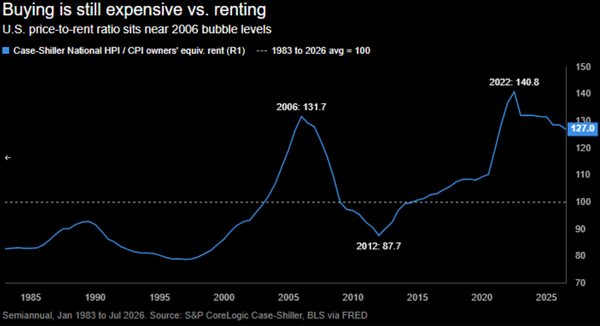
My thesis since the pandemic has been simple: the 50% run in real estate prices during Covid pulled years, perhaps even a decade, of appreciation into the present. Rents lagged, and the two metrics need to converge before real estate can find the footing and demand required to appreciate sustainably. The pandemic triggered a massive, one-time temporal dislocation because we already had an underlying housing supply shortage, and demand then surged when borrowing costs dropped and households needed to work from home. The unwind and recalibration of that event is still very much in progress as rental yields and home prices gradually realign.
With wage growth moderating, rental growth faces a persistent headwind. As a result, this convergence will be slow. It will not happen through a nominal price crash, because pent-up demand remains substantial and is held back primarily by elevated mortgage rates. That demand remains parked on the sidelines, waiting like water behind a dam for borrowing costs to ease. The price chart looks reminiscent of 2008, but the underlying debt and forced-seller dynamics are completely different today. Still, with 30-year mortgage rates holding around 7.5%, the asset class represents dead money because renting remains vastly more economical by comparison.
I expect we are looking at up to another five years of stagnant real estate returns until this valuation gap narrows considerably.
Speaking of asset classes, I have finally wrapped up the research piece I previewed a few weeks ago examining relative asset valuations and the increasing attractiveness of TIPS. This is an extensive piece that models cash, bonds, stocks, TIPS, and multi-asset instruments across distinct time horizons within an asset-liability matching framework. I think you will get a lot out of it, so keep an eye out for its release next week.
That’s all for this week. I hope everyone has a great Halloween weekend and that recent market chop is not causing any nightmares.


Comments
Log in or sign up to join the conversation.