

Indian share markets finished the trading session in red for a third consecutive day amid weak global markets.
At the closing bell, the BSE Sensex closed lower by 137 points and the NSE Nifty finished lower by 34 points. The S&P BSE Mid Cap finished down by 0.6% while S&P BSE Small Cap finished down by 0.2%. Losses were largely seen in realty stocks, bank stocks and metal stocks.
We generally refer to PE or price to earnings ratio to gauge whether the market is undervalued or overvalued. If we go by this ratio, the Indian market is clearly in overvaluation territory.
There is still another ratio, which is frequently used to evaluate the valuations. The market capitalization to GDP ratio. It is one of Buffett's favourite indicators of broader market value. The market cap of all the listed companies in the country divided by the gross domestic product (GDP) of the country gives us this ratio.
Market Cap to GDP Ratio Close to 100%
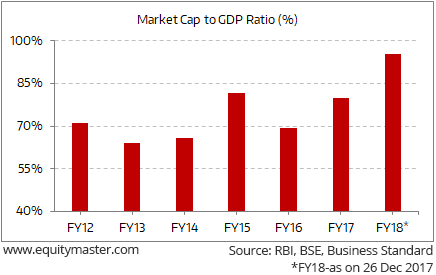
The idea behind this ratio is simple. Stock prices are derived from expected earnings for corporates and GDP represents revenue of the country. This gives investors an estimate of whether the two are moving in tandem. A ratio above 100% shows overvaluation and one below 50% shows that the market may be undervalued.
Even this ratio is showing valuations reaching its peak levels. India's market cap to GDP ratio reached 95%. This ratio was more than 100% after the 2007 bull run. Stock prices had seen a significant meltdown after that amid the global financial crisis.
Asian stock markets finished mixed as of the most recent closing prices. The Hang Seng gained 0.62% and the Shanghai Composite rose 0.44%. The Nikkei 225 lost 1.56%. European markets are broadly lower today with shares in Germany off the most. The DAX is down 1.56% while France's CAC 40 is off 1.10% and London's FTSE 100 is lower by 0.62%.
Rupee was trading at Rs 65.22 against the US$ in the afternoon session. Oil prices were trading at US$ 61.34 at the time of writing.
Automobile stocks finished the day on a strong note after strong February numbers.
Maruti Suzuki India reported 15% rise in its sales to 1,49,824 units in February 2018, as compared to 1,30,280 units in February 2017. Of total, the company sold 33,789 vehicles under mini segment (including Alto, Wagon R) in February 2018, as against 33,079 units sold in corresponding month previous year.
The total exports stood at 11,924 units in February 2018 as compared to 9,545 units exported in February 2017.
Meanwhile, Mahindra & Mahindra (M&M) posted a 19% growth in its February sales at 51,127 units. The company had sold 42,826 vehicles during the same month last year. The passenger vehicles volumes (which includes UVs, cars and vans) grew 8%.
This performance comes on the back of a sustained momentum and demand, both in the personal and commercial vehicle segments, which the company believes will also continue in the month of March.
In another development, Ashok Leyland recorded a 29% increase in its total sales at 18,181 units in February 2018. The company had sold 14,067 units during the same month previous year.
Moving on to news from pharma sector. Fortis Healthcare Ltd reported a net loss for the September and December quarters, after it sought an extension to approve results for the two reporting periods.
Fortis posted a net loss of Rs 236.1 million for the quarter ending 30 September, compared with a profit of Rs 382.4 million a year ago, mainly on a one-time charge due to the closure of a hospital.
For the December quarter, it reported a net loss of Rs 191 million, compared with a profit of Rs 4.53 billion on a one-off gain by an associate company in the year-ago period.
Fortis Healthcare share price finished the day down by 0.1% on the BSE.
Moving on to news from banking sector. As per an article in The Livemint, Axis Bank Ltd has deferred a US$500-million bond sale after international investors expressed concerns about the health of India's banking system in the wake of the US$2-billion fraud at Punjab National Bank (PNB).
The Nirav Modi and Rotomac scams have soured the sentiment of global investors vis-a-vis Indian banks and widened the trading spreads of existing bonds.
Axis Bank is yet to decide on a fresh issue date for the senior unsecured notes with a tenor of 5.5 years and a coupon of around 3.25%.
In August last year, Axis Bank raised US$500 million in bonds as part of its US$5 billion global medium-term note program. Institutional investors from Asia, Africa, Europe and the US had subscribed to the issue.
Axis Bank share price finished down by 0.7% on the BSE.
In news from the economy, regaining its status as the world's fastest-growing major economy, Indian economy grew at five-quarter high of 7.2% in the October-December period of the fiscal year 2017-18 (FY18), as against 6.5% in the previous quarter and 6.8% in the same period last year, on the back of a sharp pickup in the services sector, a rebound in industrial activity, especially manufacturing and construction, and an expansion in agriculture.
The previous high was recorded at 7.5% in the July-September quarter of fiscal year 2016-17. Besides, the growth for the second quarter of FY18 has been revised upwards to 6.5%, from 6.3% estimated earlier.
All three sectors - agriculture, industry and services - have accelerated in the third quarter. 'Agriculture, forestry & fishing' sector recorded an improvement in GVA growth to 4.1% in October-December from 2.7% in the previous quarter.
The per capita income in real terms (at 2011-12 prices) during 2017-18 is likely to attain a level of Rs 86,689 as compared to Rs 82,229 for the year 2016-17.
Meanwhile, India's core sector output expanded at a faster pace of 6.7% in January 2018, against the 4.2% growth recorded in December 2017, as petroleum refinery and cement output zoomed while steel power and coal production improved.
According to data released by the Ministry of Commerce and Industry, it showed the combined Index of eight core industries stood at 133.1 in January 2018, which was 6.7% higher compared to the index of January 2017. Its cumulative growth during April to January 2017-18 was 4.3%. The Eight Core Industries - coal, crude oil, natural gas, refinery products, fertilizers, steel, cement, and electricity - comprise 40.27% of the weight of items included in the Index of Industrial Production (IIP).
And here's a note from Profit Hunter
The Nifty 50 Index traded on a volatile note during the week.
On Monday, it opened the session gap up and rallied 92 points to end the session positive. In fact, the momentum continued until Tuesday afternoon and the index slipped, trading negatively for the remainder of the week. It finally ended the weekly session 0.31% down.
For past three weeks, the index is finding resistance from 10,650 - 10,700 level (red line). This week as well, it slipped after touching a high of 10,632. On the flip side, the rising trendline (blue line) is providing good support for the index.
So unless we see the index breaking the trendline or 10,700 level, we can expect it to trade within this range.
Nifty 50 Index Ends Marginally Down




Comments
Log in or sign up to join the conversation.