

This week investor attention will likely have a heightened focus on statements from the Federal Reserve following its two day meeting on Tuesday and Wednesday. Recent equity market weakness may be partially associated with Fed statements late last year indicating a tighter monetary policy stance, i.e., higher rates, beginning in March.

Since mid December, the 10-Year U.S. Treasury yield has jump from around 1.33% to a recent 1.78%. The most recent 10-Year rate is down from last week's high of 1.90%. During this move higher in longer term rates, the yield curve has actually flatten, short rates rising more than long rates. The spread between short and long rates now equals .75% or 75 basis points. I touched on this in an article last week, Yield Curve In Focus And Sentiment. The sentiment discussion centered on investor sentiment and not broader consumer sentiment.
Consumer sentiment is a variable the Fed likely places weight on as the consumer accounts for 70% of economic activity. Historically, the Fed has not raised the Fed Funds target rate when consumer sentiment was this low. As the maroon line in the below chart shows, the January reading for the University of Michigan Consumer Sentiment was at 68.8. This is down from 88.3 in April of last year. Clearly, the University of Michigan reading has been mostly near the 80 level at the start of prior tightening cycles.
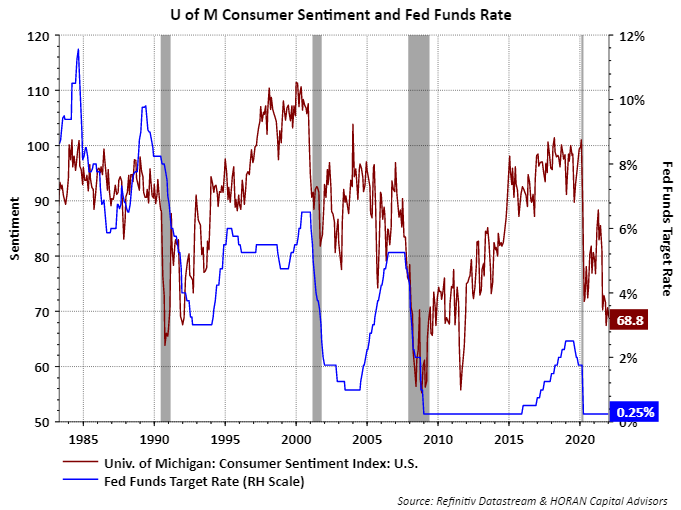
With last week's report on both jobless claims and continuing claims coming in higher than expectations, possibly the heated pace of economic growth is slowing. Certainly the Fed needs to get interest rates off the zero bound, but four rate hikes this year might be more than the economy can digest.

Comments
Log in or sign up to join the conversation.