

Intro Walmart Inc. (WMT) is the world’s largest retailer, built on selling everyday essentials at low prices through its stores, Sam’s Club warehouses, and growing e‑commerce platforms in the U.S. and abroad. Most of its revenue still comes from groceries and household goods, which keeps cash flow steady across cycles, while businesses like online sales, digital ads, and memberships add extra growth on top. The stock has just pulled back after its latest earnings report, even though its core engines remain intact, bringing a long‑term, recession‑resistant giant back to levels many investors had been waiting for. Fundamentals Walmart’s fundamentals are strong and steady. Revenue has been growing in the mid‑single‑digit range for years, with Q1 FY27 up 7.3% and higher‑margin areas like e‑commerce, advertising, and memberships growing even faster than the core grocery business. The company stays profitable with positive EPS, generates more than 12 billion dollars in free cash flow over the last year, and earns a mid‑teens return on capital, which signals efficient management and room for long‑term compounding rather than a business nearing the end of its runway. The recent drop was driven less by weak numbers than by expectations: guidance for full‑year earnings (about 2.75–2.85 dollars per share) came in below the 2.91 dollars the market expected, after a big prior run‑up and a valuation already rich versus peers. Even after that pullback, Walmart carries a solid balance sheet, a long dividend track record, and a beta below 1, so from a financial health perspective it still looks like a durable, cash‑generating compounder with room to grow through its digital and service businesses over time. Technical |
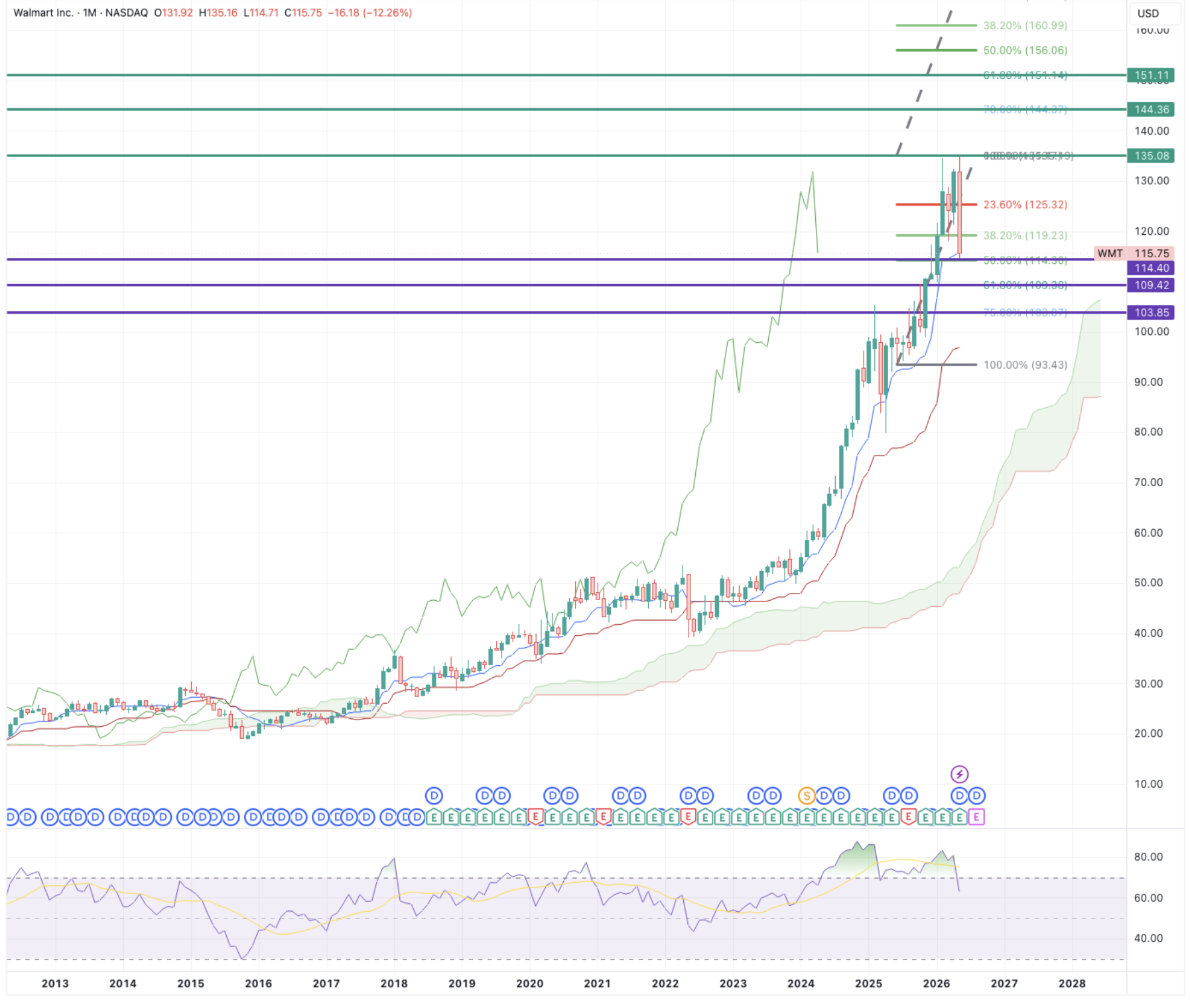 |
On the monthly chart, Walmart stays in a strong long‑term uptrend, with price well above a green Ichimoku cloud and the RSI cooling from overbought highs near 87 down to the low‑60s, which points to a healthy pullback rather than a trend break. On the weekly chart, price is still above the cloud but has formed a double top and slipped below the neckline, so a further dip toward the 103 area is possible even though the RSI is near a level that has marked bottoms before. On the daily chart, candles sit below the cloud and the RSI is oversold around 29, which lines up with your plan to treat Walmart as both a long‑term bullish story and a “buy‑the‑dip” swing opportunity, with buy orders layered lower and profit‑taking near prior highs. |
Overall risk level: Medium |
Walmart operates in a competitive, high‑volume retail environment where thin margins are normal and any cost pressure, like higher fuel or distribution expenses, can quickly weigh on profitability. Full‑year guidance came in below expectations, and some analysts still consider the stock richly valued versus peers even after the post‑earnings drop. External risks include ongoing pressure on lower‑income consumers from high gas prices, competition from Amazon and fast‑growing online marketplaces in discretionary categories, and potential regulatory headwinds around tariffs and pricing legislation. Summary Walmart remains one of the most cash‑generative and recession‑resistant businesses in the S&P 500, with a long‑term bullish technical structure still intact despite the recent pullback. The drop came from guidance that disappointed a crowded trade, not from a business that is deteriorating, and the monthly RSI reset from near‑extreme levels gives the stock room to breathe and rebuild. As promised, an investment strategy applicable to your risk tolerance: Long‑term investors may buy at the current market price or take advantage of pullbacks at key levels like $114.40, $109.42, or $103.85. Swing traders could consider taking profits at key levels like $135.08, $144.36, or $151.11. |



Comments
Log in or sign up to join the conversation.