

 When most people first came across Robinhood (HOOD), they probably knew it for one thing. Commission-free stock trading. The app exploded in popularity during the pandemic and became closely associated with meme stocks, crypto speculation, and a new generation of retail investors entering the market. But Robinhood today looks very different from the company that first disrupted the traditional brokerage industry. What started as a simple way for everyday investors to buy and sell stocks is gradually developing into a much broader financial business — one that wants to play a bigger role in how people manage their money. And Wall Street is starting to take notice. Robinhood shares jumped sharply this week following a wave of bullish analyst coverage, adding to an already impressive run for the stock. But after such a strong rise, investors are now being asked to decide whether Robinhood's evolution as a business can keep up with the expectations being built into its share price. That brings us to the big question: Can Robinhood successfully grow from a trading app into a financial super-app - and are its fundamentals strong enough to justify the excitement surrounding the stock? Fundamentals Robinhood delivered a strong Q2 2026, with revenue growing 32% year-over-year to a record $1.31 billion and net income increasing 48% to $573 million. Customer assets also grew 32% to $369 billion, with a record $22 billion in new deposits during the quarter. Robinhood's income now comes from several areas, including trading, interest income, Robinhood Gold subscriptions, exchange and clearing services, and crypto infrastructure, making parts of the business less dependent on how actively customers are trading. Robinhood Gold has grown to around 4.8 million subscribers, while the company continues expanding its wider financial ecosystem. Robinhood Securities has also been named as a co-manager for Oura's upcoming IPO, alongside major Wall Street banks, giving Robinhood another opportunity to participate in the IPO market and potentially bring new listings to its retail investors. Another positive is Robinhood's share buyback program, with $414 million of shares repurchased during Q2. However, the stock's high valuation means investors are already expecting strong growth to continue. Technical |
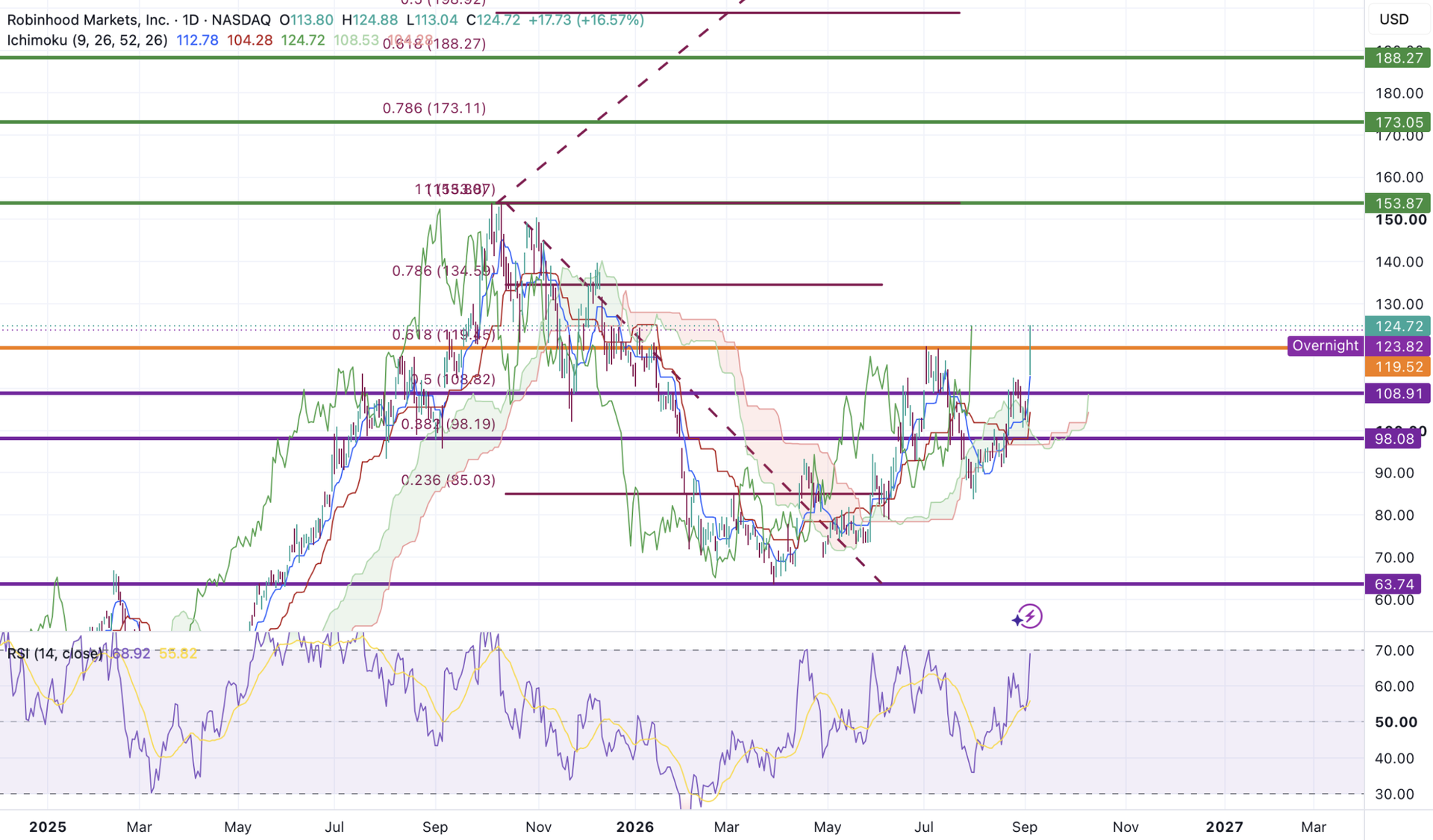 |
On the daily chart, Robinhood was in a downtrend from October 2025 to March 2026 after reaching a new resistance level of 153 and has since been making a volatile and choppy recovery. More recently, the stock jumped above the 61% Fibonacci retracement level, an area it previously tested back in July, as new Wall Street coverage and higher analyst price targets helped drive renewed momentum. The Ichimoku Cloud has also recently turned bullish, with the candles now trading above the cloud, which could act as support. Despite the recent jump, Robinhood is still trading below its previous high of $153, which remains an important level to watch. Buy Limit Ideas
Profit Taking Ideas
|
Risk Level: High |
Robinhood remains a high-risk growth investment despite its improving fundamentals. A large part of its business is still influenced by how actively customers trade stocks, options and cryptocurrencies, meaning revenue can rise and fall with market conditions and investor sentiment. Its expansion into areas such as crypto and prediction markets also brings regulatory uncertainty, while competition from established brokers, banks and fintech companies remains strong. Another major risk is valuation: after the stock's significant rise, investors are already expecting Robinhood to deliver strong future growth, leaving less room for disappointment if revenue or customer growth slows. For investors, Robinhood may have significant long-term potential, but its high valuation, exposure to market activity, and rapidly evolving businesses make it a higher-risk investment. Summary Robinhood has come a long way from the commission-free trading app that disrupted the brokerage industry. The company is profitable, growing quickly and finding more ways to generate revenue from its customers, while record deposits and growing customer assets suggest people are trusting the platform with more of their wealth. For Triple Compounding™ investors, the interesting part of Robinhood's story is what could happen if those customer relationships deepen over time. Its younger customer base could potentially earn, save, and invest more as they grow their wealth, giving Robinhood an opportunity to grow alongside them. But a great growth story doesn't automatically make a great investment at any price. HOOD has already risen significantly, and its current valuation reflects high expectations for what the company could become. Robinhood will need to continue growing, diversifying its revenue and successfully executing on its newer businesses to justify that optimism. The opportunity is certainly there. The bigger question now is how much of Robinhood's future success is already priced into the stock - and whether investors are being adequately rewarded for taking on the risk. |



Comments
Log in or sign up to join the conversation.