
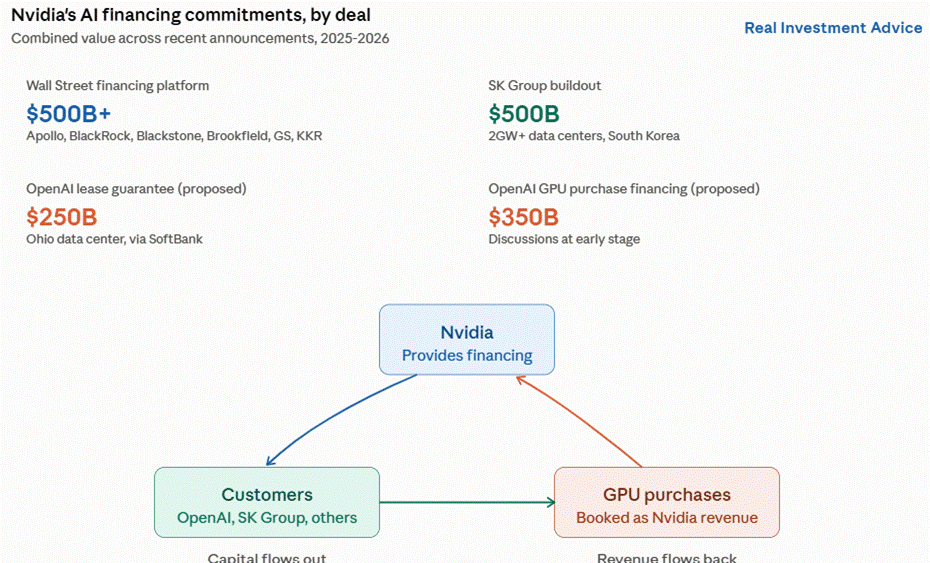
Nvidia announced an agreement with Wall Street heavies, Apollo, BlackRock, Blackstone, Brookfield, Goldman Sachs, and KKR. The six Wall Street firms will arrange more than $500 billion in third-party capital for AI infrastructure. The firms will create funding vehicles that allow investors to invest money directly in AI data centers in exchange for a share of the income those data centers generate. From Nvidia’s perspective, the agreement is very beneficial with little risk. The Wall Street-led financing arrangements provide the big hyperscalers with capital to build data centers at a time when their financial obligations and balance sheets are being more closely scrutinized. The data centers in turn run on Nvidia GPU chips.
Despite the seemingly good news, Nvidia shares fell. The reason is that the press release also mentioned that Nvidia is weighing a $250 billion guarantee on OpenAI’s data-center lease payments and $350 billion in GPU purchase financing. That follows a $500 billion AI buildout tied to SK Group. Some critics argue these deals blur the line between chipmaker and lender and further highlight circular financing concerns, where Nvidia is essentially providing its customers with funds to buy Nvidia chips.
The $500 billion structure involving the six Wall Street firms may ease those fears, since it entails outside capital, not Nvidia’s balance sheet, absorbing the risk. Bear in mind that as financing for AI data centers grows rapidly, it increases one risk for many investors, which Axios summarized well: “if one major company runs into trouble, it could have a ripple effect through the AI ecosystem.” As we wrote recently in Carnage in Hyperscaler Credit Part One and Hidden Debt Part Two, Oracle is the “one major company” to keep an eye on if this is a concern of yours.
What To Watch Today
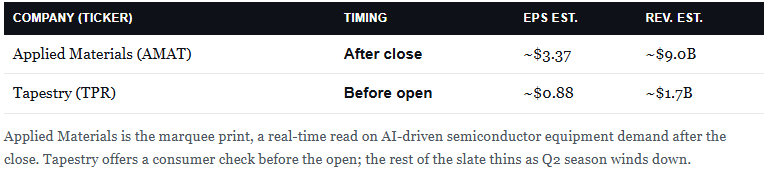
Earnings
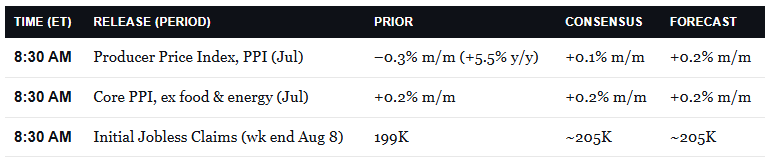
Economy
Market Trading Update
Over the past week, we’ve argued that new highs tend to beget new highs, and that the right response to a record close is discipline, not panic. Today, the better question isn’t whether to chase the tape. It’s who’s actually buying, because the return of retail buying and corporate buybacks is what keeps dragging prices back to the highs.
The S&P 500 has climbed back to within a fraction of a percent of its August 7 record close of 7,757.64, roughly 3% above its 50-day average and about 10% above its rising 200-day line. The 14-day RSI is in the mid-60s, firm but not yet overbought.
So where’s the bid coming from? Scott Rubner at Citadel Securities laid it out this week, and his checklist is the most constructive I’ve seen from him in months. Retail returned to net buying last week, reversing the late-June flush. The corporate buyback window is reopening with more than a trillion dollars of authorizations, a record for this point on the calendar, and nearly 70% of that sits outside Technology. Passive demand never left, with roughly $1.6 trillion into funds this year and July the single biggest month on record. Even breadth is healing, with more than 70% of the index back above its 200-day average, the best reading since December 2024.
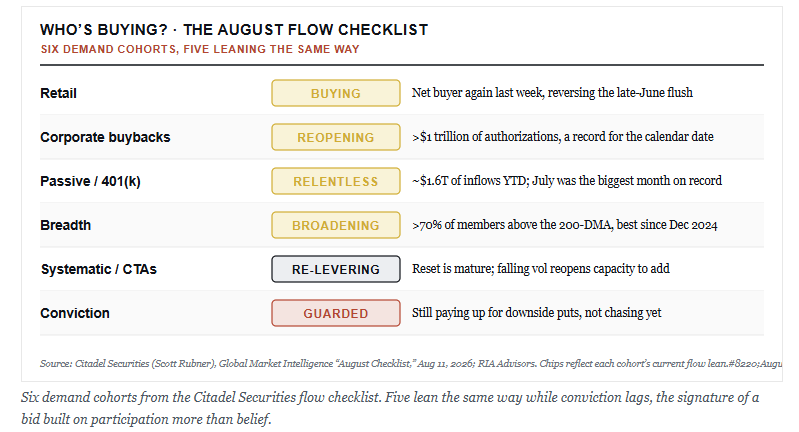
Notice in the scorecard below how many cohorts lean the same way at once. That’s the whole point to pay attention to. No single buyer sets the price, but when several sources of demand strengthen while selling pressure fades, the flow math tilts higher. Rubner’s own data shows retail is still paying up for downside puts even while it buys. In other words, while participation is back, conviction isn’t, at least not fully.
A crowded bid is a near-term tailwind, NOT a foundation, and flow analysis is never complete because, for every buyer, there’s a seller. Seasonal patterns get harder as positioning fills. Therefore, as noted on Monday, we’re using the strength rather than surrendering to it.
In our equity models, we’re staying long the trend while treating this bid as a chance to do the unglamorous work: trim the biggest winners back to target weight, lift quality, and hold a cash buffer for the eventual pullback. If you’re putting new money to work, do it on weakness toward the 50-day near 7,500, not on strength into round numbers. Let the buyers carry the tape. Just don’t mistake a strong bid for a margin of safety.
CPI Update
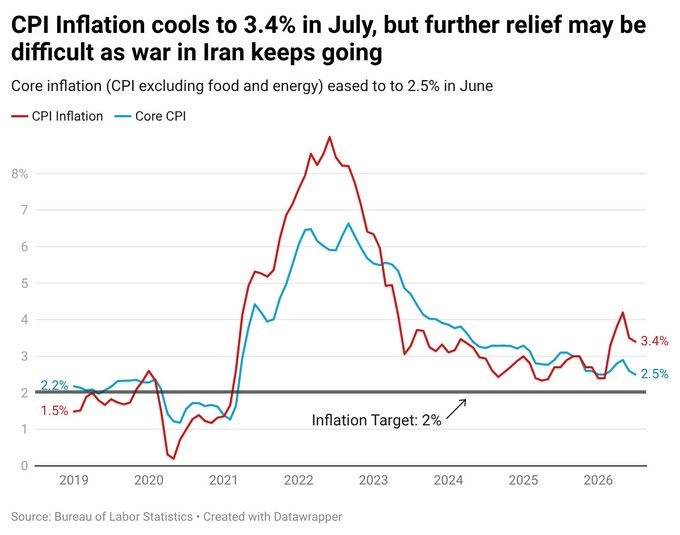
Wednesday’s July CPI report gave Warsh ammunition to restrain the Fed’s hawkish members. Headline CPI rose 0.1% month over month, in line with the Wall Street consensus. The core CPI rose 0.2%, also matching expectations. On a yearly basis, headline CPI held at 3.4%, unchanged from June’s revised reading. Core CPI, which strips out food and energy, fell to 2.5% from 2.6%, the lowest reading since March 2021.
The details reinforce the headline numbers. Energy fell 1.5% in July, with gasoline dropping 2.9%, continuing the decline that began as the Iran conflict’s oil premium unwound. Core goods inflation, the tariff-sensitive category we’ve watched closely, increased by just 0.2% following two monthly declines. Shelter, the category that has proven to be sticky at higher-than-market prices, has recently started to catch up to reality. It rose only 0.1% on the month, though it still accounted for roughly two-thirds of July’s modest monthly gain given its outsized weight in the index.
Per CME FedWatch, Wall Street is giving a 50- 50 chance of a hike for the September meeting. In our opinion, that positioning is difficult to square with an economy that just posted a negative July payroll print and a second month in a row of benign inflation. While we are not there yet, continued good news on the inflation front may soon have the market asking whether a softening labor market justifies a cut instead.
Lacy Hunt Turns Bearish on Bonds
Economist Lacy Hunt has been a bond bull longer than most money managers have been in the business. Recently, he made a surprising U-turn on his bullish stance. The following paragraph opens his Second Quarter Review and Outlook.
The structural backdrop for U.S. inflation increasingly suggests that the long-run equilibrium range is migrating from roughly1.5–3.5% toward 3.5–4.5%, with a significant risk of episodes of inflation above 5%. An important core reason is the steady erosion of the disinflationary architecture that dominated the 1990–2020 period, even as various cyclical pressures also play a role.
For nearly four decades, Lacy Hunt has been pounding the table for lower yields. As chief economist of Hoisington Investment Management, Hunt bought long-term bonds, betting that globalization and excessive debt impede economic growth, keeping a lid on inflation and interest rates. Despite the extraordinary monetary efforts to stem the 2008 financial crisis, the decade of extremely loose monetary policy following the crisis and even through the pandemic-related surge in the money supply and high inflation, Hunt held his deflationist line.
So, when Lacy Hunt and his partner Van Hoisington posted their Second Quarter Review and Outlook titled “Capital Scarcity and the End of Globalization’s Disinflationary Era,” heads turned. Backing their words with action, Hoisington Investment Management, managed by Hunt and Hoisington, sharply reduced their clients’ bond duration and put the proceeds in Treasury bills.
That reversal of such long-held opinions deserves serious attention. We provide a summary of their new views and some counterpoints to help you assess their new stance.
Tweet of the Day


Comments
Log in or sign up to join the conversation.