

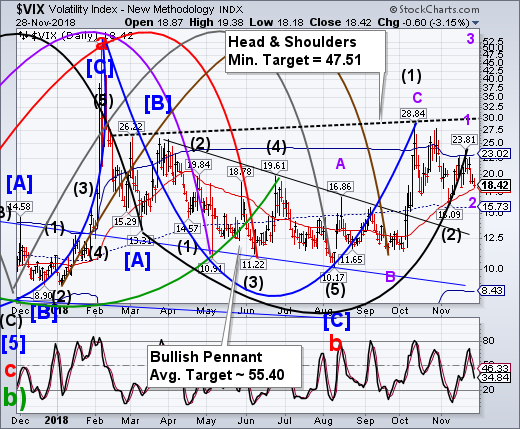
VIX declined from its Cycle Top resistance at 23.02 on November 20 to test its 50-day Moving Average at 18.08 today. The long-term buy signal remains after the week-long consolidation. A breakout above the Cycle Top may confirm the resumption of the rally.
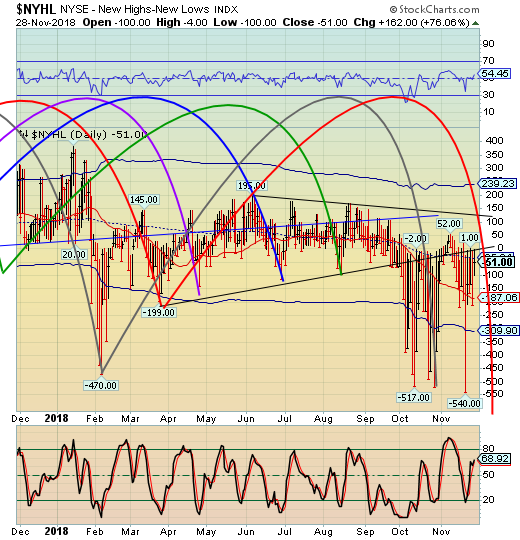
-- The NYSE Hi-Lo Index remains in the negative, leaving it on a sell signal despite the rally. A close above 0.00 may change the tenor of the signal.
(ZeroHedge) When the Powell headlines hit the tape at exactly 12pm and traders and algos focused on just one headline, namely the so-called materialization of the "Powell Put" that we are now "just below" the neutral rate, it was immediately seen as a capitulation by the Fed chair, and confirmation that the rate hike process is approaching a pause, if not the end.
Of course, as we noted earlier, the market may have been somewhat myopic in its take of what Powell actually said, because as Amhert Pierpont's Stephen Stanley explained the markets overreacted "to what he said, perhaps partly because some of the newswire headlines don’t quite accurately convey the nuance of what he said, but that is what markets do." Indeed, that's precisely what the market did, and it did so with a force not seen since the early February VIXtermination event, when the S&P's first correction for the year was followed by a furious bottom fishing rally a few days later, on February 9.
As shown in the chart below, just after the "Powell Put" headline hit, the NYSE Uptick - Downtick index soared to 1,648. This was the highest TICK print since February 8 (and August 2011 the next highest).
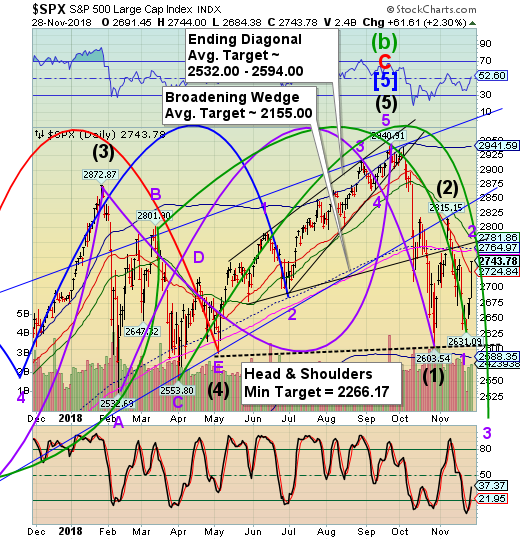
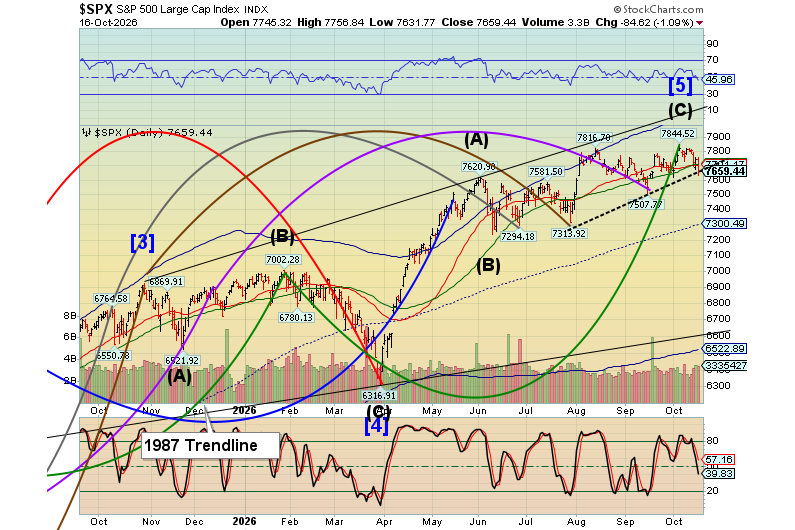
-- SPX rallied out of its Master Cycle low made last Friday, making a perfect 61.8% Fibonacci retracement of its decline. It still remains beneath its 200-day Moving Average at 2761.54. The 50-day Moving Average is just 30 points away from making a Death Cross on the 200-day. The SPX is now positive for 2018, but it may not last.
(Bloomberg) U.S. stocks rallied the most in eight months and the dollar fell after a dovish tone from the Federal Reserve chairman fueled speculation the central bank is closer than thought to pausing on rate hikes.
Stocks that had fallen the most during the six-week slump in American equities led gains after Jerome Powell saidrates are “just below” the range of a neutral policy, potentially removing one of the biggest overhangs. Aside from the Treasury market, where shorter-term yields turned lower but only by a few basis points, moves in other asset classes were just as heady:
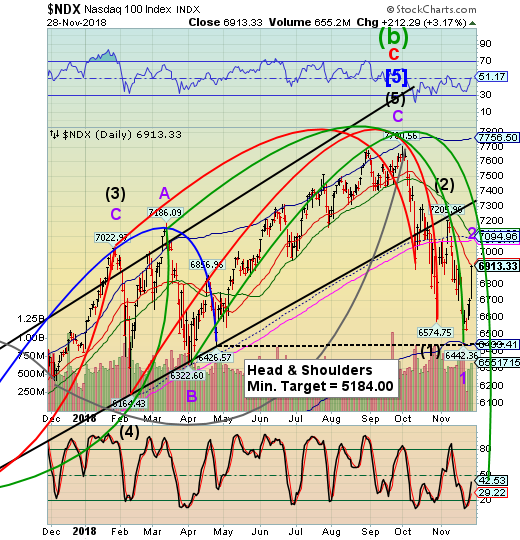
-- NDX also made its Master Cycle low last Friday, followed by a near-perfect 61.7% Fibonacci retracement. It seems to be stopping just under Intermediate-term resistance at 6926.22. The 200-day Moving Average is at 7075.17 with the 50-day Moving Average poised just above it at 7111.66. The Cycle Bottom support at 6433.41 may act as a magnet launching the next retest of the low.
(CNBC) Tech stocks continued to rally Wednesday as the Nasdaq Composite Index were up 3 percent by market close, marking its best day since Oct. 25. But the rally didn't help Facebook much. It only rose 1.3 percent.
Facebook's other FAANG peers, which include Apple, Amazon, Netflix and Google parent company Alphabet, all fared well in the rally. Amazon and Netflix each topped 6 percent. Apple rose 3.9 percent and Alphabet was up 3.8. Microsoft also saw a 3.7 percent lift.
Facebook has struggled to come back from a series of scandals that have continued to unfurl regarding the company's practices for protecting customer data and stopping the spread of misinformation on its platform. Just a day earlier, a Facebook official testified in front of representatives from nine parliaments about its practices where a Canadian lawmaker suggested Facebook be broken up. Later, a former FTC official claimed that Facebook had even misled representatives in the testimony.
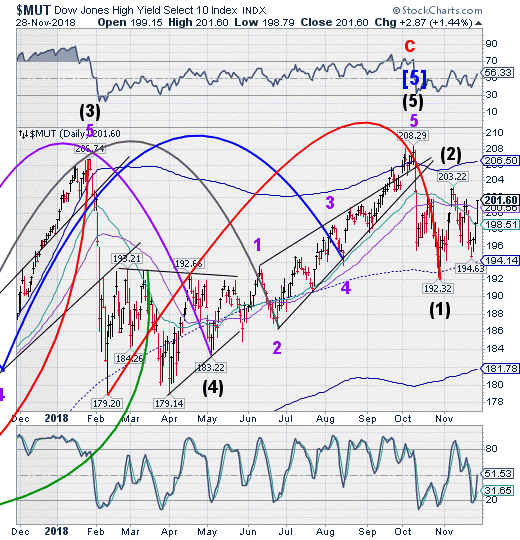
The High Yield Bond Index appears to have an 81%retracement of the decline from its November 8 high. It has risen above its 50-day Moving Average at 200.56. A decline beneath it would reinstate the sell signal.
(Forbes) Jerome Powell is somewhat of an oddity. While many U.S. Federal Reserve (Fed) chairs have been macroeconomists that sharpened their skills in academia, Powell forged a high-profile career managing specialty finance and leveraged buyout funds as a partner at The Carlyle Group.
The Fed’s dual mandate is to target inflation and maximize employment. It also has to pay attention to market vulnerabilities and track the health of financial conditions. However, Powell’s unconventional background and less reliance on models has made it difficult for investors to handicap the pace of Fed tightening, or conversely determine how quickly he would ease if growth slowed or equities dipped.
Indeed, for most of this year, Powell has been less concerned about equity weakness and more troubled by the surging stock of high-yield corporate debt. In the minutes from the Fed’s September meeting, it specifically highlighted leveraged loans as a potential risk to financial stability. This alarm has also been echoed by former Fed chair Janet Yellen and International Monetary Fund (“IMF) head, Christine Lagarde.
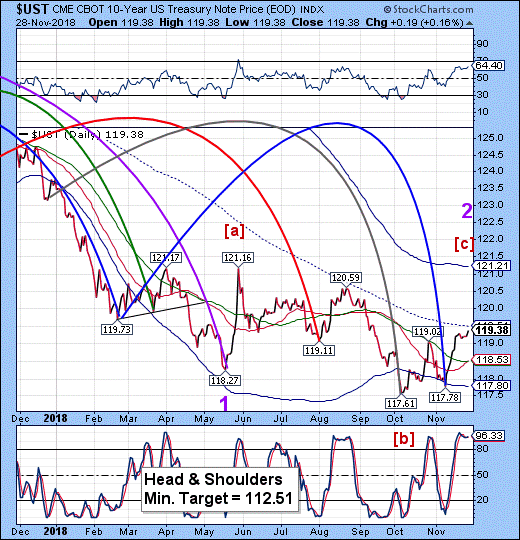
10-Year Treasuries rallied toward mid-Cycle resistance at 119.51. Should UST rise above that resistance, it may have the capability of rallying back to retest the Cycle Top at 121.21, or extend slightly higher.
(Bloomberg) The prospect of an inverted U.S. Treasury yield curve is back on bond traders’ radars. It’s just not the part they expected.
For most of this year, the yield spread between seven- and 10-year Treasuries was the smallest of all benchmark U.S. maturities, never closing above 10 basis points and dipping to as low as 2 basis points in mid-May. Some strategists predicted that the difference would eventually fall below zero and encourage other parts of the curve to invert. That never happened.
Since the U.S. stock market began its decline in early October, though, the shortest-dated Treasury notes are leading the way toward inversion. As of mid-November, the yield curve from two to five years is flatter than the one from seven to 10 years, a phenomenon that hasn’t happened since the 2013 taper tantrum. The yield difference between two- and five-year notes fell this week to 4.6 basis points, the smallest gap since September 2007. That month should ring a bell for any seasoned bond trader: It was when the Federal Reserve cut its benchmark lending rate by 50 basis points, its first of many reductions over the ensuing 15 months.
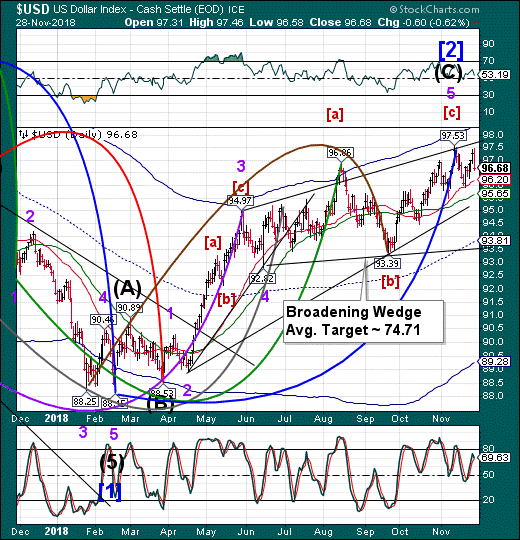
- The U.S. Dollar reversed today from a lower retracement high. However, the Cycles Model shows probable strength that may last through the weekend. USD has formed another Broadening Wedge. A decline through the lower trendline may trigger a strong decline.
(Xinhua) -- The U.S. dollar extended losses against other major currencies in late trading on Wednesday, after Federal Reserve Chair Jerome Powell said Wednesday the central bank's interest rates "remain just below" neutral, raising bets on fewer rate hikes in the future.
"Interest rates are still low by historical standards, and they remain just below the broad range of estimates of the level that would be neutral for the economy - that is, neither speeding up nor slowing down growth," Powell said in a speech at the Economic Club of New York.
Investors largely took the Powell's latest speech as a sign that the Fed would slow down its pace of policy tightening, as the remarks was widely viewed as a "dovish shift" from what Powell said about Fed's rates in early October.
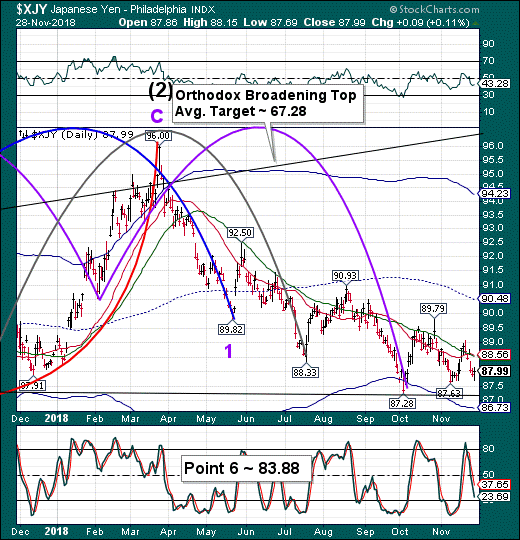
--The Yen bounced at a support provided by its prior low. However, the Cycles Model suggests weakness may prevail into early December. The Cycles Model maintains that the “point 6” target given by the Broadening Formation is still on the table.
(Bloomberg) The world’s currency prognosticators appear to agree on at least one major trend for the next couple of years: The yen is going to get stronger.
From about 113.70 per dollar now, the yen will probably appreciate to 105 by 2020, according to a Bloomberg survey in which the weakest estimate was for 113. But the more bullish analysts, including Commerzbank AG and Morgan Stanley, see it solidly below 100, reaching levels last seen in 2013. Rather than a result of haven buying precipitated by global chaos, Commerzbank, for one, expects the rally to come from tighter Bank of Japan monetary policy.
Couple that with the Federal Reserve’s rate-hike path running out of steam, and Ulrich Leuchtmann at Commerzbank sees scope for 96 yen per dollar by the end of 2020. Busting through 100 yen would be significant, because in recent years traders have speculated that the Bank of Japan would step in to weaken its currency in that area. The dollar-yen rate hasn’t closed below 100 for an extended period since 2008-2013, when investors sought shelter in Japan’s currency amid the financial crisis and its aftermath.
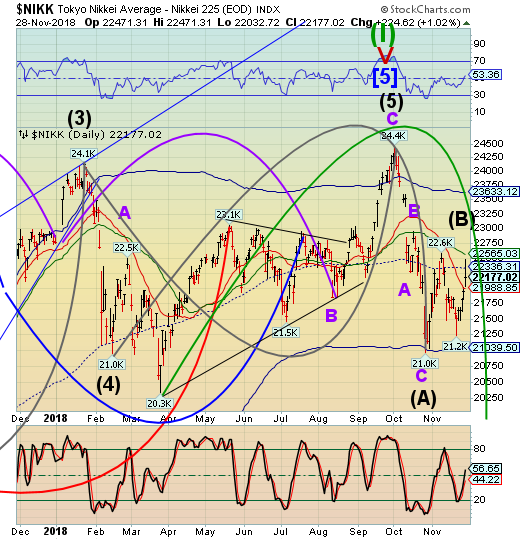
Nikkei bounced toward its 50-day Moving Average at 22565.03, but fell short. The next Master Cycle low is anticipated by mid-December. A probable reversal may have already begun.
(Reuters) - Japan’s Nikkei rose for a fourth day on Wednesday, supported by buying of large cap stocks such as Fast Retailing which offset weakness in airlines.
The Nikkei share average ended up 1.0 percent at 22,177.02 points, the highest close since Nov. 12.
Overall sentiment was underpinned by hope of a possible de-escalation of the U.S.-China trade dispute.
The Japanese market took heart from a rise in U.S. shares overnight, where all three of Wall Street indexes recouped losses after White House economic adviser Larry Kudlow said a meeting between President Donald Trump and his Chinese counterpart on Saturday was an opportunity to “turn the page” on a trade war.
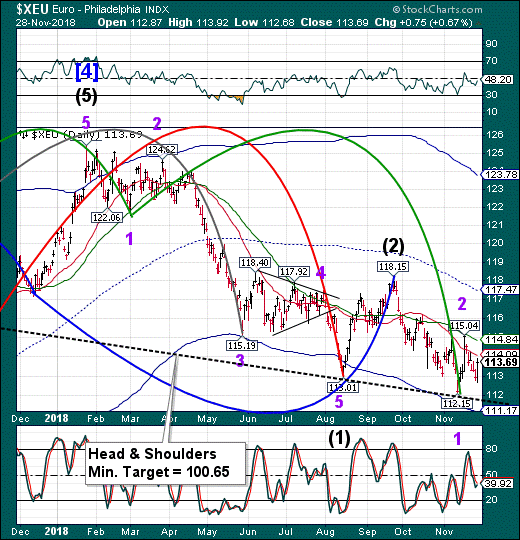
-- The Euro bounced today on news of Powell’s statement. The bounce may last another day or two. However, the ongoing weakness may precipitate the triggering of the Head & Shoulders formation.
(Reuters) - The euro zone has lost some growth momentum but this was mostly normal and not enough to derail plans by the European Central Bank to dial back stimulus further, ECB President Mario Draghi and two of his top lieutenants said on Monday.
Euro zone growth has been disappointing since the summer months, and Germany, the bloc’s biggest economy, even contracted last quarter, raising some concern that the ECB may be cutting support at the worst possible moment.
“A gradual slowdown is normal as expansions mature and growth converges towards its long-run potential,” Draghi told the European Parliament’s committee on economic affairs in Brussels.
“Some of the slowdown may also be temporary,” Draghi added. “In fact, the latest data already show some normalizing of production in the car industry which has been impeded by one-off factors.”
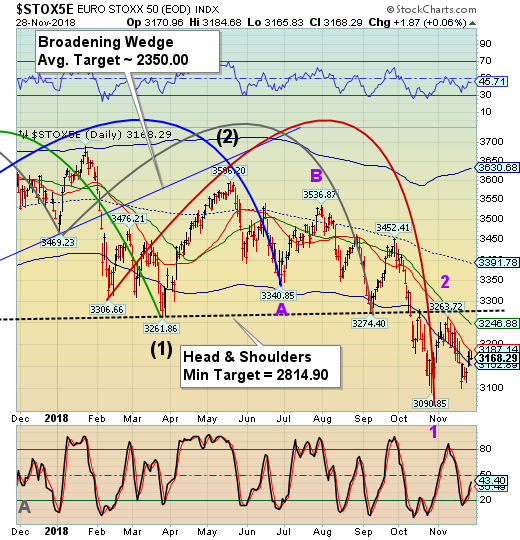
EuroStoxx 50 Index consolidated under the Intermediate-term resistance at 3187.14 after a bounce from last Thursday’s low. The retest of the Head & Shoulders neckline has already occurred and the Cycles Model calls for a decline into a new Master Cycle low by mid-December.
(CNBC) European stocks were slightly higher Wednesday, as investors attempted to decipher conflicting signals over the potential for a reprieve in the U.S.-Sino trade dispute.
The pan-European Stoxx 600 closed provisionally up 0.04 percent during deals, with sectors and major bourses pointing in opposite directions.
Europe's technology stocks sat among the gainers Wednesday, up 0.71 percent amid renewed hopes of a breakthrough in simmering trade tensions between the world's two largest economies. Stocks in the Basic Resources basket also outperformed.
Looking at individual stocks, France's EDF traded higher after President Emmanuel Macron said Wednesday that a decision regarding a possible increase of the state's stake in the company would take place next year. Shares of the Paris-listed stock rose 1.8 percent.
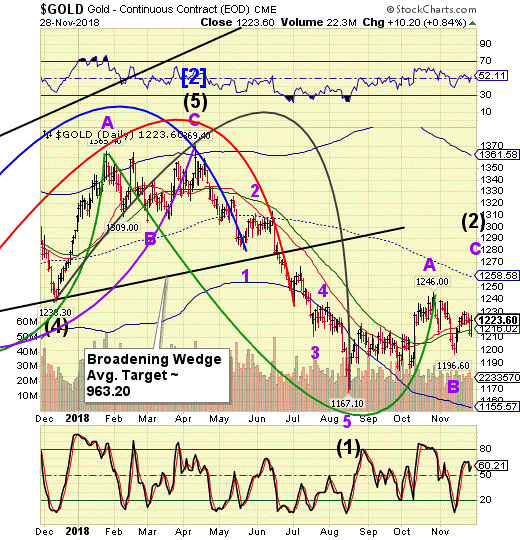
-- Gold appears to have bounced from its 50-day Moving Average today, closing just short of tis Intermediate-term resistance at 1224.37. Above that level allows gold to rally further to its mid-Cycle resistance at 1258.58. Gold may have another Cycle inversion by the end of the year.
(Bloomberg) Dovish comments from the Federal Reserve’s Jerome Powell suggesting slower-than-anticipated interest-rate hikes awakened gold from its recent slumbers and boosted most base metals.
The Fed chairman said interest rates are “just below” the so-called neutral range, softening previous comments that implied steady rate hikes were in the central bank’s foreseeable monetary policy. That helped send the Bloomberg Dollar Spot Index crashing and gold, which doesn’t pay interest, to its biggest gain in almost four weeks.
Greenback strength has dogged most metals this year as investors flocked to the American currency as a hedge against the impact of the simmering U.S.-China trade war. The presidents of both nations will have a chance to discuss the spat this weekend during a Group of 20 meeting in Argentina.
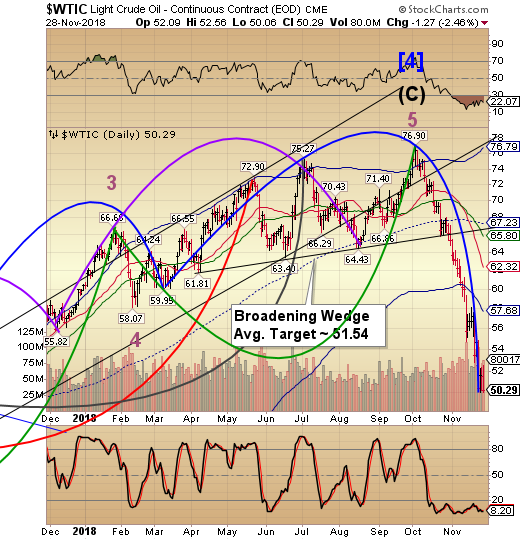
West Texas Intermediate Crude may have made an extended Master Cycle low today. This weekend I suggested “taking downside profits” in crude oil as both time and price objectives have been met. While there is no actionable buy signal, round numbers often provide very strong support and the Cycles Model suggests crude may bounce for the next three weeks.
(OilPrice) Crude oil prices slipped further down today after the Energy Information Administration reported crude oil inventories for the week to November 23 had added 3.6 million barrels. That’s compared with a build of 4.9 million barrels a week earlier.
The EIA figures came after yesterday the American Petroleum Institute reported an estimated inventory increase of 3.453 million barrels, which failed to affect prices in any significant way.
EIA also said gasoline inventories last week had declined by 800,000 barrels and distillate fuel inventories had added 2.6 million barrels. A week earlier, the authority estimated a decline of 1.3 million barrels in gasoline and a 100,000-barrel decline in distillate fuel inventories.
Meanwhile, production is hitting new highs and this will continue, according to most estimates, unless oil prices continue declining at a fast pace. The likelihood of this happening is relatively low, however. OPEC is meeting next week in Vienna to discuss a new round of production cuts and most analysts expect the cuts to be agreed with Russia also joining in again.
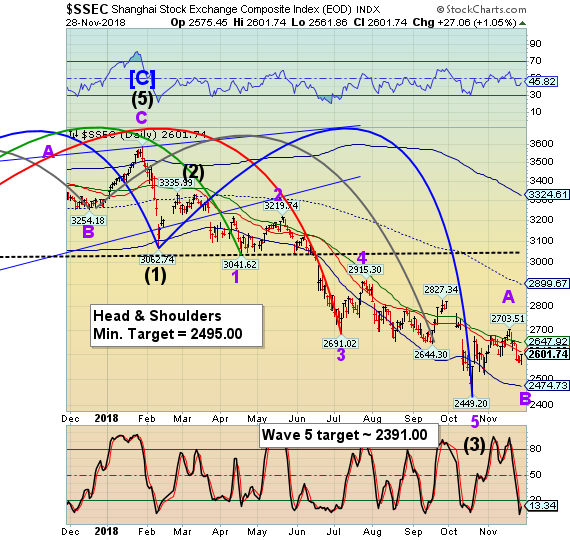
The Shanghai Index bounced today and may have begun a period of strength. A common retracement target may be near 2800.00 over the next 2 weeks. However, the bounce may extend to the mid-Cycle resistance currently at 2899.67.
(SouthChinaMorningPost) The Hang Seng Index rose 1.3 per cent and the Shanghai Composite Index added 1.1 per cent for the first gain in five days. Tencent Holdings gained the most in almost two weeks in Hong Kong, while telecom and consumer companies led the pack of gainers in the mainland.
US President Donald Trump was hopeful of a breakthrough with his Chinese counterpart Xi Jinping over dinner on Saturday evening in Buenos Aires, Larry Kudlow, Trump’s top economic adviser, told reporters on Tuesday during a briefing before the Group of 20 meeting. But the US was also ready to impose more tariffs on Chinese imports if the upcoming talks fall apart, he said.
Traders’ attention was also gripped by comments by vice-chairman of the Fed Richard Clarida before chairman Jerome Powell’s speech on Wednesday. At the end of an address to a conference in New York, Clarida said he supported “gradual policy normalisation”.
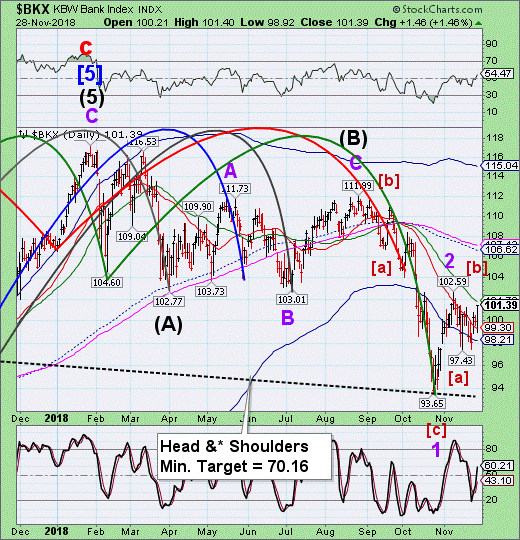
- BKX bounced toward its 50-day Moving Average at 101.78, but closed beneath it. The Cycles Model suggests the period of strength may have expired and indicates a possible three week decline may be about to begin. A decline beneath the Head & Shoulders neckline may produce a panic decline for that duration.
(TheGuardian) UK banks are strong enough to survive a disorderly Brexit that could leave the country worse off than the 2008 financial crisis, according to the Bank of England.
For a second straight year, none of the high street lenders have been told to raise billions of pounds in capital to strengthen their finances, under the Bank’s latest financial sector health check.
Seven lenders – RBS, Barclays, HSBC, Lloyds, Standard Chartered, the UK arm of Santander and Nationwide building society – were tested against a crisis scenario involving a 4.7% fall in UK GDP, a rise in unemployment to 9.5%, a 33% drop in house prices, a hike in interest rates to 4% and a 27% drop in the value of the pound.
(YahooFinance) The U.S. faces only moderate financial risks despite elevated asset prices and concern over the possible impact of rising corporate debt, U.S. Fed chairman Jerome Powell said on Wednesday as the central bank released a broad overview of the health of credit markets and the financial system.
The report flagged tensions over trade, the turbulent Brexit discussions, and trouble in China and emerging markets as shocks that could rock a U.S. financial system in which asset prices are "elevated" and business credit quality may be "deteriorating."
But in a speech following the release of the report, Powell said "overall financial stability vulnerabilities are at a moderate level...The risks of destabilizing runs are far lower than in the past. The institutions at the heart of the financial system are more resilient."
"We do not detect a broad-based buildup of abnormal or excessive leverage," of the sort that, as in the 2007 to 2009 financial crisis, led lending to evaporate and amplified what became the worst economic downturn since the Great Depression, Powell said.
(YahooFinance) Warren Buffett’s Berkshire Hathaway acquired a new $4 billion stake in JPMorgan Chase, according to its third-quarter holdings report. This means that five out of Berkshire Hathaway’s top 10 holdings are banks: Bank of America, Wells Fargo, American Express, US Bancorp and JPMorgan Chase.
The holdings report underscored Berkshire Hathaway’s banking focus. It bought more than $13 billion worth of bank shares in the third quarter, including an additional investment of nearly $6 billion with Bank of America, increasing its long-held position. Added together, Hathaway holds $75.84 billion in bank stock. It is dominated by Bank of America and Wells Fargo, with stakes of $25.84 billion and $23.25 billion, respectively. JPMorgan Chase is just one of the famous stocks Warren Buffett bought and sold this year.

Comments
Log in or sign up to join the conversation.