


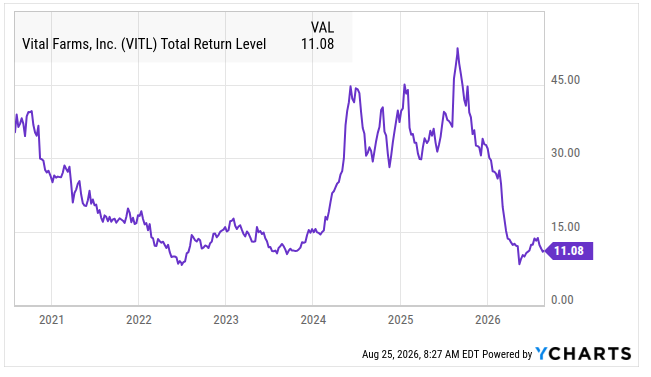
Vital Farms (VITL) has plunged in 2026, falling 65%, including a decline of 13% so far in August. It is slightly higher than when it was removed from the Russell 2000 Index in late June, and it did advance subsequent to the removal. It is down a lot, though it is above the all-time low that was set in 2022 and tested in April:
Why Vital Farms Has Declined
I have tracked VITL for a while now. I like what the company does (boosts small farmers of chickens through its networks and promotes better production methods). With that said, investors were overly excited about its expansion plans that were announced in 2025 as part of its goals to get to $1 billion in revenue and to get to $2 billion by 2030, that was announced in December. It shared a preliminary outlook for 2026 of $930 million to $950 million.
Well, analysts currently project revenue for 2026 will be much less than what the company had expected, with year-over-year projected growth at just 1.5%to $771 million. In early August, the company reaffirmed its guidance of revenue of $775-800 million. It turned out that there was an egg-pricing scandal that was settled in June, and supply has surged. It turns out that egg producers expanded their capacity substantially, and the market is under pressure. Another recent challenge has been an outbreak of salmonella.
Vital Farms has done a lot since its IPO, though it has recently tested its all-time low and is trading below the IPO price. This recent weakness is common among companies that benefited from the pandemic, as VITL did. The company's error seemed to be not selling stock when it was at a higher price to fund its expansion to reach its aggressive growth goals. The industry has struggled recently, with plunging prices for eggs.
VITL Seems Cheap
With the violent price reaction, it is possible that the stock has overreacted. Vital Farms has a much larger peer in Cal-Maine Foods (CALM). Looking at the price action since the all-time low in VITL in June 2022, CALM has more than doubled since then:
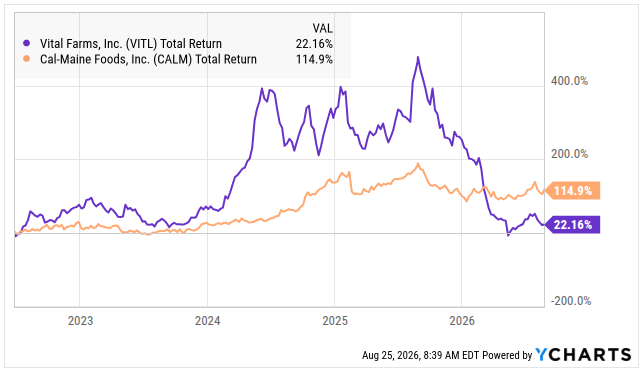
CALM has gained a bit in 2026, but its 8% rally has been much less than the rise in the Russell 2000. The current market cap of $4 billion is much higher than VITL's $475 million market cap, and CALM has a better balance sheet than VITL. Its 10-K for FY26 was filed in July, and the company reported cash of $107 million and investment securities for sale of $817 million with no debt. CALM trades at about 1.5X book value, which sounds reasonable. Taking out the sizable intangibles and goodwill, it trades at 1.6X tangible book value. The year-forward PE is about 59X, as earnings are currently depressed, and the enterprise value to projected adjusted EBITDA is about 16X.
Looking at VITL, which filed its 10-Q for the quarter ending in June in early August, cash is much lower at just $21 million, and it did have $30 million in debt. The price-to-book at 1.7X is similar to the level of CALM. There are 5 analysts providing EPS estimates, and the range for 2027 is $0.08 to $0.42 with an average of $0.26. The stock is no bargain on its current PE, and the EPS outlook for 2026 is negative. According to Koyfin, the projected adjusted EBITDA for 2027 is $52.0 million after a very tough 2026 at $2.0 million. Using the current market cap and adding the net debt, the enterprise value to projected adjusted EBITDA in 2027 is a reasonably low 9.3X.
VITL is a tiny stock that appears to be cheap, perhaps, but the balance sheet isn't stellar. In the first half of 2026, the company used $46 million to fund its operations. It seems that the company has addressed sharp changes in the egg market, and I think the stock could do better over time. In 2025, the company reported adjusted EBITDA of $114 million, a margin of 15%. The current 2028 projections are adjusted EBITDA of $72 million on revenue of $981 million, which is a margin of just 7.3%. I am using a lower number, just $60 million, and setting a target for the end of 2027 based on getting a multiple of 10X, which suggests an enterprise value of $600 million (and a market cap of $590 million). This works out to be $13.75, which is about 25% higher but still below the IPO price of $22 in 2020.
Conclusion
I don't recommend putting all of one's eggs in the proverbial basket, but VITL appears to be an attractive investment with minimal downside risk. The break below the IPO price as well as the removal from the small-cap index have weighed on it, but the company has moved to address its challenges in this market. Potentially, another company could acquire it. Further, eggs are a consumer staple that could do very well in a weakening economy, as we appear to be seeing right now.


Comments
Log in or sign up to join the conversation.