

Key Takeaways
The U.S. is 100% import reliant for several critical minerals used in AI-related infrastructure.
Core data center components—from circuitry to magnets—depend heavily on foreign-sourced materials.
The artificial intelligence boom is driving an unprecedented buildout of data centers across the United States.
Behind every AI model and cloud server sits a complex web of minerals that make modern computing possible. From semiconductors to cooling systems, these materials form the backbone of digital infrastructure.
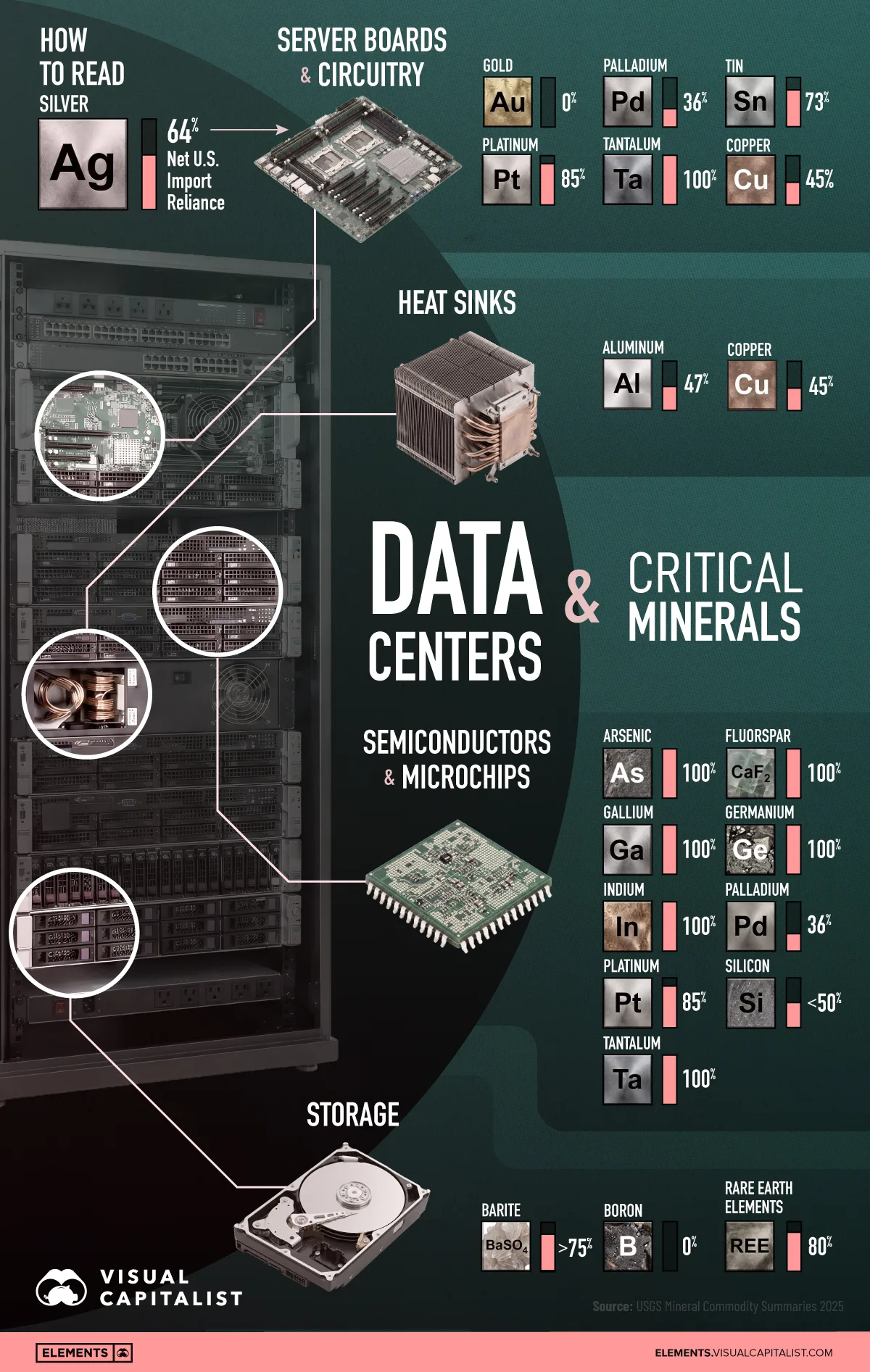
This visualization breaks down the critical minerals used in AI data centers—and how reliant the U.S. is on imports for each. The data for this visualization comes from the U.S. Geological Survey (USGS).
Semiconductors: America’s Biggest Vulnerability
Semiconductors are the “brains” of AI data centers—and they are highly import dependent. The U.S. is 100% reliant on imports for arsenic, fluorspar, gallium, germanium, indium, and tantalum used in chip production.
It also imports 85% of its platinum and 36% of its palladium needs, both critical for chip manufacturing.
While silicon, the base material for chips, has less than 50% import reliance, many of the trace elements that enable advanced computing are entirely foreign-controlled.
Data center component | Critical mineral | U.S. import reliance (%) |
|---|---|---|
Server boards and circuitry | Silver | 64% |
Gold | 0% | |
Copper | 45% | |
Tin | 73% | |
Tantalum | 100% | |
Palladium | 36% | |
Platinum | 85% | |
Heat sinks | Aluminum | 47% |
Copper | 45% | |
Semiconductors and microchips | Arsenic | 100% |
Fluorspar | 100% | |
Gallium | 100% | |
Germanium | 100% | |
Indium | 100% | |
Palladium | 36% | |
Platinum | 85% | |
Silicon | <50% | |
Tantalum | 100% | |
Data storage | Barite | >75% |
Boron | 0% | |
Rare earth elements | 80% |
Circuitry and Server Components
Beyond chips, server boards and circuitry require a range of conductive and precious metals. The U.S. imports 64% of its silver and 73% of its tin, both vital for soldering and electrical conductivity.
Copper—essential for wiring and connectivity—has a 45% import reliance. Tantalum, used in capacitors, is 100% imported.
Gold stands out as a rare exception, with 0% net import reliance, offering a small pocket of domestic security in an otherwise globalized supply chain.
Cooling Systems and Data Storage
AI servers generate massive heat loads, making cooling systems crucial. Heat sinks rely on aluminum (47% import reliance) and copper (45%).
Meanwhile, data storage components such as magnets and drives depend on rare earth elements, with 80% import reliance. Barite—used in storage-related applications—has also more than 75% reliance.
China’s Commanding Share
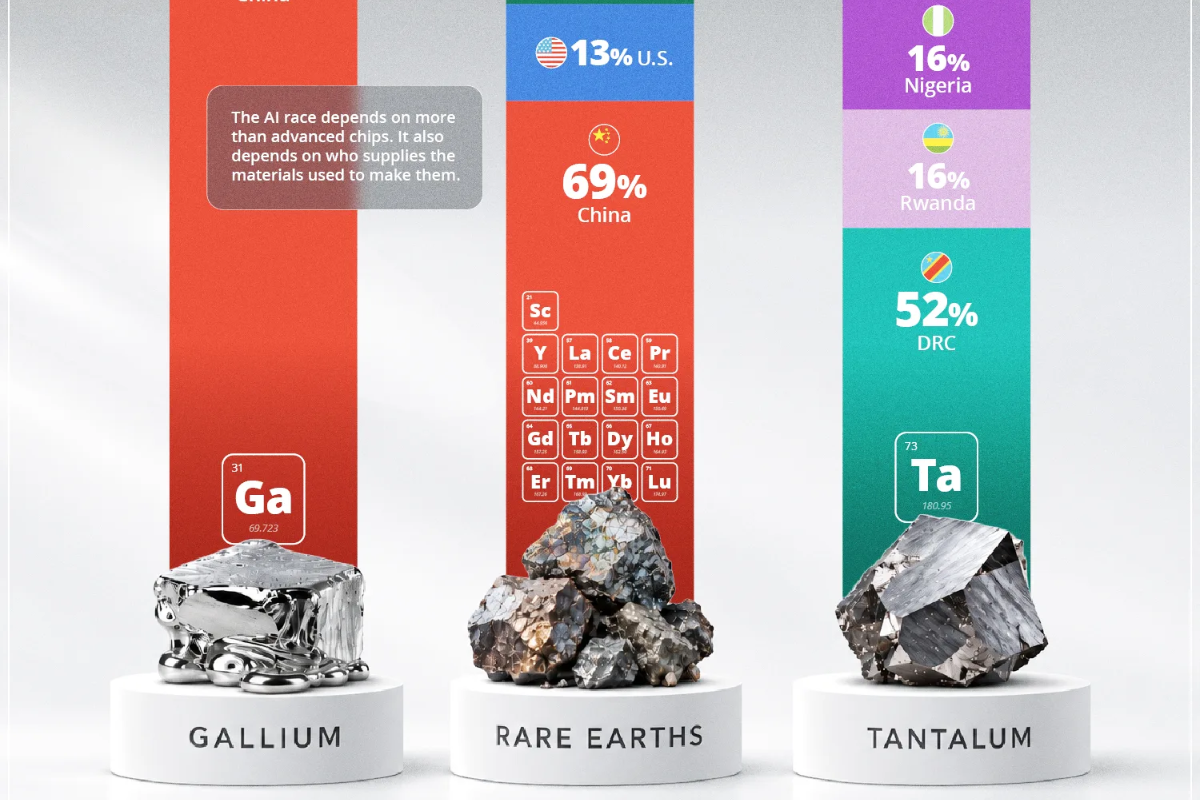
Currently, China dominates the production of most of the critical minerals used in data centers. This near-monopoly has become a major concern for other nations, with the U.S. government currently pushing for increased domestic production of these materials.
In addition to being the leading producer, China also controls much of the refining capacity for many of these minerals. For example, around 90% of rare earths are refined in China.
In the race to dominate AI, access to critical minerals may prove just as important as technological leadership.
Comments
Log in or sign up to join the conversation.