

Key Takeaways
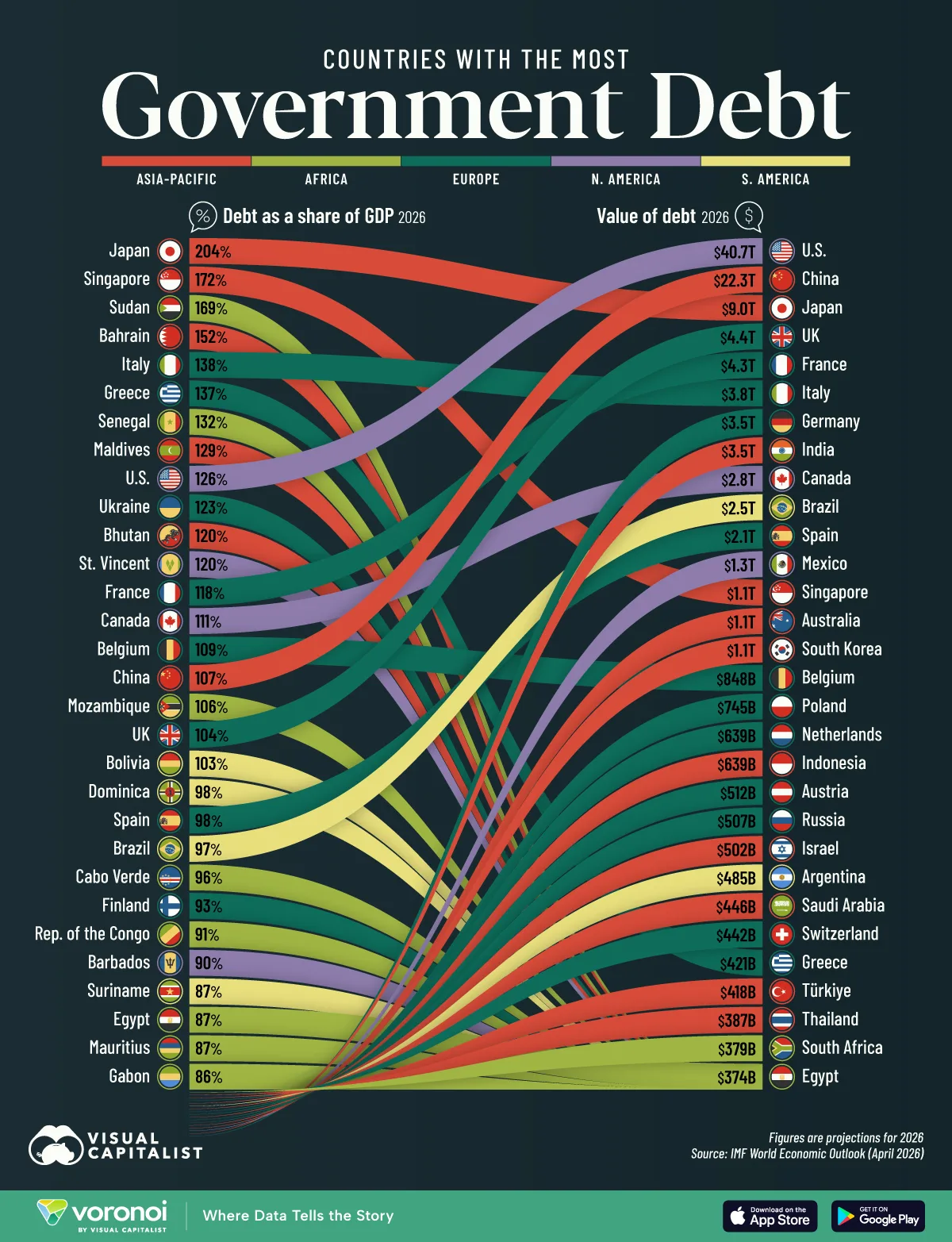
The U.S. is projected to hold $40.7 trillion in government debt in 2026, the highest total worldwide.
Japan has the world’s highest government debt relative to the size of its economy, at 204% of GDP.
Several European economies rank among the world’s most indebted by GDP despite carrying much smaller total debt than the U.S. or China.
The countries with the largest government debt totals are not necessarily those carrying the heaviest debt burdens. The picture changes considerably depending on whether debt is measured in dollar terms or relative to the size of a country’s economy.
This graphic uses 2026 projections from the International Monetary Fund (IMF) to compare the world’s 30 most indebted governments using both measures.
The U.S. Has the World’s Largest Government Debt
At $40.7 trillion, the U.S. is projected to hold by far the world’s largest stock of government debt in 2026. That figure exceeds the combined debt of China, Japan, the United Kingdom, and France, highlighting the extraordinary scale of U.S. borrowing.
The table below ranks the 30 countries with the highest government debt by total value in 2026.
The table below ranks the 30 countries with the highest government debt by total value in 2026.
Rank | Country | Value of debt (billions $) |
|---|---|---|
1 | 🇺🇸 United States | 40,739 |
2 | 🇨🇳 China | 22,290 |
3 | 🇯🇵 Japan | 8,951 |
4 | 🇬🇧 United Kingdom | 4,418 |
5 | 🇫🇷 France | 4,258 |
6 | 🇮🇹 Italy | 3,790 |
7 | 🇩🇪 Germany | 3,523 |
8 | 🇮🇳 India | 3,464 |
9 | 🇨🇦 Canada | 2,776 |
10 | 🇧🇷 Brazil | 2,544 |
11 | 🇪🇸 Spain | 2,054 |
12 | 🇲🇽 Mexico | 1,330 |
13 | 🇸🇬 Singapore | 1,134 |
14 | 🇦🇺 Australia | 1,075 |
15 | 🇰🇷 South Korea | 1,050 |
16 | 🇧🇪 Belgium | 848 |
17 | 🇵🇱 Poland | 745 |
18 | 🇳🇱 Netherlands | 639 |
19 | 🇮🇩 Indonesia | 639 |
20 | 🇦🇹 Austria | 512 |
21 | 🇷🇺 Russia | 507 |
22 | 🇮🇱 Israel | 502 |
23 | 🇦🇷 Argentina | 485 |
24 | 🇸🇦 Saudi Arabia | 446 |
25 | 🇨🇭 Switzerland | 442 |
26 | 🇬🇷 Greece | 421 |
27 | 🇹🇷 Türkiye | 418 |
28 | 🇹🇭 Thailand | 387 |
29 | 🇿🇦 South Africa | 379 |
30 | 🇪🇬 Egypt | 374 |
Measured against the size of its economy, however, the picture changes considerably. At roughly 126% of GDP, the U.S. national debt ranks behind countries including Japan, Singapore, Italy, and Greece.
The U.S. also benefits from issuing the world’s primary reserve currency, which helps sustain global demand for dollar-denominated assets. U.S. Treasury securities are widely regarded as among the world’s safest investments.
Countries With the Highest Debt-to-GDP Ratios
Japan remains a clear outlier, with government debt projected to exceed 204% of GDP in 2026. While a ratio this high would raise concerns in many countries, Japan’s large domestic investor base and broader financial system help shape how markets assess its debt sustainability.
Rank | Country | 2026 Government debt as a share of GDP (%) |
|---|---|---|
1 | 🇯🇵 Japan | 204.4% |
2 | 🇸🇬 Singapore | 171.9% |
3 | 🇸🇩 Sudan | 169.1% |
4 | 🇧🇭 Bahrain | 152.4% |
5 | 🇮🇹 Italy | 138.4% |
6 | 🇬🇷 Greece | 136.9% |
7 | 🇸🇳 Senegal | 132.3% |
8 | 🇲🇻 Maldives | 129.4% |
9 | 🇺🇸 United States | 125.8% |
10 | 🇺🇦 Ukraine | 122.6% |
11 | 🇧🇹 Bhutan | 120.3% |
12 | 🇻🇨 Saint Vincent and the Grenadines | 120.1% |
13 | 🇫🇷 France | 118.4% |
14 | 🇨🇦 Canada | 110.7% |
15 | 🇧🇪 Belgium | 109.2% |
16 | 🇨🇳 China | 106.9% |
17 | 🇲🇿 Mozambique | 106.1% |
18 | 🇬🇧 United Kingdom | 103.6% |
19 | 🇧🇴 Bolivia | 102.7% |
20 | 🇩🇲 Dominica | 98.3% |
21 | 🇪🇸 Spain | 98.2% |
22 | 🇧🇷 Brazil | 96.5% |
23 | 🇨🇻 Cabo Verde | 95.9% |
24 | 🇫🇮 Finland | 93.1% |
25 | 🇨🇬 Republic of the Congo | 91.3% |
26 | 🇧🇧 Barbados | 89.5% |
27 | 🇸🇷 Suriname | 87.1% |
28 | 🇪🇬 Egypt | 87.0% |
29 | 🇲🇺 Mauritius | 86.5% |
30 | 🇬🇦 Gabon | 86.1% |
Japan is followed by Singapore, Sudan at 169%, and Bahrain at 152%. However, debt-to-GDP ratios alone do not indicate how much trust global financial markets place in a government.
Investors also consider factors such as a government’s fiscal record, credit rating, political stability, and access to financing. Countries such as Bolivia, at 103% of GDP, or Mozambique, at 106%, may face greater borrowing challenges than more established economies such as Singapore, despite Singapore’s higher debt ratio.
How Government Debt Compares Across Europe
Several major European economies are carrying sizable fiscal deficits and elevated government debt.
Greece and Italy both have debt exceeding 135% of their respective GDPs. However, Italy’s $3.8 trillion in government debt remains lower than the totals held by France and the UK, whose debt-to-GDP ratios stand at 118% and 104%, respectively.
Spain’s government debt is projected at $2.1 trillion in 2026, equal to roughly 98% of GDP. This places its relative debt burden below those of several other major European economies.
Germany, meanwhile, has used a constitutional “debt brake” to limit structural deficits. Europe’s largest economy is projected to hold $3.5 trillion in government debt in 2026, less than France, Italy, and the UK.

Comments
Log in or sign up to join the conversation.